
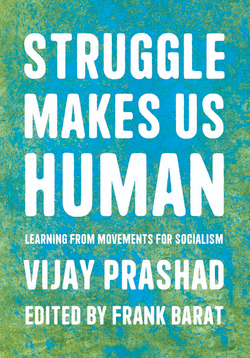
Mike Phipps reviews Struggle Makes Us Human by Vijay Prashad, edited by Frank Barat, published by Haymarket
This latest book from ground-breaking Indian Marxist Vijay Prashad grew out of three days of conversations at the start of the pandemic with French filmmaker Frank Barat, who was the coordinator of the Russell Tribunal on Palestine from 2008 until 2014. There’s a lot to think about here: Prashad discusses the growth of platform capitalism, which has added hugely to the wealth of already super-rich companies like Amazon, as consumers during the pandemic retreated from social interaction and fell prey to a system designed to atomise them. He looks further at the impact on poorer countries of cultural neo-colonialism, which encourages people to empathise with the standpoint of their oppressor – also increasingly transmitted in a passive, individualised form.
The commodification of human relations is a recurrent theme. All of us who use mobile phones, computers, etc., are intimately connected to the mining of minerals in Africa, often by children. Discussing the Apple iphone, Prashad notes: “The wretched conditions of illiteracy are related to the fact that Apple both sells the phone at a reduced price and is still able to make a fabulous profit.” It is estimated that if the product were made entirely in the US, each would cost around $30,000.
In an interesting section on the impact of history on the present-day struggle, Prashad observes that, “History is not just the things that happened. History is how you remember the things that happened.” He reflects on the role of statues and public memorials in shaping consciousness, for example, that of Edward Colston in Bristol, erected 174 years after he died – but also the statue erected to North Vietnamese leader Ho Chi Minh in Calcutta in the middle of the Vietnam War. The left-leaning West Bengal government also changed the name of the street – which housed the US Consulate – from Harrington Street to Ho Chi Minh Street, so the name was included in their address, all while the war was still raging.
There are some interesting reflections on the collapse of the Soviet Union, particularly its impact on the development of intellectual Marxism, which in the West was already increasingly separated from real world praxis even before this happened. Prashad reminds us that, for Marx and Engels, in The German Ideology, communism is not “an ideal to which reality will have to adjust itself,” but the “real movement which abolishes the present state of things.”
This helps explain why he is willing to seek the good in a number of failed socialist experiments. Marx, he points out, called producer cooperatives “possible communism.” Today there are producer cooperatives in the Indian state of Kerala with millions of members. The Landless Workers’ Movement (MST) in Brazil, through land occupations and settlements, has also begun to build socialism through collective educational projects and cooperative farming.
But Prashad’s willingness to look for the positive leads to some muddled thinking. “Many people are absorbed by the idea that the socialist experiments are authoritarian failures,” he says. “This is a result of the information war against these countries.” Er, no. The Stalinist path taken in the Soviet Union – and elsewhere – had consequences so devastating for its population that ‘authoritarian failure’ looks almost like a euphemism. But more insidiously, it also smoothed the way for the introduction of the most predatory aggressive free market capitalism, which characterises the post-Soviet Putin regime today.
A failure to learn from these experiences dooms many fighting for liberation to repeat them, creating new forms of real oppression. This is definitely not just capitalist propaganda. But Prashad ends on a hopeful note, looking for pathways to a better, socialist world. Overall, this is a good introduction to his ideas.
Mike Phipps’ new book Don’t Stop Thinking About Tomorrow: The Labour Party after Jeremy Corbyn (OR Books, 2022) can be ordered here.
 Labour Hub