
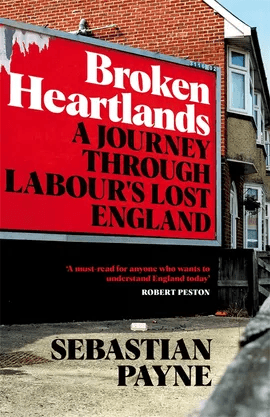
A new, updated version of a much-praised book by an award-winning journalist provides an opportunity to re-examine its central thesis. Mike Phipps reviews Broken Heartlands: A Journey Through Labour’s Lost England, by Sebastian Payne, published by Pan Macmillan
The Tory strategy in the 2019 general election was ‘laser-focused’ from the outset, argues Sebastian Payne in his book about the 2019 general election: go hard on leaving the EU – “whatever it takes”, in the words of former Boris Johnson advisor Dominic Cummings. “Whatever it takes” included getting supportive networks like Sky to call it the ‘Brexit election’ and claiming the government had an ‘oven-ready’ Brexit deal, when in fact key planks like the Norther Ireland protocol would prove unworkable, leading Johnson to renege on them. It was also a promise to make politics ‘go away’ after a year of nightly news coverage of failed Brexit votes in Parliament.
Brexit and Corbyn became the standard two reasons attributed to Labour’s 2019 defeat. But a closer look at the statistics shows that the decline of Labour support in so-called red wall seats was a gradual process that began years earlier. New Labour in office had taken much of its traditional base for granted and done little to rebuild the post-industrial areas laid waste by Thatcherism.
This is confirmed by Payne’s first-hand observations. What motivated the new Conservative MP for Blyth Valley to go into politics was less Brexit – he originally supported Remain in 2016 – and more seeing the decline of his town as shipyard closures were compounded by local government neglect. Since being elected, his efforts to get regeneration funding for his constituency have chimed with the Johnson government’s pork-barrelling strategy of holding on to red wall seats, contemptuously summarised by Dominic Cummings as “build shit in the north”.
It’s a cynical approach which may create some superficial prosperity, but is a poor substitute for what’s gone: the guaranteed work and powerful sense of social solidarity underpinned by deep-rooted effective trade unionism, particularly in the former coalfields.
Payne finds plenty of negative responses to Jeremy Corbyn on his travels through the red wall seats, but also a lot of positive vibes about Boris Johnson who seemed to many to be an optimistic, ideologically light break with austerity, with a preference for big spending projects and doing things that would enhance his public popularity. Whether these voters will feel equally upbeat about the preening austerity-merchants and shrill culture warriors who want to succeed him seems more doubtful.
The book’s original version was a big hit when it came out last year, but bits of it already feel superseded by events. Wakefield’s “enthusiastic”, “passionate”, “ebullient” Tory MP Imran Ahmad Khan, “holding one of the more comfortable red wall seats”, has since been forced out by a major scandal, a criminal conviction for child sex assault this year. Labour regained the seat with an 8.6% swing and a majority of several thousand votes.
Other parts feel similarly dated. Wansbeck MP Ian Lavery’s prediction that Johnson would soon no longer be Tory leader is dismissed – “a prediction that has not come true,” scoffs the author. Except that of course, it has.
Payne unearths something darker in some of the constituencies he visits: a hostility to migrants among some voters that makes them prey to a variety of right wing nationalist tropes. Right wing ex-Labour MPs he interviews not only seem unable to challenge these ideas: some actually echo them, blaming ‘London-based’ politicians for not understanding these ‘legitimate’ concerns.
Mike Makin-Waite who witnessed the rise of the far right in Burnley and wrote a book about the phenomenon, challenged this approach. Writing recently, he stressed the dangers of
“indulging or mirroring these voters’ current views and understandings. Union Jackery of the kind that was tried – and failed – in Hartlepool, and Blue Labour’s ‘family, faith and flag’ mantras, are sometimes promoted on the grounds that we need to ‘connect’ with people ‘where they are’. This mixes up and conflates two distinct things: the need to engage with people, and the work of promoting an accurate understanding of current issues and challenges which can be the basis for progressive politics.”
Payne also visits Coventry North West, the most urban and ethnically diverse stop on his tour. The seat narrowly remained Labour in 2019, but the author detects a breaking up of the once-solid Labour ethnic minority vote: “the same collapse of collective institutions is taking place through ethnic minority communities as has been seen among white working class votes elsewhere in England.”
It’s fair to say that this process will not be reversed if Labour continues to take this section of the electorate for granted, in the way New Labour assumed traditional working class voters had nowhere else to go.
Meanwhile, Johnson’s promises to “get Brexit done” which helped the Conservatives do so well in 2019 have seriously unravelled. There is shock and real fury in Grimsby, which went Tory at the last election for the first time since the War, at the government’s fishing deal, so favourable to the EU. “Useless” and “liar” were two of the more printable epithets flung at Johnson in this town.
Overall, I found Payne’s book quite one-sided. At a national level, he interviews many leading politicians, including Tony Blair, Peter Mandelson, Neil Kinnock, David Blunkett and Alan Milburn, with only John McDonnell from the other wing of the Labour Party. Yet there is virtually nothing here about how these New Labour grandees systematically worked to undermine the Corbyn leadership, or any recognition of the against-all-odds Labour vote gain in 2017, dismissed simply as the consequence of a poor campaign by Theresa May. Ed Miliband, to his credit, however, does recognise that the high vote for Labour in 2017 reflected a desire for “big economic change.”
“Barring a catastrophe, he is the favourite to win again in the next election,” Payne writes of Boris Johnson at the end of the first edition of his book. In his new 2022 Epilogue, things look rather different – a scandal-mired Johnson clinging to office with his electoral popularity in freefall.
But by now Payne seems to have lost interest in the red wall, barely mentioning Labour’s by-election hold in Batley and Spen. He turns instead to the ability of the Liberal Democrats to dent the Tories in their traditional heartlands. In doing so, he overlooks Labour’s own gains in the so-called blue wall. But more importantly, he sidesteps the big question his book set out to answer: was the 2019 Tory breakthrough in Labour’s red wall a lasting shift or just a temporary blip?
None of the interviews with top politicians here provide an answer. This is true especially of Labour shadow ministers, content to echo Lord Mandelson in blaming the Party’s chequered performance on “long Corbyn”, an excuse that the author seems to accept, at the expense of factual accuracy. “After the 2019 election,” he writes of the Labour Party, “Jeremy Corbyn’s supporters controlled every part of its infrastructure.” To which Corbyn supporters, reflecting on the legions of hostile Party officials, might respond: if only!
As for the Tories, their rapid fall in popularity seems to be most pronounced in those seats that voted for them for the first time, an assessment confirmed recently by their loss of the Wakefield by-election. This summer’s resignation of Johnson as leader looks set to intensify that loss of support in the red wall: none of the wannabe contenders seem to have much resonance in these seats.
Payne ends his book mulling over whether Tory MPs will really dare to dump their charismatic leader. That question is now settled. What remains unanswered is whether Keir Starmer’s Labour has the understanding, policies and narrative to win back its lost heartlands.
Mike Phipps’ new book Don’t Stop Thinking About Tomorrow: The Labour Party after Jeremy Corbyn (OR Books, 2022) can be ordered here.
 Labour Hub