
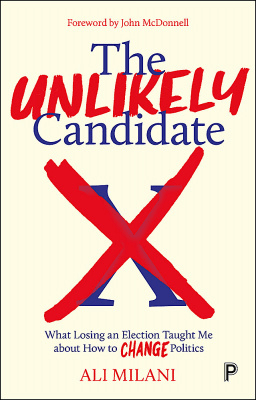
Mike Phipps reviews The Unlikely Candidate: What Losing an Election Taught Me About How to Change Politics, by Ali Milani, published by Policy Press
Ali Milani’s family came to the UK as asylum-seekers from Iran. They arrived in London when he was just five years old, not speaking a word of English, and with almost no money to their name. He grew up on a council estate in northwest London and has a vivid memory of his mother fighting back tears as she was forced to choose between paying the gas or electricity meter.
His generation was the first to feel the full effect of the Tory-Lib Dem Coalition trebling of tuition fees, putting higher education beyond the reach of many students from his background. As the recognition dawned that the huge protests against the policy were not going to change the government’s stance, Ali decided to work towards changing the way politics worked.
This is the story of Ali’s unsuccessful bid to unseat Boris Johnson as the MP for Uxbridge at the 2019 general election. Ali takes us through the battle to get nominated and selected, his painstaking effort to assemble an effective election team, his attempts at running a different kind of campaign beyond simply identifying potential voters – and his internal struggle to overcome his imperfections as a candidate.
Gradually, his confidence grows and the media becomes interested in the contrast between his personal story and the privileged life of Johnson. As the campaign to “Unseat Boris Johnson” gathers real momentum and national figures join the campaign, he receives death threats. “As I understand it to this day, I was the only candidate not from the Shadow Cabinet to have police at my rallies and plain-clothed officers at my campaign events as a result of the racist threats we had received.”
Ali’s high-profile campaign had other downsides. His public persona cost him employment opportunities: by the summer of 2019, his personal finances were so low that he was within six weeks of losing his flat and seriously considered withdrawing from the race.
But as election day neared, hundreds turned out for campaign rallies. As elsewhere in London, particularly where there were highly able socialists running on a Labour ticket, scores of people turned up for ordinary canvassing sessions. I remember in Kensington and Two Cities, campaign organisers being simply overwhelmed by the sheer volume of volunteers. Further out from the centre – as in Harrow East, where I also campaigned – numbers were far lower. Questions would be asked, once the 2019 election was over, whether volunteers might not have been deployed more effectively. But it was not clear at the time that the army of Corbyn activists who took part in the campaign could be conveniently channelled from one priority constituency to another.
“I had begun to get into the habit of asking people to shout out how far they had come from at the beginning of my stump speech,” writes Ali. “It began with visitors from neighbouring boroughs – Harrow, Ealing, Southall and so on. As time went on, it got further and further – Brighton, Nottingham, Edinburgh, Bristol. And then it began to get outrageous – campaigners flying in from Amsterdam, Brussels and even New York, to knock on doors for us.” People should remember this level of enthusiasm, which today’s Labour leadership, content to decry the Corbyn years, could not begin to excite.
With the growing popularity of Ali’s campaign, more and more MPs wanted a piece of the action, on their own terms. “On one occasion, I had to personally call Labour Party HQ and ask a shadow minister not to attend, as he had insisted we cancel our entire day’ s events and reorganise an event to fit around his brief and his calendar.”
There is much more here, besides the campaign. Ali delves into the under-representation of ethnic minorities within the Labour Party, media bias, institutional Islamophobia, the power of the Establishment, the grip of big money on the political process, the coronavirus pandemic and much more.
In the end, a bitterly cold and wet election day ended in a terrible defeat for Labour. Ali can take some solace from the fact that his Uxbridge campaign bucked the national swing against his Party – which was astonishing, given it was the prime minister’s own constituency. Readers – and those who want to be the Labour candidates of tomorrow – can learn a great deal from this memoir.
Mike Phipps’ new book Don’t Stop Thinking About Tomorrow: The Labour Party after Jeremy Corbyn (OR Books, 2022) can be ordered here.
 Labour Hub