
By Peter Rowlands
I have just finished reading this book and was not surprised that I broadly agreed with what it had to say, as I’m familiar with Phipps’s writing on Labour Hub – but well done for having written what is, I believe, the first comprehensive account of the 2019 election and the period since then, up to the 2021 conference, from the point of view of the Labour left.
In his Afterword, Phipps expresses the hope that after its 2021 Conference, the Party might be getting some of its energy and focus back. To some extent, I think that is true, partly reflecting the demise of Johnson and the cost of living crisis. But in the main, the left-right conflict has continued, largely fuelled by a nasty right who seem determined to expunge the left from the Party.
Yet this is not possible, except at the cost of destroying the Party. The left, as Phipps points out, is strong, more so than it has been since the early 1980s, and is likely to fight on the three key issues – policy, democracy and Corbyn. I can’t remember who said that Starmer could use the Forde report to effect a grand reconciliation in the Party, but there is little sign of that happening.
But even if it doesn’t, it is still quite possible for Starmer’s Labour to win an election, given that the dreadful Truss is likely to make things even worse than they are now. If that is the case, then the left must continue to argue for left policies. But if the leadership becomes vacant again, I favour a common front between the left and the soft left, with Burnham currently the most likely candidate.
Some may oppose that on the grounds that Burnham is unlikely to deliver a socialist manifesto, but then 2019 was not socialist either. It was a decent, left social democratic manifesto, and we should aim for something similar, but taking the changed circumstances into account.
In my view, a socialist party and manifesto can only come about when we achieve PR, and a coalition is possible with the main social democratic party, as in Spain and Portugal, as Phipps has described, although unfortunately not in Germany.
The main value of the book for me is that it charts a coherent way forward for the left, without being dogmatic or over-optimistic. The extracts from articles by Christine Berry, Andrew Fisher, Jeremy Gilbert, Owen Jones and others, many of which I had read before, set forth in one volume, and with Phipps’s linking narrative, constitute a handbook for progress for the Labour left, and I strongly recommend any serious activist to read it.
On the 2019 result: I find Phipps a little soft on this, partly because of the persistent distortion that makes it the ‘worst result since 1935’. In Labour Party terms, it wasn’t too bad. Of the ten elections fought since 1979, based on the overall percentage of the vote, four were worse: 1983, 1987, 2010, 2015, and two were not much better: 1992 and 2005. Only three were much better: 1997, 2001 and 2017, the latter fought under Corbyn. Given the mess of the Brexit policy, and the unprecedented assault on Corbyn by the media, in my view it’s amazing that Labour did as well as it did.
Peter Rowlands is a member of Swansea West CLP and Welsh Labour Grassroots Momentum.
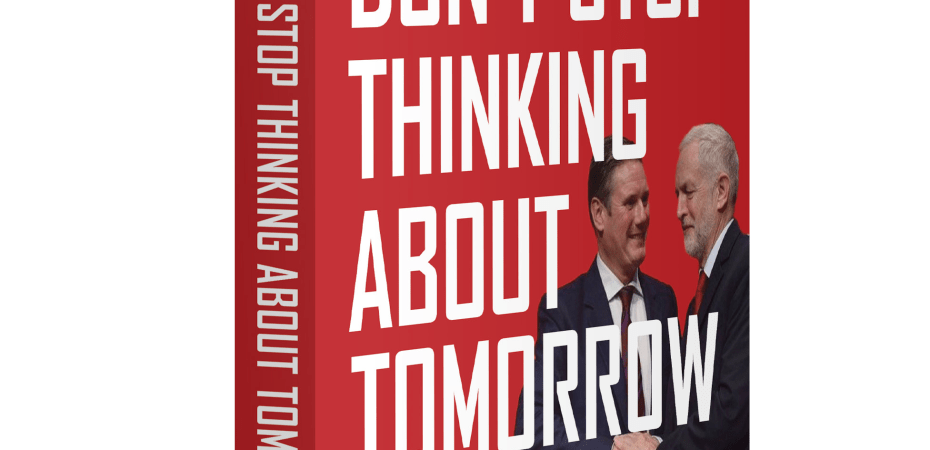
Mike Phipps’ new book Don’t Stop Thinking About Tomorrow: The Labour Party after Jeremy Corbyn (OR Books, 2022) can be ordered here.
 Labour Hub
[…] “patriotism strategy” is at the centre of Mike Phipps Don’t Stop Thinking About Tomorrow: The Labour Party after Jeremy Corbyn 2022. The issue of patriotism, flag waving in the style of Blue Labour, has however been […]