
By David Osland
The death of Queen Elizabeth II is a sad event for her friends and family. Unfortunately, I never got any closer to Her Majesty than a fleeting glimpse of her regal countenance while being forced to wave a plastic Union Jack as she was chauffeured down the High Street of the town I lived in when I was six.
While sympathy on a personal level is perfectly understandable, what is not justified now – and so what we will get, of course – is an extended period of mandatory national mourning for someone most of us will never have met, accompanied by ostentatious displays of obsequy from politicians purporting to speak on behalf of a grieving nation.
But once Britain has come to terms with the demise of a monarch, it is time for a serious conversation about the demise of the monarchy itself.
The case I am about to make will be in clear breach of section three of the Treason Felony Act of 1848. This legislation makes it a criminal offence to “imagine, invent, devise, or intend to deprive or depose our Most Gracious Lady the Queen, from the style, honour or royal name of the imperial crown of the United Kingdom.”
The penalty for advocating a republic was originally transportation to Australia, then regarded as punishment rather than an incentive. Offenders are now looking, at least theoretically, at ten years in prison.
One person who should also be behind bars on this account is the prime minister. As a young Lib Dem activist, Liz Truss told Lib Dem conference in 1994: “We do not believe people are born to rule.”
She was right. The principle of a born to rule hereditary head of state should be offensive to socialist, social democratic and liberal outlooks alike. It isn’t egalitarian. It’s contrary to any notion of meritocracy. And it’s flatly inimical to democracy itself.
In the words of romantic poet William Wordsworth: “Pure and universal representation, by which alone liberty can be secured, cannot, I think, exist together with monarchy.”
The British monarchy is not cheap. Each year the taxpayer hands a family of billionaires a sovereign grant. This currently runs to £86.3m a year. What are we getting for our money?
The monarchy is not a symbol of national unity. If anything, it is a symbol of entrenched and insurmountable class divisions, rooted in feudal flummery.
It acts as a drag on constitutional change, holding Britain back politically and economically.
The monarchy is not, as defenders insist, a force for moderation. The shocking photo of Edward VIII teaching the toddler Elizabeth II the Hitler salute is well-known. So is the subsequent visit he and Mrs Simpson paid to Hitler in person after the abdication.
This country could easily have started World War Two with an unelected and unremovable Nazi sympathiser as head of state.
A recent book – Andrew Lownie’s Traitor King – alleges that Edward VIII was still in contact with Nazi Germany as late as the Battle of Britain. That contention has not been seriously challenged.
Fast forward from the 1940s to the 1970s, when I was a teenage punk rocker. The Sex Pistols sarcastically sung ‘”God save the queen, ‘cos tourists are money.” Even in the 2020s, the idea that the royal family generates net tourist revenue is widely adduced by monarchists.
Even if they were right, it does not follow that Britain’s entire political infrastructure – the so-called ‘crown in parliament’ – should be geared around the profitability of the tourist industry.
And of course they are not right. The European royal palace that attracts most visitors is Versailles, home to the French royal family before it was overthrown by revolution in 1848.
Nor is the monarchy purely decorative and politically neutral. Gough Whitlam’s Labour government in Australia discovered that in 1975, when it was toppled by royal prerogative, and replaced with a right wing party which the electorate had rejected at the previous two elections.
The monarchy has powers to sack governments in Britain, too. It is not hard to imagine a future King or Queen invoking them in the event that the ruling class found a future Labour government troublesome.
Even an act of Parliament to make Britain a republic would itself require royal assent to be enacted. In other words, the monarchy has the right to veto its own dissolution.
All of this brings me neatly to my next point. Britain needs thoroughly to reboot its democracy to make it fit for the twenty-first century.
At this distance from the Middle Ages and the era of colonialism, it’s frankly absurd for anyone to style themselves ‘a Lord’, ‘a knight’, or even a ‘Commander of the British Empire’.
The whole honours system functions more as a prop of the royal edifice than any real way of rewarding achievement, especially if all the honoree has done is donate vast sums of money to a political party.
At the apex of this whole Brideshead Revisited fixation with the upper class is the House of Lords. Some 92 men sit in Britain’s upper chamber by hereditary right. And yes, they are all men, half of them educated at Eton.
Early radical Tom Paine long ago had some unimprovable thoughts on this, in his absolute demolition job on the leading British conservative thinker of the 1790s.
He said: “The idea of hereditary legislators is as inconsistent as that of hereditary judges, or hereditary juries; and as absurd as an hereditary mathematician, or an hereditary wise man; and as ridiculous as an hereditary poet laureate.”
At the very least, the Lords should be replaced with an elected second chamber, perhaps representing the regions. Both houses of Parliament should be elected by proportional representation.
Scotland should get independence – and Ireland reunification – if majorities in those countries want that. And Britain should give up the pretence of being a world power and renounce its seat on the United Nations Security Council.
Obviously the monarchy, the Lords and the existing constitution will remain unchallenged and unchanged until we have a government with the political will to tackle them. Can Labour lead that government?
Republicanism is not outside the Labour tradition. As an earlier Labour leader called Keir told the House of Commons in 1901: “As a believer in republican principles, I can see no use for a royal family.”
Jimmy Maxton, the Red Clydeside MP who was a figurehead for the left in the interwar period, introduced a Republic Bill in 1935. Tony Benn introduced the Commonwealth of Britain Bill in 1991.
While I’ve never had the conversation with him, it’s difficult to imagine Jeremy Corbyn not being a republican too. But abolition of the monarchy did not feature in the manifestos of 2017 or 2019. Tactically, that probably made sense, given the need in politics to pick your battles.
Keir Starmer expressed overtly republican views as recently as 2005. Even during his leadership campaign, he said he favoured downsizing the monarchy. Since securing the job, he has insisted that all of us had a “patriotic duty” to celebrate the platinum jubilee.
It’s unlikely the republican agenda will gain much official traction within Labour for the time being. Even so, the left needs to continue to push its case. Ours is not a lost cause.
While around half the population does want to see the continuation of the monarchy, republicans now represent one British person in four, with the remaining quarter undecided, and thus there to be won over.
Meanwhile, the House of Windsor has undermined itself after a series of scandals in recent years. The charity of the heir to the throne, Prince Charles, is alleged to have accepted payments totalling £2.6m from a dubious Qatari politician, some of it in the form of cash in a suitcase.
The firm needs the money, of course. Especially Prince Charles’ brother Prince Andrew, who was forced to reach a £12m out of court settlement over allegations of a relationship with an underage trafficked woman, introduced to him by notorious paedophiles Jeffrey Epstein and Ghislaine Maxwell.
Prince Charles’ son Prince Harry has married a mixed race American woman, who has allegedly been subjected to sustained racism from the rest of the royals.
There is no justification for this charade to continue. A country in which streets of the capital are blighted with rough sleepers – and where over 200,000 people are homeless – should not be handing over tens of millions of pounds each year for the maintenance of nine palaces for a single family.
To conclude with another quote from Paine: “Monarchy would not have continued so many ages in the world, had it not been for the abuses it protects. It is the master fraud, which shelters all others.”
Yes, it’s time for a republic.
David Osland is a member of Hackney North & Stoke Newington CLP and a long-time left wing journalist and author. Follow him on Twitter at @David__Osland
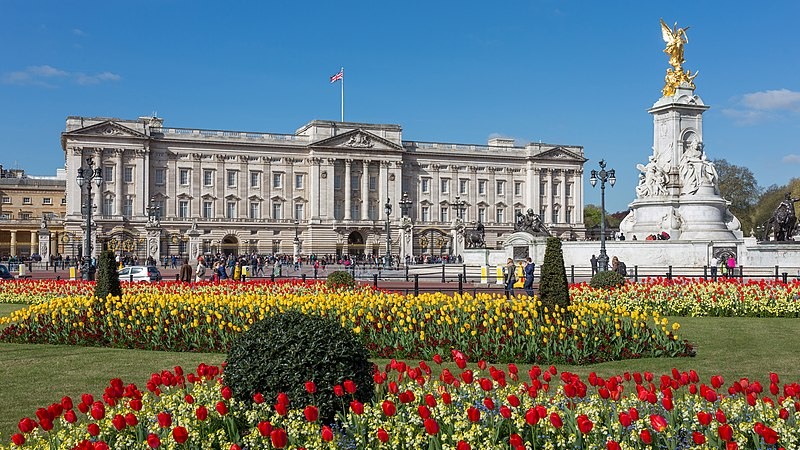
Image: Buckingham Palace. Author: Diliff, licensed under the Creative Commons Attribution-Share Alike 3.0 Unported license.
 Labour Hub