

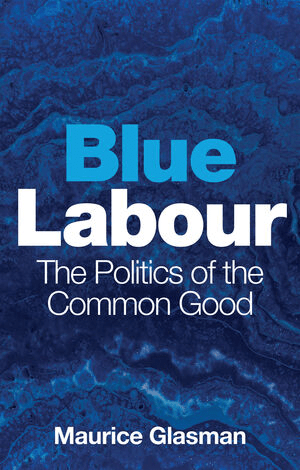
Mike Phipps reviews Blue Labour: The Politics of the Common Good, by Maurice Glasman, published by Polity
A lot of people believe the Labour Party has lost its way since 1945. Maurice, Glasman, Baron Glasman since 2011, believes Labour lost its way even before that historic election and sees Clement Attlee’s record in office as largely a continuation of wartime planning. His big idea, Blue Labour, extols older values and beliefs, namely “family, faith and flag” which are apparently nurtured through local institutions such as churches and football clubs.
He is on record as saying that so-called mass immigration under New Labour served to “act as an unofficial wages policy”, although there is scant evidence for this prejudice. Even more controversially, he called on progressives to reach out to supporters of the English Defence League and “to build a party that brokers a common good, that involves those people who support the EDL within our party.”
In recent times, these views have been picked up by some on the fringes of the movement to join in a right wing ‘culture war’ against the left. So I picked up my review copy of Glasman’s new book with some foreboding. Did I really have to wade through this stuff?
In fact, the book does not really engage with most of these controversies. Perhaps Glasman is rowing back from his more controversial statements, or maybe he feels his ideas are being commandeered by forces with a very different agenda to his. We don’t know: it’s a very short book and we are not told. So it seems best to engage with what Glasman does want to talk about – and there are still plenty of things here to challenge.
Blue Labour, Glasman tells us, began as a critique of New Labour’s embrace of global markets. The reality is that “human beings are not commodities, but creative and social beings longing for connection and meaning.”
This is standard, uncontroversial democratic socialist thinking. The problems start when Glasman’s attack on globalization encompasses modernity, technology, mobility, openness and much else. In doing this, he fails to distinguish content from form. The content of Tony Blair’s economic policy was neoliberalism, with its disruptive consequences of undermining democracy and fuelling precarity at work. Glasman is right to critique and resist this.
The packaging was modernity, education and aspiration. These are not bad things, but Glasman counterposes tradition, work and rootedness to them. Precisely because these values don’t translate readily into policies, this is a false binary.
Furthermore, New Labour’s economic embrace of markets was accompanied by a conservatism in aspects of social policy – on civil liberties, criminal justice and an emphasis on social responsibility to counter-balance rights – which actually chimes with Glasman’s own outlook.
Following New Labour’s ejection from office in 2010, Ed Miliband’s leadership failed to offer a clear vision. But “Jeremy Corbyn could. Coming from a Bennite tradition that upheld parliamentary sovereignty, accountability and a strong analysis of the problems with the prevailing global political economy, he could speak to the renewal of Labour’s soul.”
So what went wrong? The Party “retreated to an accommodation with globalization and lost the Labour heartlands,” says Glasman.
This is a flawed argument. It stacks up only if one makes an identification between continued EU membership and globalization in general. This is simplistic, as the social benefits of the Maastricht Treaty underline. The EU was and remains a contested site of struggle for a more socially just Europe, a fact recognised by many in Labour’s grassroots – and democratic socialists elsewhere in the EU – who had no interest in accommodating to neoliberalism.
This is pretty much all Glasman has to say about the Corbyn leadership period. The book’s dust jacket refers to Corbynism as “a jumble of old school statism and identity politics” but I failed to find such unfocused tropes in the book itself, which mercifully mentions identity politics just once.
Much of the book is a philosophical tract on the character of human nature, with significant nods to Karl Polanyi’s understanding of the counter-movement against industrialisation “of working people who sought to conserve society and defend their human status in defiance of the free market.”
Following Polanyi’s analysis of the rise of 1930s fascism, Glasman believes that government attempts to mitigate the impacts of market storms lead to statist nationalism. But this is not actually inevitable. It was predicated on the failure of democratic socialist parties to offer a clear alternative. Such a failure could be fatal for society. This is why the popular front at that time could, with some accuracy, be labelled the ante-chamber to fascism. In the modern era, after Obama: Trump.
Glasman may be onto something when he looks to society to challenge the excesses of capitalism and transcend the state/free market dichotomy. But his focus on the German model of social partnership is a very limited vision and in other respects it’s not distinguished from David Cameron’s ‘big society’.
In reality, there are many contradictions in Glasman’s outlook. Despite his scepticism about state intervention against the market, he nonetheless values state sovereignty against international institutions and applauds the creation of the statist NHS. He misconstrues the Brexit vote and the Conservative landslide of 2019 as a working class rejection of liberal globalization, without highlighting the rampant statist nationalism in Johnson’s project, a nationalism at which he is rightly alarmed elsewhere.
Turning to international politics, Glasman savages the idea that liberal globalization leads to democracy and liberty, as expressed by Bill Clinton when he argued that China’s accession to the World Trade Organization would lead to “faster and further” moves towards “greater openness and freedom for the people of China.”
The rule of President Xi suggests the opposite. Whether the new rivalry between the US and China signals the “disintegration of globalization” is more questionable. But we can agree with his penultimate paragraph: “As the organizing principle of its foreign policy, Labour should make free and democratic trade unions a condition of any trade deal and build its alliances around that commitment.”
Let’s hope so. But it should be recognised that such internationalist sentiments are at odds with the UK-centric patriotism of his earlier outpourings, strangely absent here. On this latest rinse, Blue Labour does not seem so blue after all.
Mike Phipps’ new book Don’t Stop Thinking About Tomorrow: The Labour Party after Jeremy Corbyn (OR Books, 2022) can be ordered here.
 Labour Hub