
Michael Calderbank reflects on Keir Starmer’s Labour Conference Speech
The lower ranks of Anglican clergy were once so poor and hungry that they were prepared to accept even a rotten egg on the grounds that it was “good in parts”. That’s my feeling about yesterday’s Leader’s Speech.
If you look hard enough there are bits that you can pick out as something worth swallowing – support for the Hillsborough Law; investing in getting new doctors and nurses into the NHS; public investment in infrastructure and green technologies, and so forth. Yet while there are now enough key dividing lines to suggest that a Labour government would be an essential break away from the Truss/Kwarteng horror show, sadly these elements aren’t enough to shed grave misgivings about the Starmer project as a whole.
Maybe I’m just a “glass half empty” person, but I’m struggling to go along with Andrew Fisher’s assessment that with this speech “Starmer has clearly… slammed the door on New Labour” or that it “owed more to Shadow Chancellor John McDonnell…than Tony Blair”. Not that Fisher’s piece is without important insights: clearly it is highly unlikely that Starmer will become Prime Minister in a period where optimism still reigns about “the dynamics of the market” or “the rigours of competition” (to which Labour is still nominally committed by Blair’s replacement version of the historic Clause IV).
The brute reality of the situation a Labour government would face militates against the wide-eyed faith in the potential of leveraging private finance further into the public sector as a means of delivering “modernisation”. If Blairism is assumed to mean, as Peter Mandelson said, being “intensely relaxed” about people getting “filthy rich”, then today’s ‘centre ground’ has clearly shifted away from the 90’s modernisers. Those ideas today look very outdated, as the leadership is surely aware.
Much of the speech was boiler-plate political rhetoric, conjuring up a mood of renewing hope and optimism with little substance behind the claims: “It’s time for Britain to stand tall again. To believe in ourselves again. To chart a new course. And to get our future back.” It’s hard to tell what any of this actually means!
Yet in at least one crucial respect, Starmer remains consciously in the mould of Sir Tony rather than even his right-wing social democratic predecessors. As his spin doctors were keen to point out, Starmer made a big point of reusing the old New Labour line that “Labour is the political wing of the British People”. The import of this statement is what is implied by what it does not say. Historically, of course, Labour was created in order to give political expression to the interests of the organised working class, as embodied in the trade unions and socialist societies. Elite groups in British society – the landowners, financiers and mercantile classes – already had a political voice. Labour needed its own voice – this wasn’t controversial, even for the old Labour Right. In re-imposing the frame of a single national popular interest, New Labour consciously and deliberately chose to relegate the unions to becoming just another interest group to be balanced off against others.
To this extent, resorting to this old bit of Blairite rhetoric is of a piece with Starmer’s instruction that members of his Shadow Cabinet should avoid supporting striking workers on picket lines. Given that Liverpool dock workers from Unite were taking strike action just minutes away from Starmer’s podium, his failure to offer a word of solidarity was surely a calculated slap in the face.
The sole reference to trade unions in Starmer’s lengthy speech was in the context of “a true partnership between government, business and trade unions”. Defending the “right to strike” – in the limited context of the Thatcher-era anti-union laws, retained under Blair – is one thing, it seems, but showing support for striking workers against exploitative, profiteering bosses is apparently a step too far.
As Fisher accurately observes, the “elephant in the room” at Conference is the awkward silence maintained by the leadership on the question of the pay claims of public sector workers, as well as whether private sector workers should be supported in their industrial struggles. The oblique references in the speech to “the courage to make very difficult choices” represent a real warning signal.
Despite the austerity years which mean that millions of workers having faced the most prolonged pay squeeze since the Napoleonic wars, there is every prospect that a future Labour government will be telling its workers that they must continue to swallow real-terms pay cuts. With teachers, firefighters and civil servants set to join the rail workers, posties, and dockers on the picket lines, the industrial pressure building on the Tories will not be easy for a Starmer government to brush off once in power.
In some respects, Starmer even lags behind New Labour. In 1997, the then Shadow Foreign Secretary Robin Cook spoke of introducing an “ethical dimension” into British foreign policy, although we know how this would ultimately play out. Perhaps a modern-day Cook would be in danger of expulsion for criticising NATO, whereas now “our support for NATO is non-negotiable”.
It’s not just that Britain’s membership of NATO is not up for dispute, but that we support NATO full stop. No wonder the only reference to ‘imperialism’ Starmer makes is in reference to Putin’s Russia. OK, but what about the disastrous role of western imperialism in Yemen, for example, to say nothing of the catastrophic aftermath in Afghanistan?
New Labour also had a constitutional reform agenda of extending electoral reform – though not, sadly, proportional representation (PR) in the House of Commons – and devolution across Scotland, Wales and Northern Ireland. Despite receiving 140 motions from CLPs supporting the call for Labour to back PR, now also supported by many affiliated unions, Starmer showed contempt for the Party’s democratic policymaking by refusing point blank to commit to include a commitment in the next manifesto. Which , whether you support PR or not, surely begs the question what role debates and democratic votes on policy motions at Conference are intended to play?
In addition, whether rejecting in advance any agreement with the SNP to kick out the Tories will be either electorally popular north of the border or politically expedient after the election, certainly remains to be seen. It seems like an unnecessary hostage to fortune.
The leadership might be feeling understandably confident in relation to the most ideologically extreme and politically hapless Tory administration since the fag end of Thatcherism. But it’s can’t afford to take people for granted. The social, economic and climate crises will continue to pose the reality of antagonistic class interests more sharply than a politics based on ‘the national interest’ or ‘the British people’ can easily accommodate into a sustainable ‘centre-ground’ consensus.
Michael Calderbank is a member of Tottenham CLP and a contributing editor on Socialist Register.
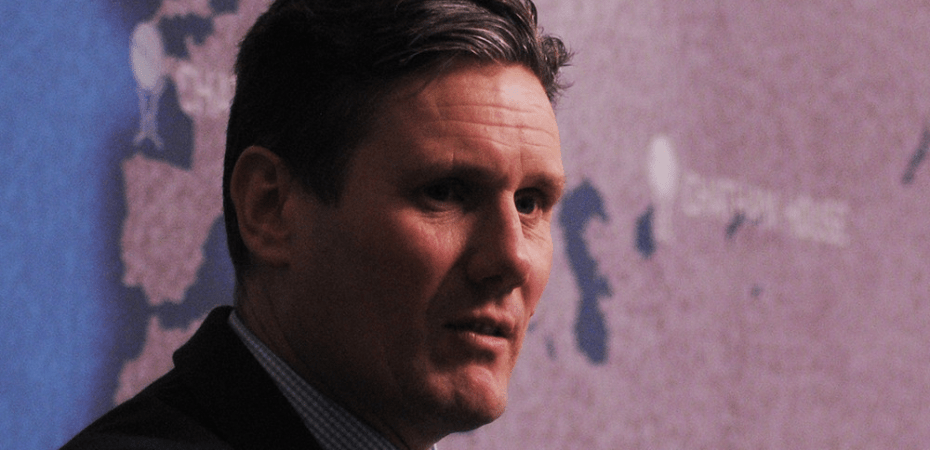
Image: Keir Starmer, https://www.flickr.com/photos/chathamhouse/8450776372. Licence: Attribution 2.0 Generic (CC BY 2.0)
 Labour Hub