
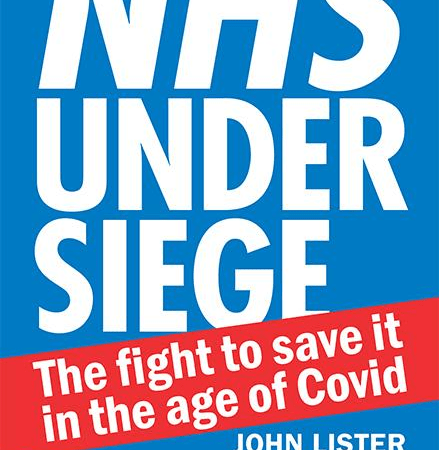
John Lister writes about NHS Under Siege, the book he jointly wrote and edited with Jacky Davis, published in May by Merlin, price £9.99.
Less than six months ago, in April 2022, Dr Jacky Davis and I completed work on a book summing up the current state of the NHS. NHS Under Siege explores the decade of decline in which real-terms funding was run down from 2010 reducing it from its best-ever levels of performance to a generalised state of crisis in 2019, and how this was compounded by the Covid pandemic and worsened by the subsequent return to austerity funding.
We worked hard to ensure it was as up to date as possible, with references as recent as March this year: but of course we could not have foreseen the bizarre events that would follow.
Since then we have seen the disgrace and downfall of Johnson and his cabinet, two abrupt changes of Health Secretary, the election (by the most unrepresentative 0.125 percent of the population) of Liz Truss, a creature of hard right lobby groups, as Tory leader and thus Prime Minister, and the disastrous “mini-budget” that has collapsed the pound and unleashed fresh economic chaos.
During her campaign for the Tory leadership, Truss’s only substantive comment on the NHS was to state that she would take £10m of the £13m per year “health and care levy” from the NHS, to give it to the chaotic, privatised social care system. That would amount to an unprecedented 7 percent cut in funding for the NHS, enough to collapse some key services and see any hint of possible light at the end of a long tunnel snuffed out for under-paid, over-worked and burned out NHS staff. It would almost certainly trigger a mass exodus, worsening the current level of 132,000 unfilled clinical posts.
Even as the situation has changed rapidly for the worse for the NHS, the performance has continued to worsen as the lack of front-line capacity, lack of capital to build new, refurbish or even maintain clapped out buildings and equipment, and staff shortages drive up delays for emergency and waiting list patients in acute and mental health services.
Hospitals clog up for lack of beds, worsened by continued Covid cases and the desperate lack of social care that keeps 12,000-plus patients each day in hospital beds who should have been discharged. Falling numbers of GPs, loaded down with extra tasks, battle against the odds and even increase numbers of appointments – but still suffer constant abuse from the right wing press.
A growing chorus of conservative columnists and broadcasters on niche right wing networks, delighted by each new setback to the NHS, take every opportunity to denounce and denigrate it. They now demand that Truss and co go even further, and scrap the tax-funded model the Tory right has always hated, to embrace more costly and bureaucratic social insurance systems like Germany or even more expensive and more privatised systems such as the Netherlands or Switzerland.
So is our book now an irrelevance? I don’t think so. Still not enough people recognise that the crisis state of today’s NHS was neither the result of Covid, nor the inevitable failure of a system that is somehow an outdated relic of the 1940s. The decline of the NHS was the inevitable and predictable result of ten years of real-terms cuts in spending from 2010: NHS Under Siege charts each stage in that process, with evidence.
Not enough know or remember that in 2000 the NHS had to be rescued from its parlous state after two decades of under-funding, and was put back on its feet by a decade of above-inflation investment. NHS Under Siege explains how this was done, the strengths and weaknesses of the New Labour model.
As Tory ministers point to the higher levels of spending during the pandemic, a major chapter explores the mishandling of that pandemic, the siphoning of billions in contracts to Tory donors and cronies, the privatised waste of billions on test and trace – and the needlessly high death toll of patients and NHS staff. A follow-up chapter warns of the new period of austerity funding that has followed the peak of the pandemic – which we now know was aiming to claw back all of the ‘extra’ spending over the next three years, even before the threat of new cuts from the Truss cabinet.
As we wait nervously for the November 23rd budget that Chancellor ‘Kamikwasi’ Kwarteng has strongly hinted will contain brutal spending cuts to balance his gifts of billions to energy companies and to the richest one percent, the prospect of further outright cuts to the NHS raises the question of building new campaigns across the country. NHS Under Siege – which is sub-titled The fight to defend it in the age of Covid –devotes a chapter to the “long, honourable tradition” of fighting back, and gives a profile of some of the most useful campaigning bodies.
Further depth is added by a dozen chapters by experts on different aspects of the developing situation, public health experts, union leaders, and expert witnesses to the People’s Covid Inquiry organised last year by Keep Our NHS Public.
With the NHS facing the most serious-ever threat to its future, the message from NHS Under Siege is “don’t mourn: organise”. Defeatist, ultra-left approaches, which exaggerate the scale of privatisation, suggest the NHS has already been abolished and ignore the political constraints on the radical right are rejected. All they achieve is demoralising people who should be fighting back.
The NHS has not been ‘sold off’, and won’t be. Parts of it (far too many parts) have been contracted out. But the private sector has no appetite to buy up most of a loss-making, under-funded NHS – especially when they can cherry pick the bits of it they find most lucrative and know their contracts are backed by government funding.
Over the three decades since Margaret Thatcher tore up the post-war consensus on the welfare state, the NHS has been the least soft target of any of the public services. Governments wanting to cut its funding or contract out services have generally opted for more subtle salami tactics rather than outright attack. In many of our lifetimes we have seen it actually rebuilt from a parlous state: it can still be defended again and rebuilt with investment and a rolling back of privatisation.
NHS Under Siege keeps the faith and reminds us that there is still a lot of NHS to defend. Even for the richest there is no private sector alternative to most of the NHS, and the longer we wait the harder it will be to keep it safe and keep it public.
 Labour Hub