

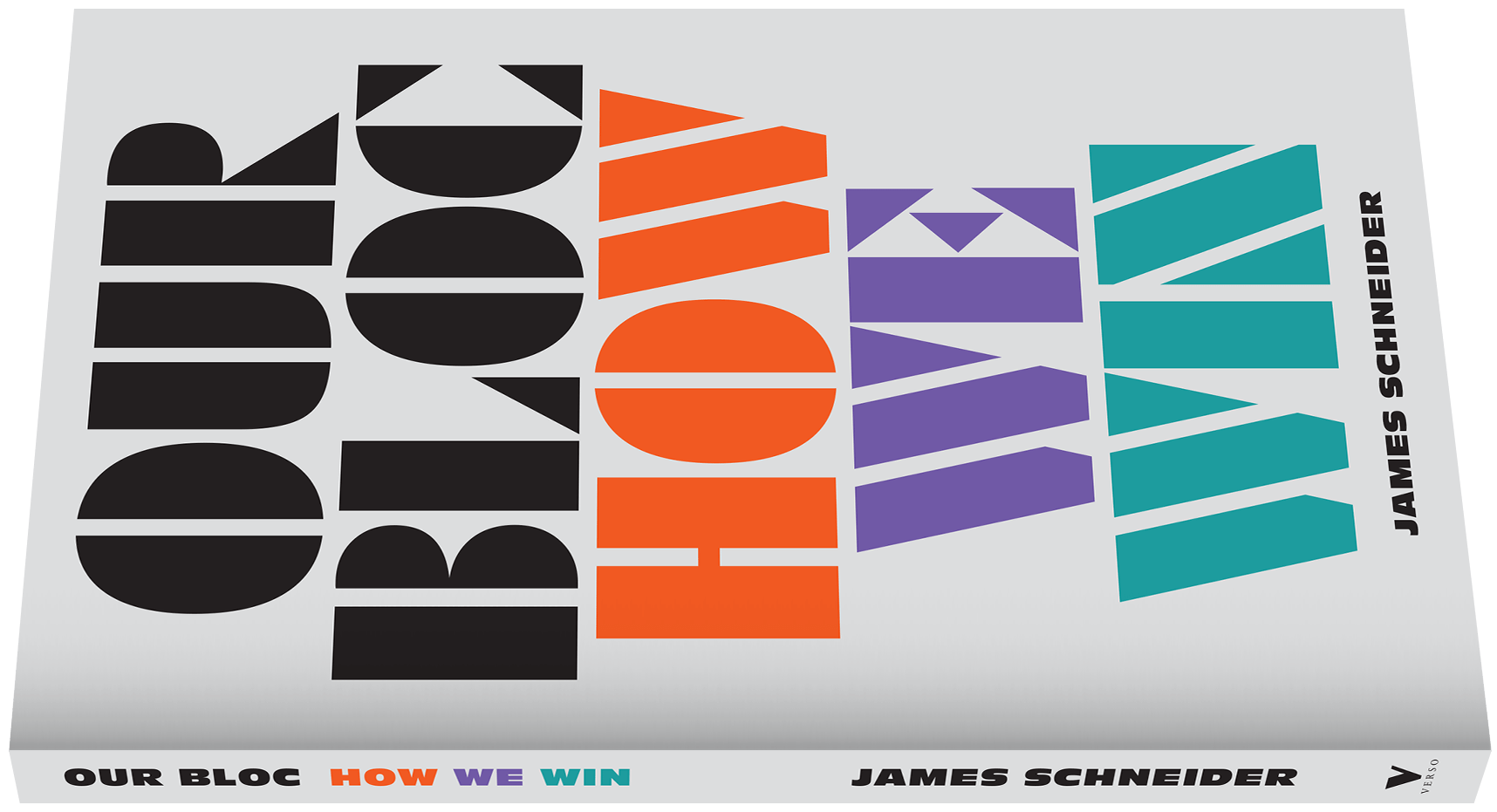
Mike Phipps reviews Our Bloc: How We Win, by James Schneider, published by Verso.
With the failure of the Corbyn Project, the left is in danger of retreating into pre-Corbyn strategies, argues the former leader’s Director of Strategic Communications and Momentum co-founder James Schneider.
But “despair would be a betrayal”, he argues, because the situation is emphatically not hopeless: things looked bleak in 2015 too, but notwithstanding years of long decline for the unions and Labour left, that defeat produced “a challenge to the system that raised the hopes of millions and frightened the rich and powerful.”
While the Corbyn Project was ultimately defeated, 13 million people voted for it in 2017. We must not lose sight of the goal, Schneider rightly argues, of “constructing a social majority for change with a political vehicle and the organisational forces in society… to carry it out.”
The conditions that gave rise to the Corbyn leadership still pertain. Public dissatisfaction is underlined by the fact that Boris Johnson was obliged in 2019 to present himself as an agent of change.
To win, the left needs to construct a bloc of social movements, trade unions, Labour grassroots and socialists in Parliament. This was the original goal after 2015. But to bring together a movement, while trying to cling to the newly-won leadership in the face of unremitting hostility from parliamentary colleagues, was a huge task. Yet, partly due to the bungling of our opponents – the attempted coup against Corbyn in 2016, the Tories’ underestimation of his strengths in 2017 – we not only held on, but did well enough to silence many of his internal critics, at least for a while.
Schneider argues that by 2019, the progressive movement inside and outside the Party, was substantially more developed than in 2017. For him, it was Brexit that caused Corbyn’s defeat in 2019: “Within the party, those who both supported Corbyn and wished to overturn the referendum result acted as the establishment’s dupes.”
I disagree. We learn very little from the 2019 defeat if we put all the blame for it on Brexit. In particular, we need to put the focus back on the idea of a hegemonic progressive bloc that Schneider’s book is about. The apparent closeness of the 2017 election result unfortunately strengthened support for a ‘one more heave’ approach at the next election, when what was really needed was a fundamental rethink about how to build the social majority for a Corbyn government.
Keir Starmer leads a very different Party today. But the fact that he had to base his 2020 leadership bid on continuity with Corbyn’s policies to get elected underlines the continued popularity of those ideas. Likewise, the fact that the right of the Party still have no substantive policy ideas and the political agenda is being set by the left demonstrates the latter’s ongoing strength. Hence the right’s priority of attacking it.
Rather than ploughing on as normal in Starmer’s Party, or wandering off to set up a new outfit, Schneider proposes a third way: building “strong, well-organised and interconnected movements able to mobilise the mass of the country – as well as a political party with the skill to win elections, the will to carry through its policies and sufficient openness to movements to prevent its deradicalisation once in office.”
We are some way from the first of these ideas – even getting affiliated unions to act together is a struggle, let alone the various social movements. And we are even further from the kind of Party Schneider envisages. He has a range of practical proposals on this, but many have a top-down feel, focusing on policies that could hold the different movements together under the same banner.
Schneider suggests the ‘Green New Deal’ encapsulates the aim of this movement. But it may not be possible to reduce the perspectives of widely different organisations – from Black Lives Matter to renters’ unions – to one simple slogan.
But this is only one aspect of the challenge, Fresh policy thinking is also needed, along with a stronger understanding on how new policies should be presented. From 2017 on, there was “too little idea of sequencing, prioritisation and electoral appeal.” Furthermore, the left needs to break from a technocratic approach to implementation.
Schneider advocates a flexible strategy that rejects both the idea that Labour is the only possible vehicle for socialist advance and equally the suggestion that Labour could never be such a vehicle. Like much of the foregoing, it’s hard to disagree with many of these ideas. Critics, however, might legitimately question whether this open–ended approach actually constitutes a strategy at all. By choosing to be concise, Schneider’s 133 pages may have sacrificed detail for generality.
Mike Phipps’ new book Don’t Stop Thinking About Tomorrow: The Labour Party after Jeremy Corbyn (OR Books, 2022) can be ordered here.
 Labour Hub
[…] for, it’s much more difficult for a new, less known, smaller group to achieve. In Our Bloc, Schneider seemed to reject the idea that Labour could never be the vehicle for such a strategy: here the possibility of […]