
On October 5th, roughly a year of unrest in Hungary’s chronically underfunded public education system reached its peak. Tens of thousands of teachers, students and supporters flooded Budapest’s Margaret Bridge, after earlier announcing that they would stop the traffic for two hours in the afternoon. Meanwhile the cost of living and energy crisis affects not only teachers: dustbin collectors started a collective action, which is thought to be Hungary’s first wildcat strike against the Budapest municipality which is controlled by the left-liberal opposition. This article, by Tóth Csaba Tibor, is a reflection on the duality of solidarity and attention that favoured the teachers as well as the shortcomings of opposition lawmakers in addressing the bin workers’ strike, while being rightfully supportive of the teachers’ action.
I’ve just come from Kossuth Square. The main square, which the system intended as a symbolic meeting place back in 2014, was full on October 5th: filled with a crowd of teachers, students, parents and sympathizers who have been hearing for decades: their case is not important, they are ‘intellectuals’, people with glasses, graduates, in short, enemies of the system. Their wages may be low, their freedom of speech may be curtailed: it doesn’t matter, because the Fidesz-KDNP [the alliance of the Hungarian Civic Alliance (Fidesz) and the Christian Democratic People’s Party which has governed Hungary since 2010] and the Orbán regime are on the side of ‘ordinary people’ instead of them.
Cutting through the crowd, I had the feeling that the plight of the teachers sent from Kölcsey High School was the last straw: the workers and students of the last stronghold of public education, treated as stepchildren, seem unable to tolerate any more: the austerity packages imposed on them in 2022 will no longer be tolerated without protest.
If you look at the numbers alone, this is absolutely understandable. To summarize only the most important ones: under the Orbán regime, the most important and highest salary increase for teachers took place in 2013; it was 34 percent. Since then, the will to raise wages has decreased, but prices and, most recently, since 2020, inflation have stubbornly increased. Despite all of this, it is typical of the situation that in 2021 the teachers’ unions and the government had already discussed a thin, 10 percent wage increase. And 2022 is the year when the government finally announced what were essentially the most drastic cuts since coming to power. (And it wants to blame all of this solely on the war sanctions – which Viktor Orbán and Péter Szijjártó [Foreign Affairs Minister] themselves voted for in Brussels!) And although at the level of words it is still about ‘inflation tracking’, the situation is that this money is gradually becoming not enough for food and utilities for workers in one of the country’s most important sectors.
Therefore, it was neither surprising nor unexpected, especially not this year which has been dotted with teachers’ protests, that the teachers’ unions, movements and others are no longer satisfied with empty words.
Wednesday’s demonstration and the accompanying actions spoke volumes for this. Even though the servile media is not willing to report this fairly, the truth is that the students and protestors could not fit on Margaret Bridge, and afterwards on Kossuth Square you could barely move at all, only baby steps, like a Peace Procession.
This definitely carries a serious message. And even more so, in the eyes of the participants of the bridge occupation, about two-thirds did not even come from the teaching community: they were high school students, students, and those under 18 years of age. When Viktor Orbán became prime minister 12 years ago, they were still babies and small children; they are already growing up in this system, in this era.
They no longer ask anything of the oppressive nightmare and the tyranny of the central power: they would rather spend their young years and university days in a different political reality.
Yet in the crowd, on the bridge, you could hear from countless places that the discontent was looking for a target – the old site of protests, the Fidesz headquarters in Lendvay Street, the Carmelite Monastery [Prime Minster’s residence] or even the Parliament building. However, after the pre-announced bridge closure, the evening ended in a simple after-party: as if everything had been arranged, as if any of the demands of those present had been met, and there was something to celebrate.
It was a strange finale to such a day.
As well as the huge crowd that inspires hope and joy, it is also a strange phenomenon that the people involved react in a thousand different ways to the thousands of faces of growing dissatisfaction caused by austerity, and the expressions of this still do not want to be connected at the political level.
In the capital city, public spaces have been taken over for a second day, and now the garbage collectors are on strike. Just like teachers, trash collectors are essential workers.
Without their daily efforts, we would soon drown in our own mountain of waste. The immediate superiors of the FKF [a private waste management company, one of the largest in in Hungary], at the Metropolitan Municipality – while standing up for the teachers belonging to the state – are far from being so brave towards them, for whom they could perhaps do something.
Mayor Gergely Karácsony first blamed his own helplessness on the global crisis and the universal nature of cost of living problems. And the fact that the government of course does not transfer the money owing to the municipality in the same way as in the time of [former Budapest Mayor] István Tarlós.
This is one explanation. However, it does not explain why it is necessary to threaten the garbage collectors with Orbán’s 2012, disgraceful Labour Code. Plus, if the capital city of Budapest is doing everything for them, then why do the frustrated workers blow the whistle and send the director of the company to ‘a warmer climate’, as happened on Wednesday?
The cost of living crisis is only just beginning: wages are rising almost nowhere except for the police (and even then not much). The first gas and electricity bills, which will show a significant increase, will be received by everyone only at the beginning of November. Who knows how long the price caps will last on some basic foods and fuel? What kind of situation we may face after that cannot even be guessed today.
This is a common cause for all of us: couriers closed bridges in June, and teachers in October. However, in reality, everyone should be there next to everyone else on the streets, because it will not work any other way: what remains is the routine expression of a society forced to its knees.
To put it another way: MOL [a Hungarian oil and gas company], which is also one of the absolute winners of the energy crisis, has now been given the traditional state task of waste management. Therefore, there should be no doubt: there are people for whom this crisis is a pure benefit.
Of course, it would not be honest to say that the European general inflation and energy crisis is a characteristically Hungarian phenomenon. It is enough to mention the case in February, when the garbage collectors of Coventry, England, went on strike against the basically left wing, pro-Labour city council over the cost of living crisis.
The city administration had a hard time putting up with this, and wanted to break the strike, disregarding its party logo. Not so the young and new-left Member of Parliament for South Coventry, England, Zarah Sultana. She sided with the city’s garbage collectors almost without thinking, protested with them during the strike and even went against the council representatives of her own party, if necessary, not caring that it was inappropriate, disloyal to the party, or not expedient for her career.
For all these ‘crimes’, the elite of the Labour Party, who rejected Sultana’s action, wanted to replace her: within the British Labour Party: apparently all party members in the constituency can vote in each ward on whether they want to keep Zarah Sultana as a representative.
She won an overwhelming victory of more than two-thirds among her own voters. The ‘partisan’ enemies immediately fell silent.
This can be a lesson for today and for the tough period ahead: you don’t have to be afraid to stand up for everyone: it will be good!
This article was originally published in Hungarian in Mérce here
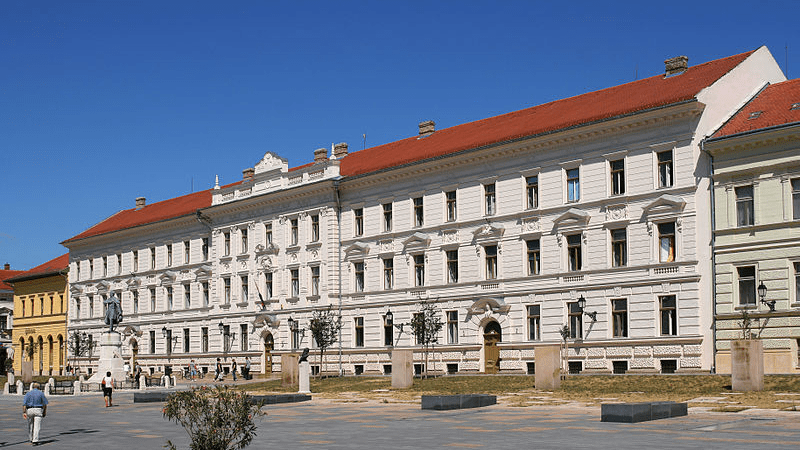
Image: Kossuth Square. Author: Lestat (Jan Mehlich). Permission: Lestat (Jan Mehlich) put it under GFDL and Creative Commons Attribution ShareAlike 3.0
 Labour Hub