
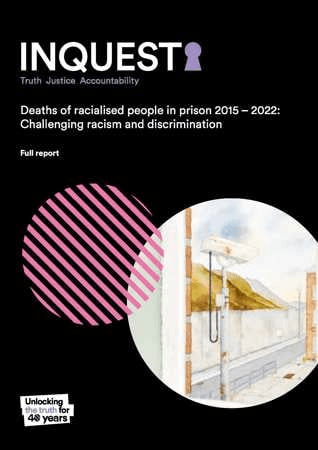
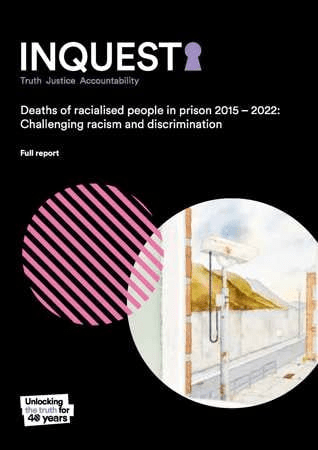
A new report from INQUEST, Deaths of racialised people in prison 2015 – 2022: Challenging racism and discrimination uncovers new data and tells the stories of 22 racialised people and how they died preventable and premature deaths in jail.
Through a literature review, an analysis of never before published data on ethnicity and deaths in prison, and an examination of the relevant inquests and investigations, the report explores the role of institutional racism in the prison estate.
Key issues include the inappropriate use of segregation, racial stereotyping, the hostile environment, the neglect of physical and mental health, the failure to respond to warning signs, and the bullying and victimisation of racialised people.
INQUEST’s research exposes deeply concerning patterns affecting people from racialised groups, which contribute to premature and preventable deaths in prison. Despite the thematic issues these cases raise, post-death investigations and inquests are consistently silent on issues of racism and discrimination.
Featured in the report are the experiences of Mohammed Irfaan Afzal, who was a 22-year-old man of Pakistani background. He was being held on remand at HMP Leeds when he died on 4th August 2019 from a chest infection, after losing so much weight he became emaciated. Prison staff described his presentation as “bewildered” and “child-like”.
Mohammed was physically healthy upon arrival in the prison but over 48 days lost almost one third of his body weight, leaving him vulnerable to infection. Investigations into his death identified failures to assess his health, not only in the days before when he appeared unwell, but also for mental ill health and learning disabilities.
Ayesha Afzal, Mohammed’s sister, said: “My brother suffered for the last few months of his life scared, starving, sick, and alone. That will haunt me every day until I die. No one has been held accountable for his death, and there has been no justice.”
In another case, prison staff identified a need for Tariq Dalton, a 42 year old mixed-race man of Pakistani and Irish heritage, to be seen by a doctor, but on four occasions GPs failed to see him in person. The prison repeatedly prescribed the anti-inflammatory drug meloxicam, but had not obtained Tariq’s community GP records which included two previous incidents of haematemesis (vomiting blood).
At the inquest, every prescribing clinician stated they would not have prescribed meloxicam to a patient with a history of haematemesis. Tariq was at a high risk of experiencing gastro-intestinal irritation which could lead to ulcers and internal bleeding as a side-effect of the medication. In the 36 hours before his death, Tariq complained of vomiting blood but was not physically seen by a doctor and did not receive any medical attention.
Some 2,220 people died in prison between 1st January 2015 and 31st December 2021. The data shows that the highest number of deaths occurred amongst Black and mixed-race people and Asian and mixed-race people respectively. This neglect of both the physical and mental health of racialised people is a key theme arising across the cases highlighted.
Deborah Coles, Executive Director of INQUEST said: “We see time and time again repeated patterns of failure which contribute to the deaths of Black and racialised people in prison. Yet for too long the systemic issues contributing to these deaths have been ignored.
“The failure of post-death investigations to examine the potential role of racism or discrimination in deaths renders racialised issues invisible. As a result, the opportunity to acknowledge and address racial injustices and inequalities is lost.
“The decision to imprison the people featured in this report ended up being a death sentence. Imprisonment is ineffective in reducing crime and instead perpetuates harm and violence, with racialised and marginalised groups worst affected.
“In order to end deaths of racialised people in prison, in the short term we need more focused investigation, oversight and action on these deaths. In the long term we must halt prison building and redirect resources from the criminal justice system to welfare, health, housing, education and social care.”
INQUEST is an independent charity providing expertise on state related deaths and their investigation. Their work is informed by 40 years of specialist casework.
On 20th October 2022, INQUEST will hold an online seminar to further discuss the report alongside the researchers and families involved.
 Labour Hub