

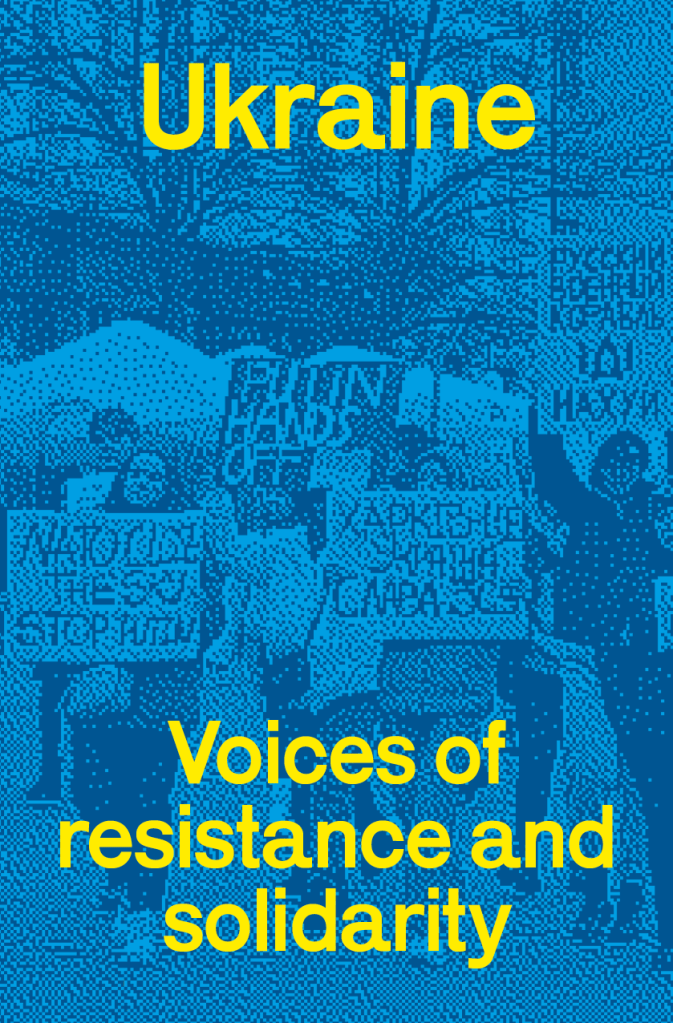
Mike Phipps reviews Ukraine: Voices of Resistance and Solidarity, eds. Fred Leplat and Chris Ford, published by Resistance Books and Ukraine Solidarity Campaign
Under the Soviet regime, as Mick Antoniw explains in the Introduction to this timely book, the common narrative was that “those who opposed or criticised it were essentially right-wing reactionaries or even Nazi sympathisers.” This outlook neglected both the radical, socialist history of Ukraine and the full horror of Stalin’s policies in that country, which caused the death of millions, followed by a programme of relentless russification that continued after World War Two.
Today, there are still plenty on the left ready to excuse the chauvinist and imperialist policies of Putin’s authoritarian regime towards Ukraine, including its concentration camps, liquidation squads, torture and rape of civilians and other war crimes.
This collection of writings about Ukraine exposes the myths that Putin apologists cling to. It showcases the real progressive movements in Ukrainian society, including the trade unions and women’s organisations.
Oksana Dutchak unpicks some of the most commonly heard anti-war arguments and looks at the sub-texts behind them. She focuses on how abstract calls for peace usually entail a surrendering of Ukraine’s sovereign territory. Likewise, using the fear of escalation into a nuclear war as a justification for Ukraine’s capitulation essentially signals that any nuclear power – not just Russia – is entitled to do what it likes.
As Ukrainian sociologist Taras Bilous concludes in his contribution: “I’ve tried to follow and participate in the discussion of the international left about the Russian-Ukrainian war. And the main thing that I now feel from these discussions is fatigue and disappointment. Too much time being forced to rebut obviously false Russian propaganda, too much time explaining why Moscow had no ‘legitimate security concerns’, to justify war, too much time asserting the basic premises of self-determination that any leftist should already agree with. Perhaps most striking about many of these debates… is the ignoring of the opinion of Ukrainians.”
Viktoria Pihul highlights the impact of the war on women and girls – the targeting of maternity hospitals, the use of rape and gender-based violence, the millions of female refugees. At the same time, women serving in the military have been hailed for their fearlessness and bravery.
True to its socialist stance, the book’s contributors also raise concerns about the mass privatisation and labour force flexibilisation that international actors are preparing for Ukraine once the war has ended. Against this, Vitalii Dudin proposes a sustainable economy, secured employment and the democratic input of civil society, including Ukraine’s trade unions, into the country’s reconstruction. Above all, the cancellation of Ukraine’s debt is a demand central to the country’s recovery.
Much of the material here has been published elsewhere, but these contributions are some of the most illuminating and are accompanied by a useful historical backgrounder by John-Paul Himka. Overall, it’s a really worthwhile handbook, containing lots of information and the key arguments that socialists need to be making – sadly, within the left itself.
Book launch with Yuliya Yurchenko, author of Ukraine and the Empire of Capital and a member of Sotsialnyi Rukh; and Fred Leplat, co-editor of Ukraine: voices of resistance and solidarity.
Wednesday 26th October, 6.30pm
Marchmont Community Centre, 62 Marchmont Street, London WC1N 1AB
Registration here. Meeting hosted by the Ukraine Solidarity Campaign.
Mike Phipps’ new book Don’t Stop Thinking About Tomorrow: The Labour Party after Jeremy Corbyn (OR Books, 2022) can be ordered here.
 Labour Hub