
By Tony O’Brien
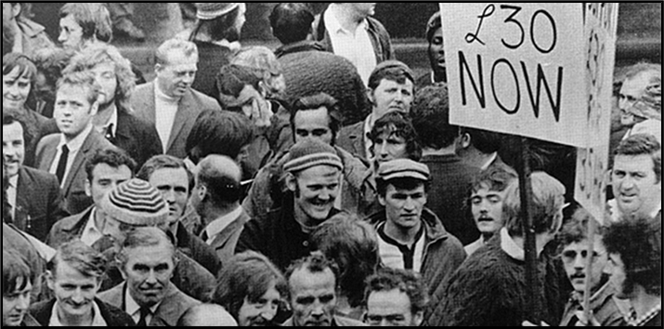
In 1972, shortly after its formation, the building workers union UCATT, together with the General Municipal Workers Union (GMWU) and the Transport and General Workers Union (TGWU), who were involved in construction and civil engineering, started what was the single most important building trades unions strike in their history. For the first time ever in the building industry, workers all over the country went on a national strike to demand a minimum wage of £30 for a 35-hour week and abolition of the “lump.” This strike affected most major sites, effectively forcing employers to negotiate.
The background to the 1972 strike was the building boom of the 1960-70s. This was a time when there were numerous sub-contractors with many crafts making for a constantly changing workforce, differing contracts and pay rates.
Employers were constantly seeking to break union organisation by bringing in non-union labour and by blacklisting or victimising trade union activists. It was a time of labour-only subcontracting, or the “lump”.
Lump workers were self-employed and thus not entitled to holiday pay, national insurance or PAYE tax deductions, instead receiving a fixed “lump” sum, supposed to cover all expenses. It was also a time between 1951 and 1971 when the building unions had lost up to 30 per cent of their members.
In April 1970, 288 delegates from 50 union branches and a similar number of stewards from sites met in Manchester and founded the “Building Workers’ Charter” (BWC) as a rank and file movement. And just before the strike in April 1972, 865 delegates attended its conference.
The Charter was responsible for the unions adopting a militant claim for £30 for 35 hours.
The strikes began between May and June 1972, with selective strikes on what were high-status sites – mainly hotel and larger construction jobs. It was hoped that stoppages of work on the employers’ highly lucrative jobs would force them to negotiate. The national trade union leadership tried hard to keep the dispute to one of selective strikes. If this strategy had prevailed, it would have fragmented the strike and could have led to a defeat. Activists knew that this selective strike action would not be enough to secure their demands.
In a meeting of building workers in Conway Hall in Central London the demand went up for an all-out strike. My site was already out on strike and following the Conway Hall meeting many other sites in London stopped work. At the same time, other similar actions took place throughout the country. The system of flying pickets was widely developed to bring most sites out on strike. In east London, hundreds of us would meet at 6am every morning in what was then the TGWU Dockers’ offices in the East End of London. We briefly discussed our targets and then got into vehicles to spread the strike.
So, what began was a very effective use of ‘flying picketing’ throughout the country. With only a small number of exceptions it was not at all difficult to get a clear majority of building workers to join the strike. Workers were so fed up with low rates of pay that they readily welcomed us. In those days, you did not have the security on sites you have today. So, in most cases it was quite easy to walk onto the site and call a site meeting. After explaining the reason for strike action there was no problem in getting a vote from the workers to join the strike. Following our success in getting all-out strike action, the employers began to buckle and after 13 weeks agreement was reached with our unions.
The deal made never met our demands for an immediate 35 hour working week for a £30 basic rate of pay, and an end to the use of labour only and the lump.
Protests from the rank and file were massive; 12,000 building workers marched in Liverpool, demanding no settlement short of the full claim. In London, several thousand lobbied the pay negotiations.
We demanded nothing short of the full claim and that any agreement made be put to a vote of union members, yet the UCATT General Secretary Sir George Smith refused. On Tuesday 14th September 1972, the union side in the negotiations agreed a settlement with the employers.
This was despite the strength of feeling from striking building workers that the strike should be continued until the full claim was met. The union executive’s control of negotiations meant that in the end this magnificent strike was sold short as they settled and called the strike off.
Nevertheless, some individual local employers had already, during the strike, agreed to pay the £30 a week claim. It was, however, despite our union leadership’s actions, still a major historic victory. Our morale was hugely lifted knowing that after so many years of low pay and bad working conditions we could successfully take on our country’s building employers with strike action and beat them. The outcome of the strike was a pay settlement that gave us the biggest pay rise ever. The settlement was for an immediate £6 per week pay rise for craft workers and £5 for labourers. The weekly basic, along with a guaranteed minimum bonus was raised by a further £6 and £5 respectively over the next two years, lifting the craft rate from £20 to £32 and the labourers from £17.50p to £27.20p. That was a 33% increase in pay.
The aftermath from the strike was a lack of preparation by the union leadership to face the inevitable backlash from the employers, when a wave of victimisations took place, most notoriously of the Shrewsbury 24. The union leadership had succumbed to the witch-hunting of the television and press and refused to support them. Instead they should have called on all building workers to resume an all-out strike until these workers were released from prison.
The campaign to overturn the convictions of the Shrewsbury building workers won a significant victory when on 30th April 2019, halfway through a Judicial Review hearing in Birmingham, when the Criminal Cases Review Commission conceded the case and agreed to reconsider the referral of the convictions of the pickets to the Court of Appeal.
Nationally, the backlash from the employers came within less than a year of the winning of the national building strike. A conspiracy began to take shape, led by what was then the “Economic League” (the forerunners of the blacklisting “Consultative Association”) and supported by most of the major construction companies. Evidence for that conspiracy was later found on thousands of pages in the files of 3,200 blacklisted building workers when the government’s Information Commission raided the offices of the “Consultative Association” in 2009. The highest point of that conspiracy was the taking to court and jailing of what was known as the Shrewsbury 24. Hundreds if not thousands of those names discovered on the blacklist files were involved in the 1972 building workers’ national strike and what occurred after this strike.
In my case, within nine months of the ending of the building workers’ national strike two workers brought on to the site at Mile End tried to physically assault me with hammers. I was only saved from being attacked by these two thugs after I escaped from them and ran into the protection of other workers in the site canteen.
The two workers declined to follow me into the canteen and rapidly disappeared from the site. As there were no witnesses to the actual attack, management refused to make any enquiry. Instead, shortly afterwards, they gave me notice of dismissal for refusing their request that I stop taking time off to carry out my convenor’s duties.
A carpenter had warned me that he had overhead the foreman speaking to other carpenters to frighten them by saying: “Should they support me they may not find further work with the company and this job was soon to be finished.”
Despite this attempt to split the workforce they voted to take strike action over my sacking. The strike had limited potential for success, since most of the work on the site was coming to an end. Many workers were already transferred to other jobs or had left to find other work. Two out of the three stewards did not have any previous experience of the union, became very annoyed at the lack of any follow-up action by the union, and despite my pleas they resigned as stewards shortly before the end of the strike.
This was about nine months after the end of the national building workers’ strike. What happened to me must have happened to many others, as there always comes a crunch time for every trade union activist who has been successful in establishing and maintaining trade union organisation on their sites. It comes towards the end of the job. That’s when nine times out of ten you will become excess to requirements with any old excuse being used to sack you or make you redundant and given a week or a week and a half’s pay for every year of service.
Or in many cases you are sacked without any redundancy pay and told to work your notice. While any of this can happen to all building workers, it would happen more often if you had become a successful trade union steward.
Tony O’Brien, a carpenter by trade, worked in the building industry, became a steward, was blacklisted and ended up working for Southwark DLO, where he was Convenor for many years and later National Secretary of the Construction safety Campaign. Now retired, he is UNITE delegate to the London National Pensioners Convention.
Remember Our Past, Organise Our Future!
50th Anniversary of the National Building Workers Strike
Friday 28th October 2022, 6pm -9pm
Congress House, Great Russell Street London W1C1B 3LS
Confirmed speakers
Terry Renshaw -1972 striking building workers
Tony O’Brien – 1972 striking building workers
Paul Routledge – Former Industrial Correspondent
Linda Clarke – University of Westminster
Pete Kavanagh – Unite London & Eastern regional Secretary
Chair – Jim Kelly – London & Eastern region Chair
Image: c/o the author
 Labour Hub