
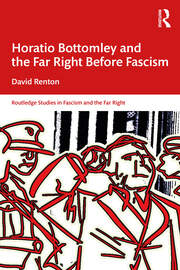
By David Renton
A hundred years ago, British politics was aflame – as it is today – with stories about the potential return to power of a conman and political rogue. In 1922, the stories concerned the right-wing MP, Horatio Bottomley. He had never been Prime Minister, nor even a member of the Cabinet. But in his twenty years in the public eye, he did more harm than most.
In 1906, Bottomley had founded a news magazine, John Bull. During the 1914-1918 war, John Bull had become the best-read magazine in Britain. “If, by chance,” Bottomley wrote, “you should discover one day in a restaurant that you are being served by a German waiter, you will throw the soup in his foul face, if you find yourself sitting at the side of a German clerk, you will split the inkpot over his vile head.”
Of the Germans, Bottomley wrote, “You cannot naturalise an unnatural beast – a human abortion – a hellish freak. But you can exterminate it.” Within days of that article, riots broke out against German civilians living in Britain. Bankers gathered in their top hats on the steps of the Stock Exchange to pass a motion, “No Germans must be left in the City of London”. Smithfield porters hung signs from their necks, “No business transacted with Germans”.
Rather than being isolated for such violence, Bottomley was rewarded. Lord Northcliffe, the owner of the Daily Mail, made Bottomley one of the best-paid columnists in Britain.
Like Johnson, Bottomley tried to leave it to the last moment before choosing sides in the great factional controversies of his day. All his enemies were on the left, not the right. On the issue of tariffs, the Brexit controversy of the 1900s, Bottomley avoided taking sides.
Elected to Parliament as a right wing Independent in 1918, he became one of the leading champions of an “Anti-Waste” campaign: an argument over the future of Conservative economic policy. The right had been in a coalition government since the war, led by a Liberal Prime Minister, David Lloyd George. Bottomley sided with those Conservative ultras who wanted austerity in public services to fund tax cuts for the rich.
Bottomley founded a People’s League to put pressure on the Conservatives. Its Vice Chairman was George Makgill, author of the novel The Red Tomorrow, a lurid antisemite, and one of the founders of MI5. With Bottomley’s support, five Anti-Waste MPs were elected.
Yet Bottomley struggled to convince in the part he had given himself as custodian of public finances: part of his public reputation came about from the great sums he had wasted in his private life: £150,000 on unsuccessful West End plays, £340,000 gambling on horses (and these were the actual sums he spent, before accounting for inflation).
Bottomley was the great survivor of Edwardian public life. Between 1893 and 1922, he was in court in 120 cases. They included bankruptcy proceedings, and civil claims in debt. Any one of them might have brought Bottomley low and yet, somehow, he had always escaped.
In 1922, however, Bottomley’s career suffered a setback from which even he struggled to recover. After the war had ended, Bottomley had stablished a Victory Bond Club, offering shares at £1 each, supposedly mirroring the value of the government’s War Bonds. He was accused of “fraudulent conversion” (in other words, using investors’ money for his own ends).
At the heart of his criminal trial, was the question of whether Bottomley had defrauded the patriotic former soldiers who bought shares in his Club. “The dear boys,” Bottomley insisted, “whether they are sleeping or still with us, know that I have not betrayed them.”
But the prosecution was able to show that of the millions invested in his Bonds, little had been spent on the supposed purpose of purchasing Government War Bonds; rather, most had gone to Bottomley. He had given his horse trainer £1,000, and sent £30,000 to a mistress in Paris.
Convicted in autumn 1922, the readers of John Bull, and the people who had followed his career were convinced he would recover – as he had always done before.
This time, however, there was no second Act. On his release from prison, Bottomley was in his mid-sixties and too old to recover. His former friends were now government ministers, or the millionaire backers of successful newspapers. They had no further use for him.
Bottomley’s career ended in failure, and he knew how the story was likely to be told: as a litany of vice, alcohol, and sexual excess. We are all familiar,” he began one piece, “with the newspaper interview with the robust octogenarian, or nonagenarian, who attributes his longevity to a course of living held up as an example to all. Early rising, daily walks, simple diet, abstention from alcohol and tobacco, and a list of virtues are paraded for our inspiration, however contradictory and inconsistent they may be.”
Undoubtedly, Bottomley did not age well. And yet the real question remains – not what, in the end, brought him low – but how did anyone fall for a conman who was so obviously crooked? Bottomley was a patriot, and he was neither the first nor the last of that kind to act on his supporters’ loyalty to their country by enriching himself as best as he could at their expense. It is an old routine, and we have not seen the last of his kind.

David Renton is the author of Horatio Bottomley and the Far Right Before Fascism, which will be published by Routledge in November.
 Labour Hub