
By Praveen Kolluguri and Mohan Sen
There is rightfully anger over the abuse of “due diligence” to stitch up Labour parliamentary selections by excluding left candidates. One prominent example is the barring of black community activist Maurice Mcleod in Camberwell & Peckham. In that case there is also a very serious issue about whom the party hierarchy has approved to join the local “longlist” of candidates.
Members of the CLP’s shortlisting committee have resigned in protest, citing along with the exclusion of Mcleod the inclusion of Neeraj Patil. Patil was previously a Labour councillor and in 2010-11 ceremonial mayor in the neighbouring South London borough of Lambeth. He is also, astoundingly, a member of India’s far-right Bharatiya Janata Party (BJP).
The facts are very publicly documented. In 2014, Patil announced he had joined the BJP at a BJP press conference, trumpeted on BJP social media In 2015 he formally met and was photographed with BJP prime minister Narendra Modi, inviting him to London. In 2017 he publicly campaigned for the BJP and told Indian media, “I admire prime minister Narendra Modi.” In 2018 there was speculation he would run as a BJP candidate in the Karnataka state elections.
Camberwell and Peckham is not the first Labour selection Patil has been allowed to stand in; indeed in the 2017 snap election he was appointed as the candidate in Putney (South London), leading to a boycott by local activists. He avoids mentioning his BJP affiliations in Labour circles, relying on a lack of engagement with Indian politics to maintain his bizarre dual-identity untroubled. Nonetheless, the idea that those in the party hierarchy who have licensed him to promote himself are unaware seems implausible.
The contrast between left wing candidates being barred on wafer-thin pretexts while a BJP member is approved underscores, no doubt, the problem of unprincipled factionalism – but also a bigger principled betrayal.
There is arguably a wider issue of Labour tolerating support by its members for conservative or reactionary organisations in other countries. This needs considering. In the case of the BJP, however, there should be no room for debate – whatever wing of Labour you are on.
If not quite a fascist party, the BJP is certainly an extreme-right one, with links to out-and-out fascists. It was created by the fascistic paramilitary organisation Rashtriya Swayamsevak Sangh (National Volunteer Organisation, RSS), inspired by Mussolini’s blackshirts, and maintains its links with the RSS. Narendra Modi was long a full-time organiser for the RSS, originally delegated by it to work for the BJP; as prime minister he remains an RSS member.
The major stepping stone in Modi’s rise to power was his time as chief minister of Gujarat (2001-14). In this role, he facilitated and helped block accountability and justice for massacres of thousands of Muslims by Hindu nationalist activists in 2002. In August this year, prime minister Modi orchestrated the release from prison of eleven men convicted after the Gujarat ‘riots’ of the gang rape of a pregnant Muslim woman, Bilkis Bano, and the murder of fourteen members of her family – including her three year old daughter.
Since Modi became prime minister in 2014, India has shifted rapidly away from a vastly unequal and often repressive liberal democracy into an ever more authoritarian ethno-nationalist regime.
Assaults on workers’ rights and social provision – in economic terms the BJP is radically neoliberal – have intertwined with deepened repression – legal, extra-legal and in some cases blatantly illegal – against activists and dissenting voices. And, crucially, there is increasingly violent persecution of minorities, indigenous peoples and oppressed castes. In particular, India’s 14% Muslim minority faces an ever more precarious situation. While the BJP in national, state and local government has changed numerous laws to undermine the rights and safety of Indian Muslims, more and more voices among its activist supporters call openly for a repeat of the Gujarat massacres on a nationwide scale.
This is the party Labour’s hierarchy appears to have no objection to being represented in the Parliamentary Labour Party!
Ironically, the poisonous influence of the Hindu nationalist right and far right has been wielded in the UK mainly to attack Labour and support the Tories. For the most part our Party’s response has been not fightback and persuasion but pandering. In the midst of the Tories’ collapse in the polls, they recently won a council by-election in Leicester on a huge swing. Simultaneously with a right wing Hindu nationalist campaign boosting the Tories, large numbers of Muslim voters switched to the Greens in protest at the fact that the Labour candidate was also a Modi-sympathiser!
Keir Starmer has sent repeated public signals that he wants to conciliate the Hindu right. A number of organisations promoting a pro-Indian government message are increasing their influence in the party. Barry Gardiner, widely seen as part of the left and respected in the unions for his campaigning against fire-and-rehire, has at times strongly supported Modi.
Neeraj Patil’s attempts to become a Labour MP are part of this wider problem. He should be removed from the selection, either by the leadership or by the local shortlisting committee, as a first step in establishing that the BJP’s violent bigotry is not welcome in our Party.
Like other right wing ethno-nationalist politics, Hindu nationalism is in extreme contradiction with the basic values of equality, diversity and workers’ rights that everyone in Labour, no matter their political location, should stand for. To highlight two significant issues, we cannot claim to support trade unionism, or to oppose Islamophobia, while allowing BJP supporters to organise in the party.
In extremely difficult circumstances, working people, oppressed groups and the left in India continue to wage heroic struggles to defend themselves against the neoliberal-Hindutva regime. The remarkable – and victorious – farmers’ uprising against Modi’s pro-corporate agricultural reforms last year showed that the regime is not invincible. But our sisters and brothers in India desperately need solidarity. The idea that we should tolerate supporters of their oppressors as ‘Labour’ representatives is appalling.
Praveen Kolluguri is BAME Officer of Kingston and Surbiton CLP and a member of the Communication Workers’ Union; Mohan Sen is a Unite the Union member based in Putney. Both write here in a personal capacity. They are supporters of the new India Labour Solidarity initiative to raise UK labour movement support for working people’s struggles in India.
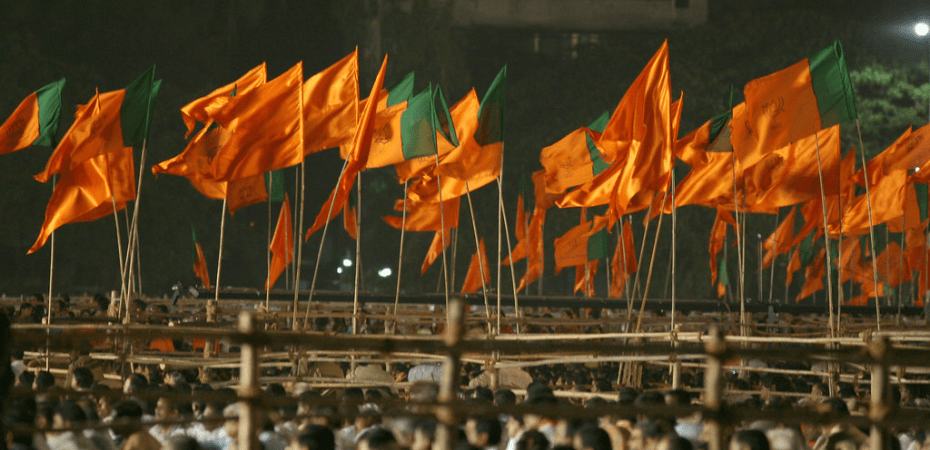
Image: BJP flags. Source: https://www.flickr.com/photos/aljazeeraenglish/3438534890. Licence: ShareAlike 2.0 Generic (CC BY-SA 2.0)


[…] potential for solidarity; the impact of a Labour government in UK-India relations; but also the concerning influence of Indian government-apologists, and even outright supporters of Modi and the Hindu right in our […]
[…] UK, including sadly an increasingly influential right-wing component – moreover one which is active in the Labour Party as well as the Conservative Party.India is, of course, now the world’s most populous country; […]