
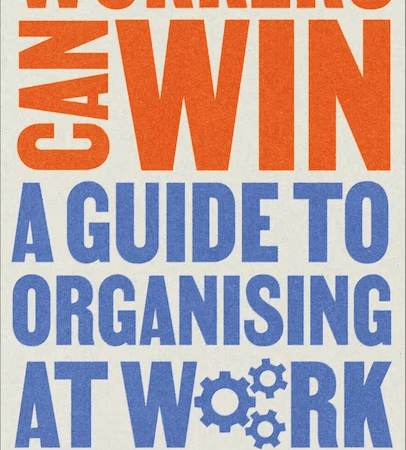
Organising at work has rarely been so urgent. Ian Allinson outlines the themes in his new book
The problems we face – from the soaring cost of living to climate breakdown – are combining with the inspiration from high-profile strikes and dashed hopes in Labour to drive more people to consider organising at work as a source of potential power. As Martin Luther King Junior put it ‘Power, properly understood, is the ability to achieve purpose. It is the strength required to bring about social, political or economic changes. In this sense power is not only desirable but necessary in order to implement the demands of love and justice.’ For the vast majority, the power we need can only be collective.
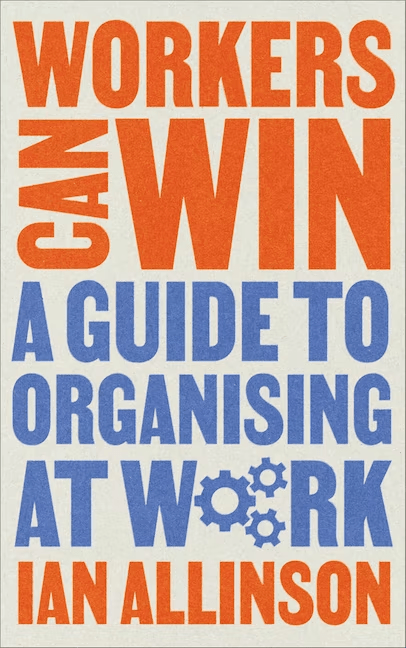
With remarkably good timing, Pluto Press has published my book, Workers Can Win! A Guide To Organising At Work. I wrote it out of frustration. In many years as a workplace activist, I found myself learning from people I met, from training courses, and from things I read, but thinking over and over again, “I wish someone had told me that five years ago.”
There were some useful books already, but they suffered two problems. Firstly, they tended either to talk about the nuts and bolts of organising techniques, or to present some grand strategy for revitalising the whole working class movement. To be effective in organising at work you need both some political ideas and the techniques, and they only really make sense together.
Secondly, activists in Britain relied heavily on books from the USA such as those from Jane McAlevey and Labor Notes. While excellent, the industrial, legal, political and cultural landscape in Britain is different from the USA, so it’s not always straightforward to apply their ideas here. Eventually I wrote the book I wished I could have read in order to save me learning so much the hard way.
Writing the book didn’t require much new research, because I’d been ‘researching’ organising for years to do it at my own workplace. I worked for many years in a largely un-unionised industry, where organising sometimes felt like running up the down escalator. I led several strikes, including Britain’s first national strike in the IT industry, and my ten years on the National Executive Committees of Amicus and then Unite taught me a lot about how unions operate beyond the workplace. Over the years I attended many training courses, conferences and meetings. A part-time masters degree in industrial relations also helped me clarify my ideas.
This book is aimed at workers who want to organise at work, but is also relevant for those trying to help workers organise. It’s accessible for someone with no background or experience at all, but goes deep enough that experienced activists and professional organisers tell me they are learning from it.
Organising isn’t about getting workers to fill in union membership forms. There are plenty of workplaces where people are in unions but nobody sticks together. Equally, there are examples, like the workers in Amazon warehouses who recently staged inspirational sit-ins, where workers take powerful collective action without being in a union. However, union organisation is vital if we aim to sustain the capacity for collective action over time and across significant groups of workers.
The book begins with an introduction and a chapter on why organising at work has such potential. Work generates conflict between workers and management, gives workers considerable potential collective power, and generates organisation with a bias towards democracy. I’m not arguing that it’s not worth organising elsewhere. The working class is strongest when our struggles in workplaces and communities come together.
The core of the book follows the journey of an imaginary activist from starting to organise at work through to taking industrial and direct action to achieve some significant wins. The first steps are important – listening to your workmates, finding out what they care about, finding allies without getting yourself fired, and building up resources, skills and support. There are different opinions about what unions are for and how they should operate. I argue against partnership with employers, for a focus on workers’ own collective action rather than over-reliance on casework or the law, and for taking up a broad range of issues in your campaigning. The book covers choosing and communicating about issues, key techniques for organising, using your rights and how to navigate their limitations, how to assess the power balance in your campaign to help you plan action, and a detailed discussion of industrial and direct action.
The last three chapters of the book deal with some problems you might encounter at any point. Chapter 10 covers management’s efforts to intensify work, keep control and sabotage your organising efforts. Many workers, when first trying to organise, have a vision of unions drawn from the BBC or the Daily Mail, and it can be demoralising to discover that support is patchy and the apparatus may not encourage militant action. Chapter 11 offers advice on dealing with your union and using a rank-and-file approach to navigate the tensions that often arise between officers employed by the union and the members. The final chapter covers identifying and dealing with campaign pitfalls, handling difficulties caused by the people in your own campaign, and the question of activist burnout. It concludes with a discussion of how the limitations of unions mean we also need socialist political organisation.
The current revival of strikes has contributed to growing interest in unionising. High inflation has increased the risks if you don’t fight back, while low unemployment has reduced the risks if you do. The government looks anything but invincible. This situation won’t continue for ever. Central banks are raising interest rates to deepen the coming recession. They will increase unemployment in the hope of curbing inflation by forcing workers to accept falling living standards. We have a race against time to establish habits of solidarity and winning, so that workers respond to job losses or new anti-union legislation with defiance rather than despair. The clock of climate catastrophe is ticking too. Organising at work has rarely been so urgent.
Workers Can Win: A Guide to Organising at Work, by Ian Allinson is available from Pluto.
 Labour Hub