

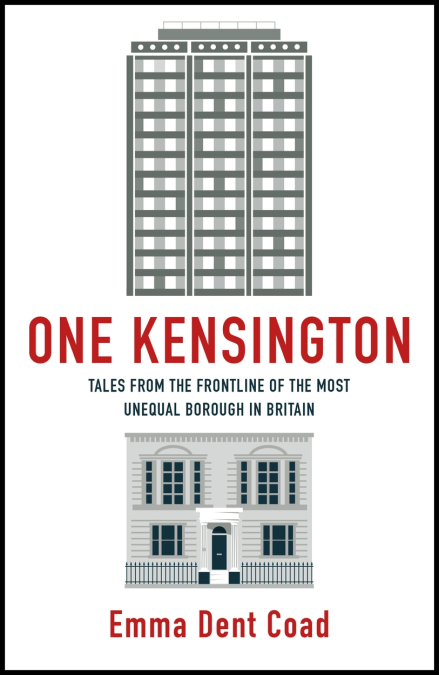
Mike Phipps reviews One Kensington by Emma Dent Coad, published by Quercus
The Royal Borough of Kensington and Chelsea (RBKC) was the site of the notorious Grenfell Tower fire. This book is dedicated to the bereaved and survivors of that atrocity.
The borough is the most unequal in Britain. Emma Dent Coad’s book aims to reveal “the actions and motivations of the Council responsible for the ongoing existence of inequity, which some believe has been deliberately fostered to drive low-income families out of the borough.”
Not only had the Council ignored warnings that the Grenfell fire could happen, it had sent ‘cease and desist’ letters to those warning them. It is now facing corporate manslaughter charges.
A senior Tory Councillor once publicly called RBKC “the richest Council in the universe”. But part of this wealth came from selling off Council properties, outsourcing services and under-investing in managing and maintaining Council homes. Penny-pinching at one end, the Council was profligate at the other – not even bothering to invest much of its huge one third of a billion pounds reserves, which sat in low-interest accounts. “One resident calculated that this cost the Council a potential £10 million a year in lost investment income.”
Add to this the money wasted on vanity projects and poorly monitored outsourcing. The author has a fine eye for detail: Holland Park Academy, “the most expensive new school in the Western hemisphere” had a swimming pool that leaked and flooded the basement lunch hall, and glass and stone panels that randomly fell off the building’s façade.
At the other end of the scale, the author highlights real poverty in the borough – women who were starving themselves to feed their children – and that was in 2012: a decade later, things are far worse. A family who needed to move due to overcrowding were told they would be considered only when they had paid off rent arrears accrued during a period of illness. Even then they had to wait ten years.
In one ward, 63% of families are overcrowded. Although the average income in RBKC is the highest in the country, a third of its workers earn under £20,000. In some parts of the borough, child poverty is as high as 57%. Life expectancy is falling; rickets is returning. But as one Tory Councillor told the author: “You can spoil a child with too much education and health.”
RBKC has 9,000 households on its waiting list. “Labour Councillors have always been told that there is nowhere in the borough to build social housing,” notes the author. But land the Council has claimed not to own was later developed for private housing. With the average house price in the Borough at £1,404,250, home ownership for most residents is a pipedream.
In the years 2018-9 and 2019-20, the Council built no affordable housing at all. Many homeless households asking for help are subjected to ‘gatekeeping’ – discouraged from applying for help at their first contact with the Council, by not being informed of their rights or their eligibility.
The attitude of Tory Councillors towards their poorer residents is vile. Dent Coad was told the ward she represented was a “dung heap”. In 2010, a paper from the Council Housing Committee concluded: “The potential for central London and the Royal Borough to effectively become a residential no-go area for anybody on a low income looking to rent is real . . . [including] long-standing families who may have lived in the borough all their lives.” The drive to move people out of the borough the author attributes to “a mix of cupidity and gerrymandering.”
The book is also a history of the author’s own activism, from National Union of School Students activist to journalist, architectural historian, Labour Councillor from 2006 and MP from 2017 to 2019. A few days after being elected to Parliament, on Tuesday 13th June, she went to bed, exhausted. “Helicopters woke me.”
It was the night of the Grenfell fire. Dent Coad was on the scene within minutes and is still reluctant to talk about the full horror of what she witnessed.
“One of the scenes I do remember is seeing the Leader and Deputy Leader of the Council being interviewed for TV in front of the blazing tower, with people burning to death behind them, saying, ‘We offered them sprinklers and they turned them down.’ A. Blatant. Lie. The first of many, no doubt… When they were asked afterwards, including at the Inquiry, why they didn’t check that the emergency plan was being followed and that officers were being mobilised, they said they had been ‘too busy talking to the press’. I have no words.”
In the first few days after the fire, chaos prevailed. People were refused access to rescue centres because they had no ID – they had lost everything – and had to sleep in the park. Only when London Gold Command, the emergency services team responsible for major disasters, had taken over were offers of help from other councils across London, which had been refused for days, at last accepted and a coordinated response got underway.
Emma Dent Coad had joined the Board of Kensington and Chelsea Tenant Management Organisation in 2008. Tenants complained endlessly about the poor service provided by the TMO, and they twice called extraordinary general meetings to discuss the failures of the organisation. In 2009 an independent adjudicator produced an “explosive” report, cataloguing the TMO’s failures.
One of the estates that had suffered endless problems included Grenfell Tower which the Council eventually agreed to refurbish. Alongside new windows, new boilers and new lifts – the old boiler frequently broke down leaving residents without heating or hot water for days on end – flammable cladding was installed.
After the fire, one Tory Councillor said: “These things happen.” But what happened at Grenfell had been predicted and was entirely avoidable. A Council with £0.3 billion in usable reserves chose to cut £276,000 from the cladding costs of a refurbishment project and use cheaper materials in an economy drive.
A month after the fire, the government appointed an independent taskforce to help the Council deliver to the Grenfell survivors. It concluded that, “RBKC failed its community on the night of 14 June and in the weeks following.” Nearly two years later, the Task Force was still unimpressed: “RBKC is not yet achieving the level of performance in its recovery effort that we have consistently suggested they aim for.”
In stark contrast to the taskforce’s praise for the level of community organisation and activism on behalf of Grenfell victims, the Council seems immune to change. But it excels at defending its venality and incompetence, with a very well-funded Corporate Media and Communications team. “After Grenfell, the Council has been on the defensive,” reports the author, “spending millions on face-saving PR in addition to huge legal bills for representation – all at the expense of Council taxpayers.”
Emma Dent Coad’s scrutiny of the Council is forensic throughout. She is supported by very diverse sections of the community, who are united by a common message: don’t destroy our community for profit.
It’s clear that the author has a long-standing and deep commitment to the poorer part of the borough which she demonstrated as an MP. It seems all the more shocking therefore that Labour officials excluded her from the longlist of the Party’s candidate selection process in October 2022.
Dent Coad said she was “devastated that the Labour Party has blocked me from standing to once again represent my community in Parliament, the community I have spent the last 20 years of my life fighting for.” She added: “I am angry that local members and our local community in Kensington have been denied the opportunity to vote in a free and fair contest, which has been sacrificed for the sake of factional intrigue from Labour officials.”
John McDonnell MP said the decision was “outrageous and risks further alienating the Labour Party from the communities we strive to represent.” He called it “one of the most disgraceful acts I have witnessed in the 50 years I have been a member of the Labour Party.”
The Party’s sidelining of Emma Dent Coad reeks of factionalism: she was a member of the Socialist Campaign Group of MPs during her brief parliamentary tenure. But, beyond that, there are real dangers involved in the exclusion of the kind of ability and expert knowledge that she brings and the elevation of on-message loyalists ready to do the leader’s bidding – dangers not just for the Labour Party but the quality of parliamentary representation and governance as a whole.
Mike Phipps’ new book Don’t Stop Thinking About Tomorrow: The Labour Party after Jeremy Corbyn (OR Books, 2022) can be ordered here.
 Labour Hub