
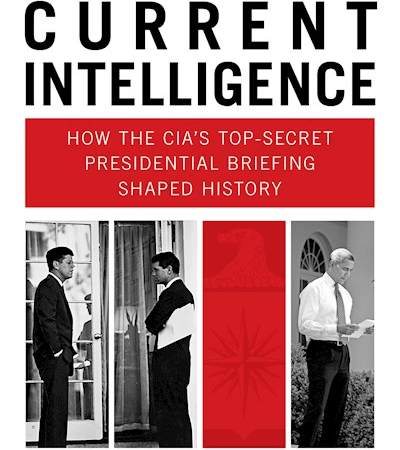
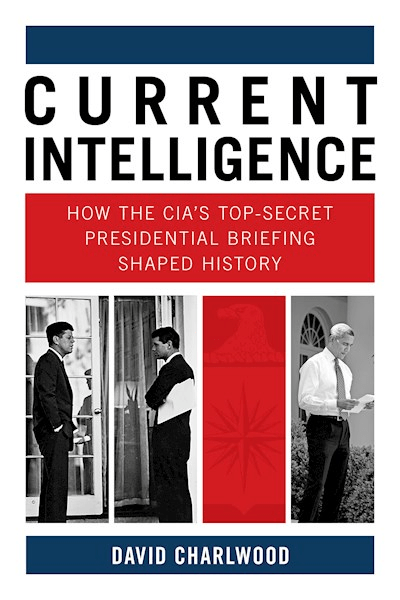
Mike Phipps reviews Current Intelligence: How the CIA’s Top Secret Presidential Briefing Shaped History, by David Charlwood, published by The History Press
How important were the CIA’s daily briefings to the formation of presidential foreign policy? This book trawls through three quarters of a century of declassified files to attempt to answer that question.
From the suppression of the Greek Communists at the start of the Cold War to the Trump era, the author offers a highly readable narrative with a lot of personal detail. It’s an engaging read – but how important was the Brief?
There were times when it got things spectacularly wrong. A month before the Soviet Union detonated its first atom bomb in 1949, the CIA estimated that the USSR was still several years away from such a development. So surprised was President Truman that at first he refused to believe it.
But his Administration soon adjusted: a major military build-up was undertaken along with a programme of economic and political preparation. A National Security Council report concluded: “The whole success of the proposed program hangs ultimately on the recognition by this Government, and the American people … that the Cold War is in fact a real war in which the survival of the free world is at stake.”
North Korea’s invasion of South Korea gave the President the pretext to embark on a massive arms race. The tale is told in a pacey linear narrative, but this sacrifices context and makes for a superficial approach. Many historians for example believe that the US’s failure to include South Korea in its ‘defence perimeter’ from Japan to the Philippines contributed to a belief among North Korea’s military backers that the invasion would not lead to a wider conflict: such analysis doesn’t feature here.
The unanalytical story-telling approach is wearing at times: “Eisenhower looked like a soldier, with a straight jaw and clear eyes…” It becomes all the more irritating as international actors are reduced to puppets in the hands of the US’s enemies and treated in an instrumentalist and blasé fashion: “Eisenhower’s first official Daily Brief concerned a foreign leader whom the CIA were about to overthrow” – this ‘describes’ the coup against Iran’s newly elected prime minister Mohammed Mosaddeq.
Yet, ultimately this casually simplistic style seems to emanate from the CIA’s briefings themselves. The apparent ease of deposing Iran’s government gave the Agency an appetite for similar operations elsewhere, including countries where they would be hugely unpopular, such as Guatemala.
“In March 1953, the Guatemalan government appropriated 209,842 unused acres from the United Fruit Company, the largest landowner in Guatemala. Landowners whose uncultivated land was redistributed were paid in government bonds to the same amount that they themselves had valued their land for tax purposes. Unsurprisingly, the United Fruit Company had been deliberately undervaluing its holdings… The company began an eye-wateringly expensive but incredibly successful public relations campaign within the USA, lobbying in the press and in all corners of Washington to try and get the US government to intervene.”
Intervene it did. A CIA-organised coup deposed the democratically elected Guatemalan President Jacobo Árbenz in 1954 and installed a military dictatorship. Eisenhower was delighted, telling his intelligence officers, “You have averted a Soviet beachhead in our hemisphere.”
In fact, a subsequent detailed search by CIA agents failed to find convincing evidence that the Árbenz government had been instruments of the Soviet Union, or even that it had any connection to Moscow whatsoever – but you won’t find that information here.
Eisenhower’s only complaint was that Árbenz himself had not been individually targeted. That ‘error’ would not be repeated in the Congo, where a CIA-orchestrated coup overthrew the elected government of Patrice Lumumba.
As Susan Williams’ excellent and detailed book, White Malice: The CIA and the Neocolonisation of Africa (Hurst, 2021) reviewed here on Labour Hub, explains, the CIA threw large sums of money at Lumumba’s opponents and organised a noisy protest against him when he addressed a conference of independent African states in August 1960. The disruption was filmed and the newsreel was showed around the world, giving an entirely false impression of how Lumumba was regarded in his homeland.
Eisenhower had told his staff that Lumumba “should be eliminated,” although in the event Lumumba’s own domestic enemies got to him and brutally murdered him before the CIA assassin, armed with a selection of poisons, could arrive. President Kennedy is portrayed by the authors here as being more sympathetic to Lumumba’s plight, but the new Administration took, if anything, a more belligerent line than its predecessor in supporting the coup, many of its advisors having business interests in the country.
Contrary to popular myth, Kennedy was also deploying military units in Vietnam prior to his assassination. The massive escalation of US involvement under his successor, President Johnson, is covered here, but there is little new to report, because the CIA had begun creating a separate, daily Vietnam report for the President, which has yet to be declassified.
What is clear is that the Viet Cong’s ‘Tet offensive’ in January 1968, when 36 of South Vietnam’s 44 provincial capitals and five of the six largest cities were simultaneous attacked, with fighters even getting inside the US Embassy compound in Saigon, took US intelligence completely by surprise. In the run-up, the Daily Brief barely mentions the preparations involved. Years later, the CIA was again caught out when Saigon fell to the Viet Cong in April 1975, eight months earlier than they had predicted.
President Nixon, who succeeded Johnson, apparently distrusted the CIA, who, he felt, had preferred his opponent in his earlier 1960 presidential bid. He told his National Security Advisor, Henry Kissinger, that it was “imperative to exclude the CIA from the formulation of policy; it was staffed by Ivy League liberals.”
Daily Briefs prepared for President-elect Nixon, during the two months before his inauguration, were returned to the CIA unopened. Thereafter, all security briefs went through Kissinger. Nixon’s hostility to the CIA increased after its head refused to pay hush money to the Watergate burglars from CIA clandestine funds, as requested by Nixon’s Chief of Staff Harry Haldeman.
The Daily Briefs read by subsequent Presidents remain largely unavailable. In any case, they may not throw much light on some of the events from the late 1970s on: after the unexpected – to the CIA – overthrow of the Shah of Iran in 1979, President Carter’s Defense Secretary Harold Brown admitted bluntly: “‘Our intelligence apparatus did not function in Iran.”
In any case, “For the CIA, the end of the Cold War was the end of the gravy train.” Staff were cut and overseas stations shut. President Clinton apparently read his Daily Brief carefully, his successor George W. Bush less so. Warnings of “significant terrorist attacks against the United States in the coming weeks or months” in 2001 went unheeded.
The author has a lot of declassified – and redacted – material to pick through, yet to this lay reader it does not seem that many new insights come to light. Much of what’s here comes from a range of other sources. The CIA’s Brief was just one part of the framework that shaped the President’s approach to foreign affairs and it was rarely decisive, for all its changing shape and the varying levels of enthusiasm that the different Presidents had for it.
There is one further area where the CIA’s Daily Brief not only got things spectacularly wrong, but also helped shaped Presidential policy. When the US-led coalition invaded Iraq in 2003, the world was told it was because Saddam Hussein’s regime possessed weapons of mass destruction. Two years later, the President-appointed Commission set up to investigate this intelligence issued a brutal indictment of President’s Bush’s Daily Briefs.
“The daily intelligence briefings were flawed,” they noted. “Through attention-grabbing headlines and repetition of questionable data, these briefings overstated the case that Iraq was rebuilding its WMD programs.” The CIA, suggests Charlwood, had been guilty of confirmation bias: everything that might support the line that Iraq possessed and was willing to use WMDs was seized upon, while contradictory information was ignored.
The Commission’s damning findings should have been enough to finish off the CIA’s Daily Brief, but bureaucratic inertia and institutional conservatism meant that little changed. All the conditions for the President to take the US to war on a false prospectus still remain in place.
Mike Phipps’ new book Don’t Stop Thinking About Tomorrow: The Labour Party after Jeremy Corbyn (OR Books, 2022) can be ordered here.
 Labour Hub