
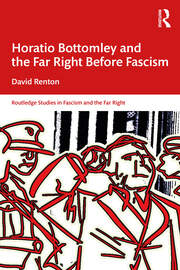
Mike Phipps reviews Horatio Bottomley and the Far Right Before Fascism, by David Renton, published by Routledge.
From humble beginnings in an orphanage, Horatio Bottomley (1860-1933) passed through political radicalism to the far right on a journey to wealth and power. He was the first Chairman of the Financial Times, a major financial speculator and an MP intermittently from 1906. He published a magazine, John Bull, vitriolic in its national chauvinism and racial hatred, which at its height sold 2 million copies, before his fraudulent dealings caught up with him and he was imprisoned for seven years for theft.
Bottomley has already been the subject of eight earlier biographies. Why do we need another?
David Renton has written extensively about fascism and the far right and it’s through this lens that we can consider Bottomley today. Some contemporary assessments were already pretty accurate: “He megaphoned the passions, prejudices and hates of the mob,” was one verdict.
But as Bottomley’s influence grew, his opponents muted their criticism. Between 1915 and 1918 he delivered 340 public lectures on the War – including one at the Albert Hall – many of them proving very personally lucrative.
He called for a military government to run Britain and for striking workers to be arrested under martial law. He fulminated against Labour leaders, demanding Ramsay MacDonald be tried for treason, “taken to the Tower and shot at dawn.”
He and his magazine denounced not just the German state, but all Germans, as evil, and incited violence against those living in Britain, incitements that were often acted upon. John Bull proposed that Germans should be made to wear badges and should be deported; readers were exhorted to wage a “blood feud” against them. Bottomley proposed racial extermination by poison gas.
On the same day this article appeared in what was then the best-selling weekly news magazine in Britain, riots broke out: Germans were attacked in Poplar, in Deptford, in Keighley and in Crewe. British nationals with German-sounding surnames found themselves having to advertise their Englishness in the press. Smithfield porters hung signs from their necks: “No business transacted with Germans.”
Prefiguring other extreme right themes that would be taken up elsewhere in Europe, Bottomley claimed that Britain had been betrayed by internal enemies, but the War was a great opportunity for national rebirth.
The response of polite society? Bottomley was offered articles in other publications by those in the media fearful of being denounced for insufficient patriotism. Lord Northcliffe made him one of the best-paid columnists in Britain and his papers spread the story that Bottomley was on the verge of a Cabinet appointment, covering London with placards reading “Bottomley wanted”. Indeed, Bottomley was invited to Downing Street for talks.
After the War, Bottomley launched a new movement, the People’s League. Its Vice Chairman, as Renton explained on this site recently, was George Makgill, a lurid anti-Semite, and one of the founders of MI5. Several MPs took an interest, including Oswald Mosley.
Ultimately, Bottomley’s financial dishonesty led to him being convicted of 23 fraud-related offences. The Establishment had no further use for him. Comparing Bottomley to Hitler and Mussolini, Renton notes:
“He had supported the Great War and made speeches defending it; they sought with all their power to remake society in the image of the trenches. He called for the shooting of strikers and Labour politicians; they not only called for the murder of political and racial enemies, they also organised the gangs to carry out the murders, equipping them and sending them into battle. They did not stop at launching new parties of the right; they took them from the margins into government.”
Bottomley’s ranting fell on fertile ground during World War I, as the sales of John Bull underlined. Anti-German hysteria flourished at this time, even persuading King George V to change his name from Saxe-Coburg and Gotha to Windsor. Streets were renamed, as was the German Shepherd breed of dog. As mentioned earlier, there were assaults on suspected Germans and the looting of stores owned by people with German-sounding names: some of this was also anti-Semitic in nature.
Similar nativist passions were on the march in Canada and Australia. In the US, 4,000 German aliens were imprisoned in 1917-8 and the Red Cross barred individuals with German last names from its ranks. Many schools stopped teaching the German language and in some cities German books were removed from libraries or even burned.
Standard wartime behaviour? Interesting data from World War II paints a more nuanced picture. The British Institute of Public Opinion (BIPO) tracked the evolution of anti-German feeling via a series of opinion polls conducted from 1939 to 1943, asking whether “the chief enemy of Britain was the German people or the Nazi government”. In 1939, only 6% of respondents held the German people responsible.
This figure increased dramatically during the Blitz and after the government launched an “Anger Campaign” to instil “personal anger… against the German people and Germany”, because the British were “harbouring little sense of real personal animus against the average German”. To strengthen British resolve against the Germans, a leading Foreign Office official gave a series of radio broadcasts denouncing Germany as a nation raised on “envy, self-pity and cruelty” and that Nazism that had “finally given expression to the blackness of the German soul”.
But by 1944, the effect of this propaganda may have been waning. The writer J.R.R. Tolkien wrote in a letter to his son Christopher that “it is distressing to see the press grovelling in the gutter as low as Goebbels in his prime… There was a solemn article in the local paper seriously advocating systematic exterminating of the entire German nation as the only proper course after military victory: because, if you please, they are rattlesnakes.”
In the same year the social research project Mass Observation found that 54% of the British population was “pro-German”, in that it expressed sympathy for the German people and stated that the war was “not their fault”. This ‘tolerance’ of the German people as opposed to the Nazi regime increased as the war progressed.
Any shift of this kind should not be overstated. The British government initially rounded up 74,000 German, Austrian and Italian aliens during World War II, irrespective of their politics. Most were released: 2,000 were interned. Any cursory survey of these years will find popular jingoism widespread.
So was Bottomley’s rise 25 years earlier one of a kind? Was the rampant chauvinism in which he gloried specific to World War I, when Britain saw itself as an undefeatable Empire, itself founded on notions of racial superiority and entitlement? While the Establishment’s willingness to make use of Bottomley may have been specific to the political difficulties of the time, it cannot be doubted that the patriotism which he channelled and magnified – including its racial element – had deep roots across society.
Even the revered rebuilders of post-war Britain a generation later, the great Labour government of 1945 to 1951, were infected by a profoundly colonial mindset. Some of its members were fanatically anti-German long after the war had ended and even Prime Minister Clement Attlee himself was prone to anti-Semitism, if the diary of his Cabinet colleague High Dalton is to be believed. Explaining why Labour MPs Austen Albu and Ian Mikardo had not been promoted into government in a 1951 reshuffle, he quotes Attlee as saying that, “both belonged to the Chosen People & he didn’t think he wanted any more of them!”
All this is beyond the scope of David Renton’s book. But in showing how the rapid spread of proto-fascist ideas need not necessarily emulate the development of street movements elsewhere, but can spring from within the media and the political Establishment itself, he has done our movement a useful and perhaps timely service.
Mike Phipps’ new book Don’t Stop Thinking About Tomorrow: The Labour Party after Jeremy Corbyn (OR Books, 2022) can be ordered here.
 Labour Hub