
By Pete Firmin
CWU members at Royal Mail have now taken strike action on 11 days since August over pay and conditions. The union won massive majorities for strike action and turnout by organising gate meetings at every workplace around the country. Members have also been kept informed throughout the dispute at gate meetings and online briefings attended by thousands. Most postal workers are fully aware of what is at stake, which is far more than pay. This has ensured that, by and large, the action has been solid, with only a few postal workers working during the dispute in a few areas.
Every time ‘negotiations’ take place between Royal Mail and the CWU, the employer seems to come back with harsher demands. Among the latest is that the union should no longer be represented in the workplace, only at national level. For all intents and purposes, this amounts to derecognition. On the day-to-day level it is the union in the workplace which means something to workers, whether it be on health and safety, conflicts and disciplinary issues with managers or allocation of duties. Take that away and the union is some distant office negotiating pay and not much else.
Royal Mail’s demands have been rightly described by the union as a ‘surrender document’, giving up terms and conditions which have been fought for over decades. Among them are the demands to make Sunday working compulsory and moving delivery times back as late as 5pm. Perhaps most indicative of where the company wants to take things is the demand to make workers ‘owner drivers’, the model used by Amazon and other courier companies.
At the same time, Royal Mail is asking the government to scrap the obligation to deliver letters six days a week, a move which would not only worsen the service, but lead to thousands of redundancies. That would be on top of the 10,000 redundancies the company is already proposing.
While demanding those redundancies, Royal Mail took on 20,000 agency workers before the strikes on worse pay, again a clear indication of where they want to take things. And they have taken advantage of the government’s change in the law to bring in agency workers during the strike.
Their determination to push these proposals through is shown not only by the fact that the 1% ‘pay rise’ has been imposed, and workers are already being interviewed about redundancy, but at least 60 workers, including many reps, have been disciplined – usually suspended – for ‘picket line offences’.
If this sounds like a management preparing the company for sale, this is a distinct possibility, with an asset-stripping hedge fund hovering in the background.
In all this, the employer has the assistance of local managers, often members of the Communication Managers’ Association (CMA), most of whom, rather than sticking to their contractual duties, have always liked to undermine strikes by postal workers by attempting to sort and deliver post. During this dispute they are receiving an extra bonus for doing so, and have been promised even greater riches if they help to push through the proposed changes in workers’ terms and conditions.
Not long ago the CMA (part of Unite the Union) was balloting its members over action to protect their jobs under the slogan ‘Save Our Services’, yet CMA members seem keen to destroy the service and postal workers’ jobs for 30 pieces of silver. The CWU recently went public over the issue of one union’s members supporting the employer’s attack on another’s, which resulted in Unite putting out a statement saying it had not agreed to accept the latest `offer’ from management to help attack the CWU. Significantly, this statement was signed by Unite officers but not the CMA. A further statement, signed by a CMA officer is rather mealy-mouthed, and there is no indication that Unite will take action against members lining up with management.
With all this going on, the CWU leadership seems to have a rather naïve belief in the power of negotiation. Some strike days were called off, in an agreement with management to `de-escalate’ things during talks. But all that happened was that management upped their demands. The union leadership talks of a willingness to `modernise’, but it is absolutely clear – as it is with the rail disputes – that `modernisation’ means being part of the race to the bottom in discarding any decent conditions. Nor does the call to reinstate the previous `modernisation’ proposals which management has unilaterally dumped inspire confidence, when that agreement was already leading to a worsening of conditions. Talks are taking place at ACAS, but ACAS’s general approach is to look for a compromise. It is difficult to see what kind of compromise is possible. Management’s latest suggestion is that talks at ACAS should be centred on its ‘final’ offer, i.e. the surrender document.
The response to the victimisations by the national union was to say negotiations are happening with management (I wouldn’t put a lot of faith in that….) and they will be addressed when the dispute is over. Now the union is asking that there be an independent investigation of the victimisations. But if `independent’ means what it usually does – an investigation by someone acceptable to both sides – then either management won’t agree, or they will insure the independent investigation is conducted by someone they can support. The idea that when the dispute is over individual workplaces will be willing to come out again, separate from national support, is a recipe for demobilisation, if not demoralisation. Full reinstatement needs to be a demand of the dispute now, not at some vague time in the future.
Just as during the pandemic there were unofficial walkouts over lack of safety measures, in the past such victimisations would often have led to unofficial walk outs, as would management unilaterally imposing changes in working practice. During this dispute a tight rein is being kept on action by the national leadership, rather than initiatives being taken from below.
Given the scale of what is being demanded by management, postal workers need to be questioning the CWU leadership’s approach. Rather than one or two day strikes, would it not make more sense to take indefinite action, especially in the run up to Christmas? Christmas is the time when postal strikes have the greatest effect: once that is past, it is a very quiet period.
The union has highlighted the role of the CEO, Simon Thompson, in driving the dispute and has called for his dismissal. It is also time to make renationalisation of Royal Mail a demand of the action.
This feels very much like a ‘do or die’ dispute with so much at stake. Postal workers need all the support we can organise, not just – but importantly – turning up in large numbers on their picket lines but organising benefits and collections for strike funds. And coordinated action by different unions will also put pressure on employers and government to settle.
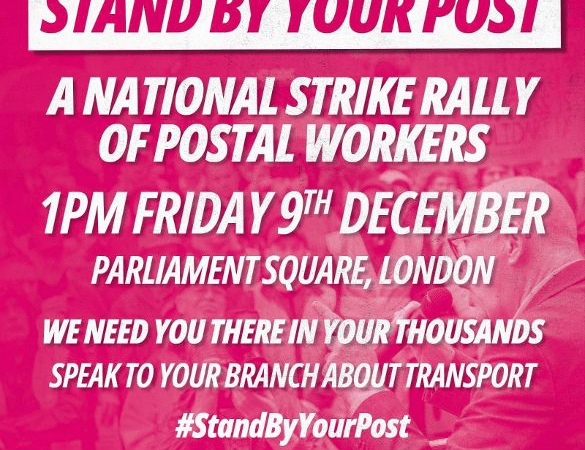
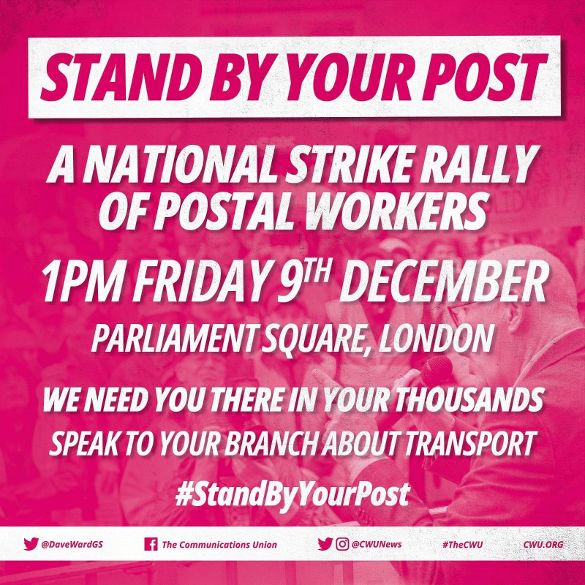
This Friday, 9th December, a strike day, the CWU is organising a national rally for postal workers in London. Supporters should do everything they can to assist with organising transport from around the country and attend the rally if they can. London postal workers – and supporters – will be marching from Mount Pleasant to the rally at Parliament Square.
Too much is at stake to let postal workers fight alone.
Pete Firmin is a retired postal worker and Vice-Chair of Brent Trades Council.
 Labour Hub