
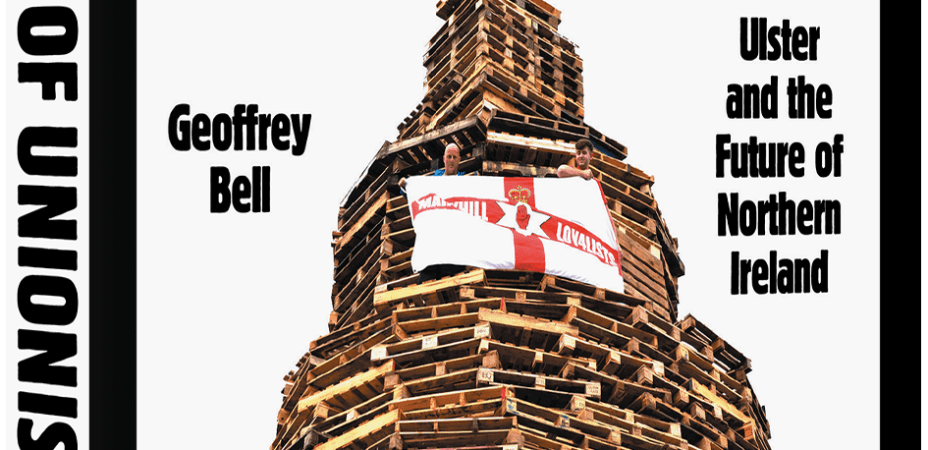
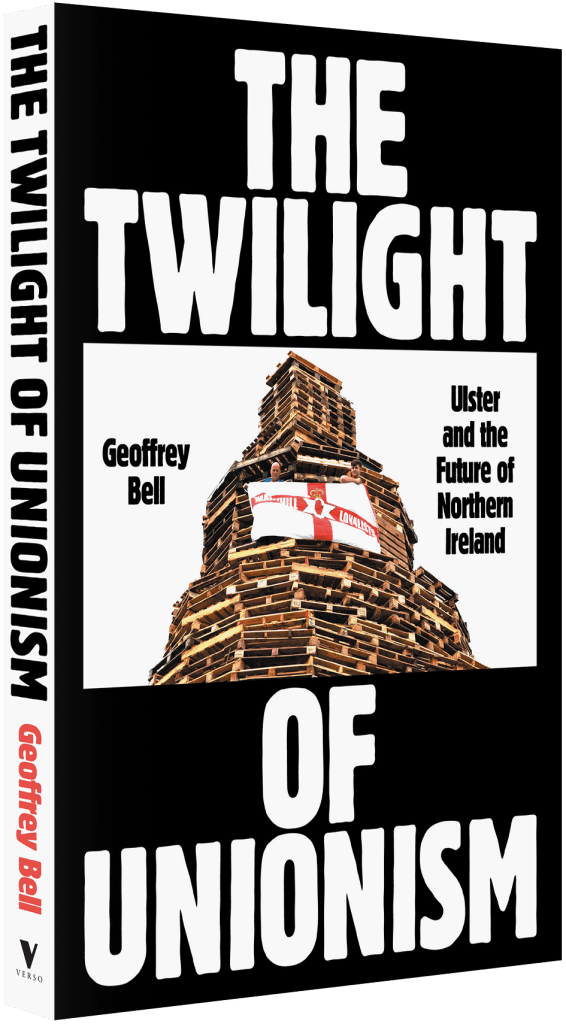
Mike Phipps reviews The Twilight of Unionism: Ulster and the Future of Northern Ireland, by Geoffrey Bell, published by Verso.
Are the British Establishment and the Tory Party in particular ready to ditch its long association with Northern Irish unionism?
Michael Gove, Priti Patel and Jacob Rees-Mogg all went to Northern Ireland to help raise funds for the Democratic Unionist Party in 2018-9, when Theresa May’s minority government needed unionist votes to survive in Parliament. Conjuring up memories of the Irish famine, Patel even suggested that the UK should threaten the Irish Republic with food shortages if it did not agree to demands to drop the Brexit ‘backstop’.
How times changed, when Boris Johnson’s government, with a comfortable majority, needed to distance itself from unionism in order to “get Brexit done”. This now meant Northern Ireland continuing to be governed by EU laws and subject to the jurisdiction of EU courts on some issues, with a de facto border with Britain in the Irish Sea.
Challenging this betrayal in the House of Commons, Ian Paisley Jr of the DUP complained that Gove “boasts of his Unionist credentials. Indeed he even boasted once in my local paper that he could sing ‘The Sash’,” a reference to the most loved song of Orangeism. Gove replied: “The hon. gentleman is right. I do have a formidable singing repertoire. I can also sing ‘The Fields of Athenry’.” This reference to a song glorifying Irish rebellion would have felt like a kick in the teeth to Paisley.
It was another indication of how little Northern Ireland now matters to much of Britain’s political class. The fact that the Leave campaign in the 2016 Brexit referendum pretty much ignored what would later prove to be the thorny status of Northern Ireland underlines that. Yet ironically, when John Major and Tony Blair had flown to Northern Ireland to argue for Remain, it was DUP leader Arlene Foster who had denounced it as “disgraceful for two prime ministers who know full well the importance of the peace process to come over here and suggest that a vote in a certain direction is going to undermine that.” But it arguably did.
Support for the unionist position in the UK is evaporating. That Theresa May’s government should be held to quite a pricey ransom by a party with such socially extreme views as the DUP led to the Daily Mirror denouncing the post-2017 election deal as a “coalition of crackpots”. Polly Toynbee in the Guardian said the DUP was “a party of Christian fundamentalists whose laws force childbirth on raped underage children.”
By Easter 2021, with riots in parts of Protestant Belfast against the notion of an Irish Sea border, the far less progressive Economist went further. It suggested that during the previous five years, the DUP had done more for the cause of the Irish unity than Sinn Féin’s Gerry Adams. It added that its actions had seen a return to street violence, that, “drunk with power”, it had ditched May to support Johnson’s hard Brexit and had thus brought the consequence of an Irish Sea border upon itself.
The growing divergence between Northern Ireland and Britain reflects public opinion in the latter. By 2021, only 10% of British people surveyed felt “very connected” with the people of Northern Ireland, while 34% said “not connected at all.” On Irish unification, only 11% opposed it and 30% were in favour; the rest were undecided.
How did this happen?
The short answer is that all the traditional ties binding British unionism together have been eroding for some time. The military and industrial connections have weakened; the fear of a radical, free united Ireland has dissipated; likewise the belief in a shared Protestant faith. The ideological convergence between Conservatism and Northern Irish unionism has weakened. In the aftermath of the Troubles, there has been an increasing realisation that Britain’s role in Northern Ireland had been more classically colonialist than many had wanted to acknowledge. Geoffrey Bell’s book charts this process over time.
Add to this the response of unionism in crisis: denialism about atrocities such as Bloody Sunday, and continued sectarianism: in October 2020, Edwin Poots, a former DUP leader and minister in the Northern Irish executive claimed Covid-19 cases in Irish nationalist areas outnumbered those in unionist areas by six to one.
Such outbursts from DUP figures are not unusual, as Bell depressingly documents. Is this a party returning to its roots or one that has lost its way? Either way, it increasingly looks a liability to its Conservative allies in Britain.
But the problem runs deeper. Only about half of the Protestant population of Northern Ireland supported the 1998 Good Friday Agreement and many who did later had regrets. Furthermore, the continued desire to uphold and celebrate unionist privilege spills over into other expressions of a supremacist mentality. In 2013-4 there were three times the number of race hate crimes reported in Northern Ireland compared to England and Wales, and most of these were in Protestant working class areas.
It seems that an unreformed six-county statelet is the only basis on which unionism can survive. The siege mentality endures but its core is shrinking: the Orange Order is in decline, as are the economic privileges Protestants once enjoyed, with the old industries long gone.
In elections to the Northern Irish Assembly in May 2022, Sinn Féin topped the poll for the first time. The Alliance Party trebled its vote, drawing most of its support from ex-unionists. Unionism may be in terminal crisis, but the death agony could take some time yet.
Mike Phipps’ new book Don’t Stop Thinking About Tomorrow: The Labour Party after Jeremy Corbyn (OR Books, 2022) can be ordered here.
 Labour Hub