
Mike Phipps looks back on 2022 – a chaotic year for the Tories and one in which Labour’s leadership consolidated its authoritarian control over the Party grassroots. The first of two parts
January
The year opens amid mounting concern over government corruption. In January, the High Court rules that the government’s operation of a “VIP lane” to award billions of pounds’ worth of contracts to suppliers of personal protective equipment during the coronavirus pandemic was illegal.
Tory MP Christian Wakeford defects to Labour. He holds the Bury South seat with a majority of just 400, and that probably only as a result of the former Labour MP for the seat , Ivan Lewis, who was suspended from the Labour Party over sexual misconduct allegations, calling on Bury voters to vote Conservative rather than back Jeremy Corbyn in 2019.
Wakeford alleges Tory party whips told him he would lose funding for a new high school in his constituency if he did not vote with the government. Senior Conservative William Wragg urges MPs to report government ministers, whips and advisers to the Speaker – and even the police – for what he claims is attempted blackmail of some colleagues suspected of opposing Prime Minster Boris Johnson.
It emerges that Johnson held an indoor birthday party during the coronavirus lockdown. The Metropolitan Police announce an investigation. Johnson has already been forced to set up an internal inquiry and apologise to Parliament for having attended one such gathering and apologise to the Queen for holding two more parties during lockdown on the eve of the funeral of the Duke of Edinburgh.
Meanwhile Labour, ten points ahead in the polls, are more fixated on burying Corbynism and grassroots Party democracy with it. Its National Executive Committee defeats a motion to restore the parliamentary whip to Jeremy Corbyn, removes the control of longlisting for parliamentary selections from local parties and votes down a motion calling for the retroactive application of a rule proscribing certain organisations to be scrapped. Former Labour MP Laura Pidcock resigns from the NEC.
February
A report by senior civil servant Sue Gray into government lockdown parties finds “failures of leadership and judgment” in Number Ten. Two days later, the rats begin to leave the sinking ship. Chief of Staff Dan Rosenfield and Johnson’s private secretary Martin Reynolds quit following Communications chief Jack Doyle and senior adviser Munira Mirza who resigned earlier.
On February 7th, the government imposes a real-terms benefit cut. Keir Starmer instructs Labour MPs to abstain. A handful defy the whip.
On February 24th, Russia invades Ukraine. The demand for unconditional solidarity with the Ukrainian people against this unprovoked aggression is far from universal on the left. Leading Stop the War Coalition figures mock rumours of an alleged massive attack by Russia on Ukraine just days before the invasion begins, dismissing the build-up of 100,000 Russian troops on the Ukrainian border as “media speculation”. When Russia does invade, committing the vilest war crimes, including the deliberate targeting of civilians and hospitals, mass looting, rape and cultural destruction, the Coalition perfunctorily calls for an end to the conflict, but in practice decides that NATO and British diplomacy are the main problem. The opportunity to build a genuine anti-war movement and solidarise with the Ukrainian people against Russian aggression is sacrificed in favour of cynical campist politics.
For Keir Starmer, the war is a pretext to extend his attack on Labour Party pluralism. Eleven Labour MPs are threatened with loss of the parliamentary whip unless they withdraw their signatures from a Stop the War Coalition statement, and the social media activities of Young Labour are suspended. A month later the NEC votes to ban three more organisations.
March
Foreshadowing the industrial action with which the year would close, the TUC produces analysis that suggests that energy bills are set to rise at least 14 times faster than wages over the coming year. Polls show a majority of voters back public ownership of energy and a windfall tax on profiteering oil and gas companies. Chancellor Rishi Sunak’s Spring Statement misses the opportunity to address the rising cost of living crisis.
In a move that indicates the state of 21st century industrial relations, P&O Ferries sacks all 800 of its sailing staff with immediate effect in favour of agency staff during a Zoom call. Security guards with handcuffs board ships at Dover to remove crew.
April
Both Boris Johnson and Rishi Sunak are fined by the Metropolitan Police for breaking public health rules during the Covid pandemic. Tory MP Neil Parish resigns his seat after admitting he twice watched pornography in the House of Commons chamber.
The Labour front bench calls for immediate nationwide injunctions to block Just Stop Oil protests, arguing that demonstrations by the environmental activists have caused “misery” for motorists.
On the second anniversary of Keir Starmer’s election as leader, theIndependent reports that “Labour parties across the country are in crisis mode after a sizable drop in members since Starmer’s rightward shift… More than 200,000 members have left the party since Starmer became leader, representing a loss of £8m in membership dues per year.”
Meanwhile Keir Starmer unilaterally raises the bar against the possibility of Jeremy Corbyn being a Labour candidate at the next elections by suggesting he will not regain the Labour whip while being a supporter of the Stop the War Coalition.
May
The local election results bring mixed news for Labour. Although the Party wins control of three London boroughs once considered to be Tory strongholds – Wandsworth, Westminster and Barnet – it nonetheless loses control of Croydon, Harrow and Tower Hamlets. But while the Conservatives lose nearly 500 seats, Labour gains are modest compared to the Lib Dems’, whose increase of 224 councillors is more than double Labour’s. One analyst suggests that the key problem is that Labour “goes out of its way to present itself as socially conservative, just as those values are shrivelling up and dying off.”
A Welsh activist points out: “Under its Corbyn-supporting socialist leader, Mark Drakeford, Welsh Labour, in a country of 3 million, gained 66 seats; in England the net gain was a mere 22, which should tell us something about how to get the Labour vote out.”
Ahead of a parliamentary by-election, the entire executive of Wakefield CLP resigns “in protest against the national Labour party breaking its own rules and refusing to allow local members to freely choose their own candidate”. One member of the local executive, who voted for Keir Starmer as leader in 2020 and is now quitting the Party, describes the shortlisting process as “jackboot diplomacy” and warns that the Party is becoming an “enemy to local democracy”.
On May 25th the report by top civil servant Sue Gray into ‘partygate’ reveals what Labour’s leadership calls a “catalogue of criminality” at the top of government and appears to contradict Prime Minster Johnson’s earlier claim in the Commons that no rules were broken. Nearly 60% of people surveyed feel he should resign.
June
Boris Johnson is booed by royalists at a Platinum Jubilee event. In Parliament, he survives a vote of no confidence, with fewer than 60% of MPs supporting him, a lower percentage than May got seven months before she fell. The consensus is that Johnson is fatally wounded.
Labour’s apparatus bars Doina Cornell, Labour leader of Stroud District Council, from the longlist to select the next parliamentary candidate for Stroud because of alleged concerns about historic social media activity. Cornell has the backing of Unite, CWU, FBU, TSSA, ASLEF and USDAW. It won’t be the last time that Party officials prevent a leading councillor from running for a parliamentary seat. Deputy leader of Hastings Council, Maya Evans, is similarly blocked, amid protests from scores of local members.
Meanwhile the leadership rejects calls to halt the trigger ballot process for the left wing Poplar and Limehouse MP Apsana Begum who is on sick leave following allegations of intimidation and harassment against her. Begum says that throughout her time in Parliament she has been “subjected to a sustained campaign of misogynistic abuse.” She later says the Party “failed in its duty of care in relation to my health and wellbeing.”
June 23rd. The Conservative lose two by-elections, Tiverton and Honiton to the Lib Dems on a massive swing, and Wakefield, regained by Labour. Tory Chairman Oliver Dowden resigns and grandees such as former leader Michael Howard call on Johnson to go. Johnson says he is looking forward to a second and third term.
July
July 5th. The Johnson government enters its terminal crisis, as top Cabinet members Health Secretary Sajid Javid and Chancellor Rishi Sunak resign from the government. The tipping point is once again Boris Johnson’s personal integrity – or lack of it. After Johnson spends a weekend denying that he knew before appointing him about sexual harassment allegations against Chris Pincher, who resigned a week earlier as deputy whip after groping two men, former top civil servant Lord MacDonald announces that Johnson was indeed briefed about them, implying that his people lied to the media on this. Johnson’s attempts to limit the damage, saying he was told, but had forgotten, cuts no ice.
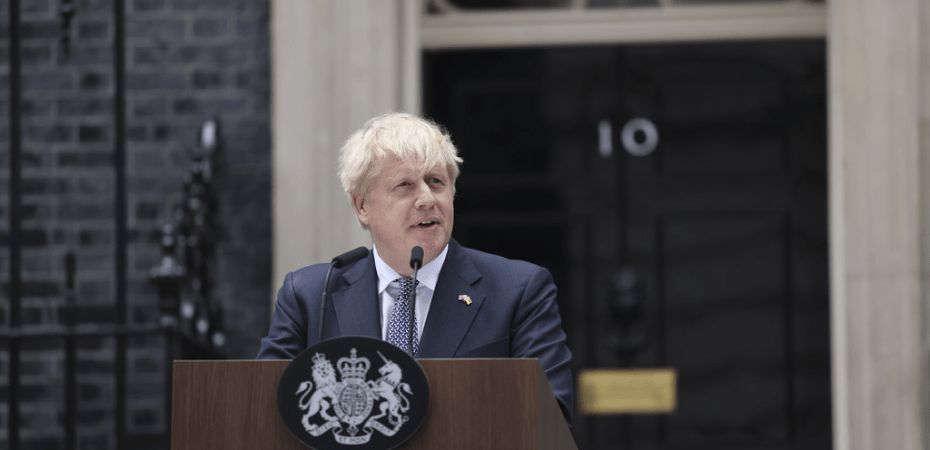
As other Cabinet ministers privately advise Johnson to resign, Levelling Up, Housing and Communities Secretary Michael Gove publicly calls on him to quit. Gove is sacked, a Number Ten source calls him a “snake” and insists the PM will “fight on”. Over the course of 24 hours more than 50 government minsters resign. On July 7th, Johnson bows to the inevitable and stands down.
To be continued…
Mike Phipps’ new book Don’t Stop Thinking About Tomorrow: The Labour Party after Jeremy Corbyn (OR Books, 2022) can be ordered here.
Image: Boris Johnson resigns. Source: https://www.flickr.com/photos/number10gov/52200049218. Licence: Attribution-NonCommercial-NoDerivs 2.0 Generic (CC BY-NC-ND 2.0)
 Labour Hub