
By Mike Phipps
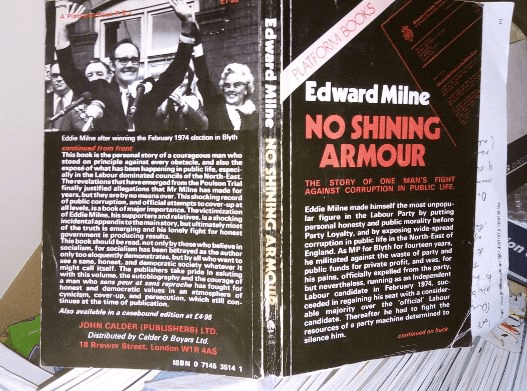
A friend recently gave me a copy of No Shining Armour by Eddie Milne, published in 1976. Milne was a union official in the shop and distributive workers union USDAW, who became Labour MP for Blyth in northeast England in 1960.
Milne was an interesting character, not especially left wing, but a man of integrity. His shock at the widespread corruption he found in the northeast and his commitment to expose it jeopardised – indeed wrecked – his parliamentary career. He was deselected by Labour in 1974.
Milne played a significant role in bringing the Poulson corruption scandal to public attention. John Poulson was an architect, who turned to bribing politicians and public officials in order to win local government contracts. After his business collapsed in 1972, an investigation revealed it had been making payments to several MPs, police officers, health authorities and civil servants.
Poulson was eventually convicted of fraud in 1974. The trial judge called him an “incalculably evil man” – and sentenced him to several years in prison. The corruption scandal, dubbed by some as ‘Britain’s Watergate’, brought down a Conservative Home Secretary and led to the establishment of a parliamentary Register of Members’ Interests.
A much more detailed analysis of this scandal can be found in Web of Corruption: The Story of John Poulson and T. Dan Smith, by Raymond Fitzwalter and David Taylor, published in 1981. Its opening summary states:
“Of those prosecuted in connection with Poulson 21 were convicted on corruption charges. There were nine councillors, four officials from nationalised industries, three civil servants, two local government officers, a journalist, a builder and the architect of the whole conspiracy, Poulson himself. Three hundred people were listed for investigation and many of them lived in fear until the Police called it a day.”
Reviewing the book in the London Review of Books, Bob Marshall-Andrews, later a Campaign Group MP, wrote:
“This is primarily a book about ‘the system’, and the gutlessness of supposed guardians of the public mores… it dramatically illustrates, not only the size and the virility of the corruption which spread into public life in the wake of the property bonanza, but also the complex motives and backgrounds of corrupted and corrupt.”
The northeast connection to Poulson’s criminal activities centred on T. Dan Smith, who was Leader of Newcastle City Council from 1960 to 1965. Initially popular for his slum clearance policies, Smith’s legacy was later associated with the destruction of historic buildings in favour of unpopular concrete eyesores. He was a charismatic and flamboyant man, who drove a Jaguar with personalised number plates, sent his children to private school and had a flat in St James, London.
While still Council Leader, Smith established a PR company to promote urban redevelopment. After leaving the Council, he worked with Poulson to persuade councillors to push their local authorities to accept Poulson’s redevelopment schemes. He too pleaded guilty to corruption charges in 1974 and was given a six-year jail term.
Andrew Cunningham, father of Labour MP Jack Cunningham, was another local politician who was also convicted and jailed in 1974. At the height of his powers in 1971, he was a member of Labour’s National Executive Committee, Chairman of the Party’s Northern Region Executive, Head of the Northern District of the largest union in the northeast, an Alderman of Durham County Council, a member of the Chester-le-Street town council and, more alarmingly, Chairman of Durham Police Authority.
Both Smith and Cunningham were well embedded in the Labour Party in the northeast and had strong support from a range of vested interests. This was the local Establishment that Eddie Milne chose to take on when he raised concerns about improper dealings.
Although the 1974 trial would eventually vindicate his stand, the response of the Labour Party nationally was to close ranks against Milne and hound him out. His enemies in the local Party conspired to get rid of him as an MP and he was deselected ahead of the February 1974 general election.
Milne had quite a lot of local support and decided to run as an independent. He won by over 6,000 votes, beating the official Labour candidate into second place. But the February election produced a hung Parliament and Prime Minister Harold Wilson called a new poll in October.
This time, considerable Party resources were thrown into the campaign against him, and there were allegations of missing postal votes and dirty tricks – Milne’s opponents apparently made mischievous use of the fact that the Secretary of the local Orange Order had the same name as him. In the event, Milne lost by 78 votes.
Milne’s stand came at considerable personal cost. He lost his USDAW job and pension. Supporters and relatives were allegedly victimised. Milne’s book suggests that local police were also obstructive in his quest for justice.
Only after the corruption trial did the Labour government set up as Royal Commission to investigate Standards in Public Life. The Party apparatus meanwhile did all it could to prevent an internal enquiry into the conduct of its elected representatives, even after the Party’s northeast Regional Conference finally had the sense to call for one.
Even after the 1974 trial, Milne’s book was explosive. It attracted 36 libel writs, including from a former Deputy Leader of the Labour Party. The costs and damages associated with it came close to bankrupting the book’s publishers.
Milne’s battles inspired some creative writing. Significant aspects of his life are reflected in the character Eddie Mills, in Peter Flannery’s 1996 television serial Our Friends In The North, particularly his fight against corruption in local government and his election as an Independent Labour MP in 1974. One of the reasons the series took so long to make – it was based on a play originally staged in 1982 – was the BBC’s fear of legal action: it was safer to wait until some of the key protagonists on whom the drama was based were dead.
Milne goes down in history not only as a tireless anti-corruption campaigner, but as one of the few people to run against his former party and win. Unluckily for him, there were two elections in 1974 and his victory over the machine was short-lived.
Perhaps there’s a lesson there for other former Labour MPs thinking of taking on the Party today. Even if you win, it’s not guaranteed you’ll be in for five years. How many times since World War II did an opposition party win a working majority (more than five seats) from a governing party with a working majority?
The answer is just once, in 1970. At every other general election, either the governing party had no working majority and was replaced by one that did; or the governing party did have a working majority – like the Conservatives today, who have a nearly 80-seat margin – and it lost to a Party that did not. If that happens to Keir Starmer’s Labour Party come the next election, there may be another election soon after.
Mike Phipps’ new book Don’t Stop Thinking About Tomorrow: The Labour Party after Jeremy Corbyn (OR Books, 2022) can be ordered here.
 Labour Hub