
Richard Price previews a meeting this week on an important, neglected area of local history
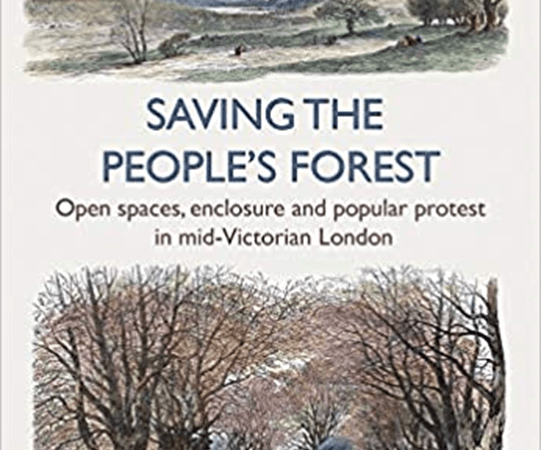
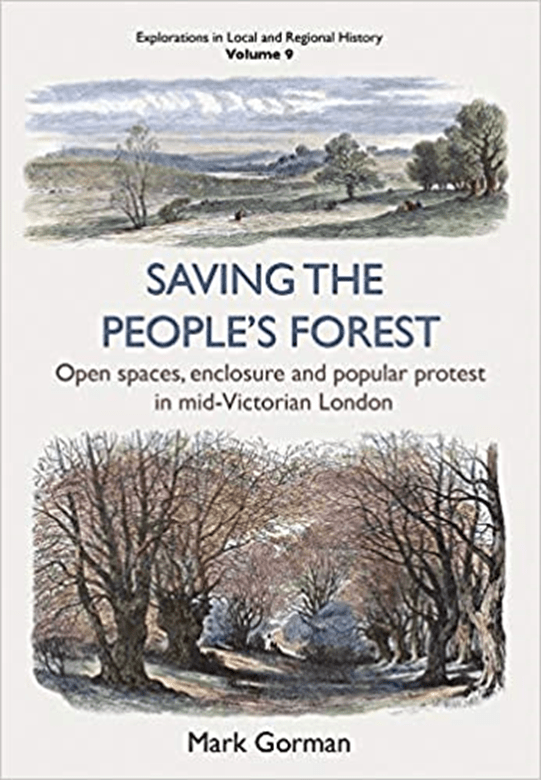
Many history books reinterpret or add to our understanding of established events. Far fewer genuinely break new ground, but Mark Gorman’s Saving the People’s Forest: Open spaces, enclosure and popular protest in mid-Victorian London is an excavation of the largely unknown story of the struggle from below to preserve the commons and forests around London. It fills a large gap in our knowledge of popular struggles.
We are accustomed to take the commons, parks and forests in and around our big cities for granted as an uncomplicated inheritance from the past, and to think of the enclosing of common land as something that took place three or four hundred years ago.
This history of the campaign to protect the 6,000 acres of Epping Forest – the largest ancient forest near London – has previously been presented as the work of enlightened members of the London upper middle class and the Home Counties gentry, fought mainly in Parliament and the courts, and culminating in May 1882 in the appearance of Queen Victoria – conveyed by royal train and carriage – at the opening of the new park at High Beach.
“The story of the preservation of Epping Forest and other metropolitan open spaces,” writes Mark Gorman, “has been told almost entirely from the perspective of these elite campaigners, who conducted parliamentary and legal campaigns against enclosures and development. In these accounts the engagement of proletarian Londoners is reduced to that of passive bystanders who occasionally broke out into violent action against the obnoxious fences.”
Challenging the views of past historians who lumped everyone who wasn’t part of this elite into a single category of ‘the poor’, Gorman demonstrates that not only artisans and skilled workers played a crucial role, but that the genuinely poor of the East End were also roused to take part in the many-faceted campaign to preserve the commons, forests and other open spaces around the edges of London. This challenges the view of historians of both right and left who have depicted the East London working class as largely apolitical and unorganisable before the rise of New Unionism at the end of the 1880s.
One of this book’s real strengths is to show the sheer variety of methods of campaigning that were deployed in addition to legal and parliamentary action, from lobbying local MPs, agitating in the popular press, organising through ancient vestry committees, demonstrations, public meetings and, in a few cases, a healthy dose of rioting.
Between 1800 and 1880, London’s population grew from 1 million to 4.7 million, absorbing dozens of villages. Although there were many distinctly middle and lower-middle class suburbs, others, including those at the built-up edge of the Forest, attracted workers and artisans seeking to escape the squalor of the core East End, with its lack of open spaces, in search of cleaner air, more room, a small garden and an outlet for leisure and socialising. Parallel to and linked to this, was the desire to protect open spaces as centres of free speech and agitation. And underpinning both was the widespread belief that the ancient forest had been, and should be, the common property of all, and that the attempts by landowners to enclose it was the legacy of the ‘Norman yoke’ which had removed common rights in the first place.
This is by no means a study confined to Epping, and takes in struggles to conserve commons across London including Berkhamsted, Clapham, Hackney, Kennington, Plumstead, and Wimbledon, along with the city’s parks.
The struggle to defend more rural forested areas united marginal forest communities, fighting a kind of guerrilla war against enclosures, newer suburbs and more inner London working class communities who flocked to the forest for holiday days out and fairs.
When these forces came together, as they did on Wanstead Flats in July 1871, they were a powerful force that government was compelled to listen to. A large demonstration, summoned by middle class gentlemen, and implored not to rip up the fences and railings enclosing a large part of the Flats responded by doing precisely that. Three companies of locally raised Essex Volunteers watched as the hated enclosures were removed, unwilling to take any action. Similar tactics were used in the Lammas Day riots in the Lea Valley in 1892.
Mark Gorman has done a terrific job reconstructing this inspiring history by his detailed work among fragmentary sources, and helped rebut the idea that the East London working class in Victorian England was merely a lumpen underclass.
Leyton and Wanstead Constituency Labour Party invites you to
Saving the People’s Forest
Mark Gorman in conversation with Richard Price
Saturday 14th January, 3 pm
Wanstead Quaker Meeting House
Bush Road, London E11 3AU
Richard Price is a member of Leyton & Wanstead CLP
 Labour Hub