
By David Osland
The maxim that physicians should ‘first do no harm’ represents a basic tenet of the Hippocratic Corpus. You’d ideally want a government dominated by public schoolboys to remember the epigram from their classics lessons.
Yet these four words are no longer applicable to the National Health Service right now. Shockingly, as many as 500 people a week are dying each week on account of delays in emergency care. Waits for ambulances are often measured in hours and days, not minutes.
Some seven million patients are on waiting lists. I fortunately have no idea how painful it is to need a hip replacement and not be able to get one, but I suspect it is excruciating. This is indeed avoidable suffering on a huge scale.
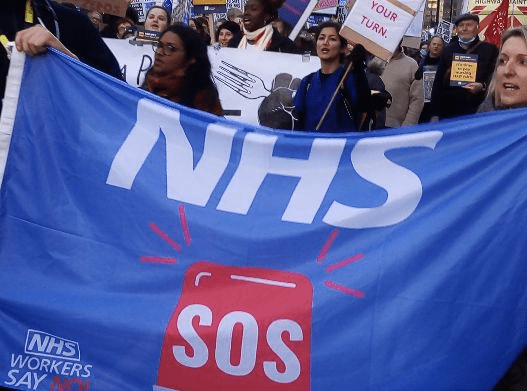
At one level, industrial action from nurses and ambulance workers is a bid to restore pay packets after decades of substantial real terms erosion. At another, it is a fight for the NHS itself. For that reason, the strikes enjoy widespread support.
Whatever the ‘but the pandemic …’ bluster from senior Tories, a situation such as this – considered from the standpoint of either ethics or practical politics – should be sufficient to ensure defeat at the next general election.
That doesn’t mean the right is willing to let a good crisis go to waste. To use a couple of Greek words Hippocrates himself would have recognised, the very notion of universal healthcare free at the point of need is anathematic to their dogma.
Opinion pages regularly pronounce that the existing NHS model is ‘no longer sustainable’, that the solution is not to ‘throw money’ at what is routinely branded the ‘bottomless pit’ of healthcare.
As a bare minimum, Britain should at least look to the social insurance schemes used in France and Germany, we are told. Free marketeers are more ambitious, and spy the opportunity of a lifetime to push for flat-out privatisation.
The symbolism of the invective is obviously important. The NHS remains the greatest achievement of the Labour Party in the 123 years of its existence.
Perhaps on those grounds alone, a segment of the Labour right appears determined to slay another shibboleth, as they see it, and meet the critics halfway.
The commitment to double the number of graduating doctors and district nurses, and the provision of thousands more training places for nurses, midwives and health visitors is welcome.
The Big Offer is greater private sector involvement. The call to conscript excess BUPA capacity might even have some immediate attractions as an emergency response, but at best would constitute a sticking plaster solution of the variety so eloquently dismissed in a recent speech by Keir Starmer.
But to turn to another ancient Greek allusion, such a move would be an obvious Trojan Horse device, softening up healthcare for a return to the for-profit principle.
The root of the NHS’s plight remains chronic underfunding. NHS England is now reduced to just 100,000 general and acute beds, down 40% on the 1980s; unfilled vacancies run to 133,000, equivalent to one job in ten.
To put it bluntly, there is no alternative to spending more money, and Labour should say so openly. If Britain wants a world class health service, it has to be prepared to pay for it.
Now is unavoidably time to flourish the big government chequebook, and not just for the NHS, narrowly conceived. Healthcare functions in conjunction with social care and public health provision, both of which have been decimated since 2010.
Some 13,000 beds are occupied by patients who are clinically fit to discharge but cannot be found places in community or social care. So called ‘bed blocking’ inevitably means delays in emergency and elective care.
Social care in particular remains something of a political third rail. There are repeated calls for a review of the service.
We’ve had reviews before, and still the result is the sort of deadlock that saw Theresa May accused of wanting to introduce a ‘dementia tax’ by proposing to confiscate users’ houses to pay the bills. Let’s have some action.
Healthcare economists also highlight poor strategic planning. Much of that seems to flow from Health-Robinson attempts to construct an artificial internal market, introduced under Thatcher.
That project has palpably failed. There are surely better ways of doing things, and there’s no need for the left to duck the debate, although that will necessitate the input of experts.
But that kind of detail can be discussed later; for now, the priority has to be a return to the standards of acute and A&E service and the bed numbers that should be taken as read in an advanced capitalist economy.
After all, 25,000 excess deaths a year is simply unacceptable. First do no harm.
David Osland is a member of Hackney North & Stoke Newington CLP and a long-time left wing journalist and author. Follow him on Twitter at @David__Osland
Image: NHS demonstration, December 20th 2022. c/o Mike Phipps
 Labour Hub