
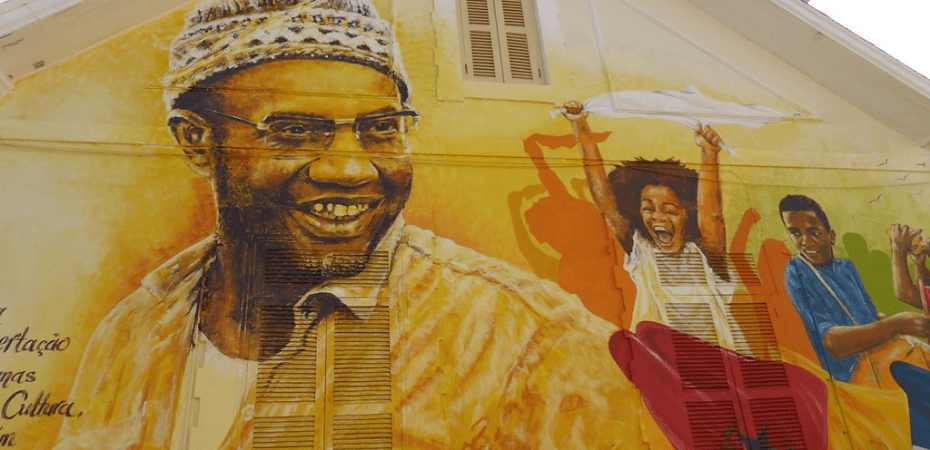
Mike Phipps explains why we should mark the passing of Amílcar Cabral, who died 50 years ago today
Amílcar Lopes da Costa Cabral was a Bissau-Guinean and Cape Verdean agricultural engineer and a man of many talents: pan-Africanist, intellectual, poet, nationalist, theoretician, revolutionary, political organiser and diplomat. He was without doubt one of Africa’s foremost anti-colonial leaders.
Cabral was born in Guinea in 1924, but brought up in Cape Verde. He won a scholarship to attend college in Lisbon where he gained a degree in agronomy and was exposed to anti-colonial ideas. He travelled extensively in Portuguese-speaking Africa and became increasingly committed to the anti-colonial struggle.
In 1956 Cabral formed the African Party for the Independence of Guinea and Cape Verde (PAIGC). But as a pan-Africanist, he was also one of the founding members of Movimento Popular Libertação de Angola (MPLA) together with Agostinho Neto, later Angola’s first post-independence president, and other Angolan nationalists.
The repression meted out against civil rights and labour movement protests by the Portuguese colonial authorities convinced Cabral that a peaceful road to independence was not feasible. From 1963 to his assassination in 1973, Cabral led the PAIGC’s guerrilla movement. Preparations for this, including training, access to arms and how to relate to the civilian population needed to be meticulous if the movement’s efforts were not to be destroyed at the outset. Cabral’s abilities made this liberation struggle one of the most successful wars of independence in modern African history.
But Cabral was more than a soldier. He saw the armed struggle primarily as a way to focus the attention of the international community on the plight of the Guineans under Portuguese domination. This was vital: even other African nationalists, let alone the wider world, were unaware of the brutality and apartheid nature of Portuguese colonialism, so successful had settler propaganda been.
The other purpose of the guerrilla strategy he pursued was to lay the foundations for a post-colonial administration. Particular attention was given to health, education and the administration of justice in territories liberated from colonial rule. In fact, it was Cabral’s unyielding commitment to this that contributed to the divisions in the movement that led to his assassination in 1973 at the hands of his own men.
The history of anti-colonial liberation struggles in Africa at this time is one of intense rivalries, encouraged – sometimes financially induced – by the colonial authorities and the American CIA. Between 1961 and 1973, six African independence leaders were assassinated with the complicity of their ex-colonial rulers.
Cabral may have been unaware of the extent to which his own leadership was being undermined – he was abroad over thirty times in 1972, vital, he would argue, for raising funds and undertaking diplomatic work. But these trips fuelled whisperings about his lifestyle. The Portuguese authorities were meanwhile infiltrating the PAIGC with a view to decapitating it, by killing Cabral.
Precisely on whose authorisation Cabral was assassinated remains unclear. The official leadership version that Portuguese agents directed the operation was a convenient narrative for a party profoundly divided by ethnicity, politics and personal loyalties.
The movement was indeed decapitated by Cabral’s assassination. One of the reasons he was such a central figure was his search for a unifying political identity – in conditions where profound historical divisions existed between Cape Verdeans and Guineans. Marxism, Pan-Africanism and the ideas of the black consciousness movement were all key influences on Cabral’s thought and his commitment to the guerrilla struggle was further shaped by the experiences of China and Cuba.
The struggle that Cabral led was essential to bringing down the Portuguese empire in Africa, which itself sparked the Portuguese Revolution a year later. While he did not live to see these events, his impact in shaping them cannot be underestimated.
“This in turn had decisive consequences for the coming of democracy in Spain and South Africa alike,” argues a recent analysis. “These two countries with a combined population of well over a hundred million people today owe a considerable debt to Guinea-Bissau, which has a population of two million.” Although the apartheid regime in South Africa clung on for many more years, Nelson Mandela paid tribute to the legacy of Cabral after his release from prison.
As a revolutionary theoretician, Cabral has been compared to Frantz Fanon and Che Guevara. As a revolutionary, he inspired million beyond the small country he worked to liberate. In 2020, he was voted the second greatest leader in the world by a poll conducted by BBC World History Magazine, with Churchill trailing a distant third.
Mike Phipps’ new book Don’t Stop Thinking About Tomorrow: The Labour Party after Jeremy Corbyn (OR Books, 2022) can be ordered here.
Image: Amilcar Cabral wallpainting in Praia, Santiago, Cape Verde. Source: https://www.flickr.com/photos/slapers/49304985926 Licence: Attribution 2.0 Generic (CC BY 2.0)
 Labour Hub