
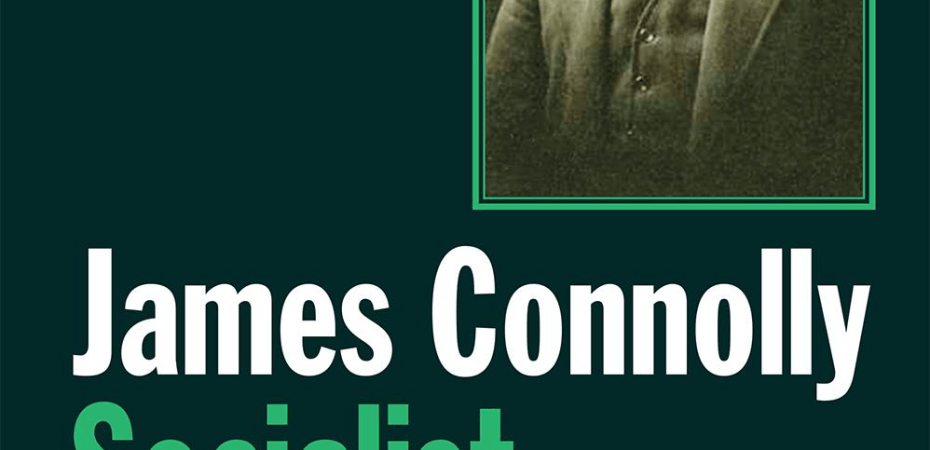
Mike Phipps reviews James Connolly: Socialist, Nationalist and Internationalist, by Liam McNulty, published by Merlin.
A new book about James Connolly is always something to anticipate – but it comes at a price. That Connolly was Ireland’s most important socialist thinker and activist is beyond dispute. But precisely because of his towering importance, his ideas and legacy are hotly contested by various currents and factions who would make him their own. Could Liam McNulty’s book break this mould?
It’s a scholarly and intelligent work. But the alarm bells began to ring as early as the Introduction, where the author states flatly: “Connolly’s involvement in the [Easter] Rising is explained, in part, by his incorrigible revolutionism in the face of the seeming collapse of the international socialist movement.” This is a controversial view, to put it mildly, and will be scrutinised below.
James Connolly was born to Irish parents in an Edinburgh slum. He left school at age 11 and after various jobs joined the army at 14, eventually absconding before returning to Scotland and getting involved in the socialist movement.
It was the era of the new mass trade unionism and the emergence of independent labour movement candidates in electoral politics. Connolly himself stood in a local election in 1894 but he was defeated and the stand cost him his job. Out of work and money, with a young family to provide for, he even considered emigrating to Chile. Instead he was recruited by the Dublin Socialist Club as an organiser.
Ireland at this time still lived in the shadow of the Great Famine of 1845-8 in which over a million people died. Colonial dependency meant that Ireland’s cities had largely missed out on industrialisation, with only one-fifth of Dublin’s workers employed in manufacturing and nearly half in unskilled work at the turn of the 20th century. Rural depopulation had resulted in widespread emigration.
The Irish TUC had been set up in 1894 but the labour movement had been largely untouched by the new unionism and a 20% unemployment rate made it difficult to organise. While Belfast, untypically, was rapidly industrialising, its labour movement was divided along sectarian lines.
Soon after arriving, Connolly co-founded the Irish Socialist Republican Party, an avowedly socialist party based on the self-emancipation of the Irish working class and the right of self-determination for Ireland, proposing a socialist republic wholly separated from the British Empire.
These ideas were not a convenient accommodation with nationalists. In the words of one analyst, Connolly “intended rather to make a commitment to socialism the litmus test of patriotism.” Connolly himself later wrote that the Irish working class was “the only secure foundation on which a free nation can be reared.”
In 1897 he famously argued: “If you remove the English army tomorrow and hoist the green flag over Dublin Castle, unless you set about the organisation of the Socialist Republic your efforts would be in vain. England would still rule you… through her capitalists, through her landlords, through her financiers.”
In 1897 Connolly and the ISRP were in the thick of protests against Queen Victoria’s Diamond Jubilee celebrations, marching through the streets with a black coffin symbolising the fate of the British Empire, which provoked mounted police and baton charges. Despite Connolly’s arrest and one fatality, it was a major propaganda success.
Further joint work between the ISRP and republicans followed. Looking back later, Connolly argued that the ideas of republicans and revolution had once been “only whispered among intimates”. The socialists broke through this secrecy with hundreds of speeches and thousands of pieces of literature to popularise the ideals.
McNulty emphasises Connolly’s internationalism – his opposition to the Boer War while many socialists in Britain wavered; his highlighting of the evils of anti-Semitism, including in the Social Democratic Federation in Britain at the time; his speaking tour of the US in 1902. Indeed, the following year, with the ISRP terminally riven by internal divisions and, unable to earn a living, he decided to resettle in America.
Connolly’s seven years in the US were important to the development of his political ideas. He became increasingly involved with the emergent Industrial Workers of the World, where he organised energetically. He also founded the Irish Socialist Federation to draw Irish-American workers towards socialism – by 1900 there were more people of Irish descent in New York than in Dublin.
By 1909 Connolly was keen to return to Ireland, where a large meeting had founded the Socialist Party of Ireland and James Larkin had set up the Irish Transport and General Workers Union, imbued with the same militant spirit and industrial strategy favoured by Connolly.
On his return, Connolly went on a speaking tour addressing packed meetings, including 2,000 in Cork. He now favoured a unified propaganda organisation for spreading socialist ideas, the creation of an Irish Labour Party, finally backed by the ITUC in 1912, for working class political representation, and a new body to represent all Irish trade unions. Independent political representation was the thorniest issue: Connolly was loudly critical of those Home Rulers in Westminster who blocked the extension of socially progressive legislation to Ireland.
From mid-1911 to 1913, Connolly was active in Belfast, “confronted with the reality of a divided working class” and mounting Unionist opposition to any form of Home Rule, the power of which McNulty believes Connolly greatly underestimated.
The author equally feels Connolly neglected the possibility of the development of an authentically Irish capitalist class, with his emphasis on the central role of the working class in the nationalist struggle, a point he backs up by underlining what he suggests was the progressive nature of British government land reforms in Ireland. I’m not so sure.
It’s a more general problem that McNulty’s biography tries to settle conclusively political differences in this way, keen to pounce on Connolly’s creative departures from the author’s own outlook, for example on the relative importance of industrial unionism over political party-building.
“A spectre is haunting all Europe!” declared the December 1913 issue of the Chicago-based International Socialist Review. “The spectre is what the daily papers call fearfully ‘Larkinism’.”
In 1907, Larkin had arrived as a union organiser in Belfast and within months recruited 3,000 dockers and organised highly effective strikes that briefly transcended the sectarian divide and even caused the Royal Irish Constabulary to mutiny. In 1909 he established the Irish Transport and General Workers Union.
By 1913, conditions in Dublin were intolerable: 23% of people lived in one room and tuberculosis was responsible for a death rate similar to that of Cairo. Larkin now led much of the city’s unskilled labour. When the millionaire who ran the Irish Independent sacked 60 and then a further 200 union members, ITGWU members across the city voted to strike.
Repression followed: Connolly was arrested and jailed. He went on hunger strike and was released after seven days. Two workers were killed by police and over 600 injured. The employers backed the repression by locking out 25,000 workers.
When Larkin was jailed, Connolly became acting leader of the union and campaigned for his freedom, which was achieved 17 days into a seven-month sentence. But despite huge international solidarity, Larkin’s attempts to spread the struggle to England were thwarted by British trade union leaders. The Dublin workers were isolated and, after over half a year, defeated.
The outbreak of World War I in 1914 caused the British Labour Party and TUC to declare an electoral and industrial truce. It also led to the collapse of the Second International as its various parties supported their rulers’ own war efforts. This outcome profoundly dismayed Connolly, who wrote: “To me, the socialist of another country is a fellow patriot, as the capitalist of my own country is a natural enemy.”
The result of the capitulation, was that “the socialist parties of the various countries mutually cancel each other, and that as a consequence socialism ceases to exist as a world force, and drops out of history in the greatest crisis of the history of the world.”
Connolly’s reaction to the war was to call on the working class “to erect barricades all over Europe, to break up bridges and destroy the transport service that war might be abolished.” McNulty believes that the failure of this to happen led Connolly to look to other forces for revolutionary potential. But this seriously underestimates the growing importance, both in Connolly’s thinking and in the material conditions of struggle, of the national question.
By 1914, the partition of Ireland was being proposed by the British government. Connolly was bitterly opposed, arguing presciently that it would mean “a carnival of reaction both North and South.” He called on the labour movement to fight it, “even to the death if necessary.”
At the same time, the Irish Citizen Army, originally conceived as a defence force against police brutality, was being reorganised – on more clearly separatist republican lines, argues McNulty – as a working class pole of attraction in competition with the more middle class Irish Volunteers, 180,000 strong in 1914, but soon to split with the majority backing Britain’s war effort. That said, many of those who later took part in the Easter Rising would inevitably have views influenced by the working class mass movements of earlier years.
Connolly’s agitation for a revolutionary uprising led him into intense negotiations in January 1916 with the Irish Republican Brotherhood, after which he became a member of its secret Military Council. Connolly was content that the IRB now shared his sense of urgency to strike while Britain was preoccupied by war.
The collective preference for action over inaction meant that the Easter Rising happened differently to what had been meticulously prepared, with last minute changes of plan dictated by events. These changes made the prospects of success much less likely. On Easter Monday morning, Connolly predicted: “We are going out to be slaughtered.” When asked if there was no chance of success, he replied: “None whatsoever.”
It would be wrong to suggest on this basis, however, that the Rising was a futile exercise designed primarily as an exemplary sacrifice. As has been pointed out elsewhere, it would be quite unhistorical to interpret these sentiments as the basis of the actual planning of the Rising – however conveniently they might fit into a false narrative that seeks to present the Rising as an irrational, even mystical, gesture.
So why did Connolly take part in the Rising? Was it the culmination of, or a rupture with, his long-held beliefs? McNulty is firmly in the latter camp. At first glance, this seems reasonable: Connolly, on this reading, spent his life organising in the labour movement with no previous involvement in armed struggle. But then it is rare for anyone to spend one’s life organising armed uprisings. What’s important about Connolly is not only his emphasis on the national question, but his willingness to confront head-on the force of the British state in all aspects of his political activity.
McNulty professes himself disappointed with what he sees as the conspiratorial nature of the 1916 action, but is even more aggrieved at the programmatic concessions Connolly apparently made to what the author calls a “radical bourgeois-democratic rising.”
This seems unsound. Connolly and others fully expected the Easter Rising to be one feature of a wider process and its programmatic basic would not have been a central concern. But it’s questionable whether any revolution is really decided by programmatic negotiation in advance, and certainly not in secret.
McNulty’s views are troubling in further respects. Others have argued that Connolly’s participation in the Easter Rising was entirely consistent with his earlier expressed views: for electoral politics in normal times; for insurrection in abnormal, such as those ushered in by the outbreak of war in 1914. Moreover, Connolly believed that the uprising in Ireland could have a much broader impact: “Ireland may yet set the torch to a European conflagration.”
McNulty bemoans the secretive nature of the Easter Rising, but it is wrong to see the issue of physical force as being hermetically separated from the popular movements of the time. Connolly’s Citizen Army was rooted in the unions but had no problem with taking part in the Rising: it was not ordered into it by a closet vanguardist. Throughout the nineteenth century, Irish political activity had combined mass movements, armed uprisings and electoralist politics. The massive armed presence of the British underlined the clear limitations of purely legal interventions.
A combination of factors increased the urgency for action. Of particular importance was the Ulster Rebellion of 1912-14 and the British government’s effective capitulation to it, foreshadowing the danger of partition, which would create a permanent division of the Irish working class. The attempted enrolment of the Irish working class by moderate Irish nationalists into Britain’s ‘Great War’ in 1914 – as well as the threat of military conscription by the British government – gave Connolly a further spur towards counter-action.
The Russian Revolution of course broke out less than a year later. Lenin said of the Irish Rising: “Whoever calls such an uprising a ‘putsch’ is either a hardened reactionary, or a doctrinaire hopelessly incapable of picturing to himself a social revolution as a living phenomenon.” McNulty plays down the significance of this assessment.
As others have highlighted in detail, most British labour movement leaders, including the Independent Labour Party, condemned the Rising. The Socialist Labour Party, with which Connolly had maintained close links, pursued a policy of silence. There were some notable exceptions, including Sylvia Pankhurst who wrote, “We understand why rebellion breaks out in Ireland and we share the sorrow of those who are weeping today for the rebels whom the government has shot.”
Over the next five years, her Woman’s Dreadnought and its successor Workers’ Dreadnought carried articles reporting and interpreting the evolving Irish revolution. In May 1920 its business manager was jailed for six months after trying to persuade a British soldier to smuggle either left-wing pamphlets or machine-guns to Ireland.
It is also of significance that few of the main leaders of socialist movements in Europe at this time were prepared to condemn Connolly for ‘capitulating to Irish nationalism’ – and for good reason: Irish nationalists were also internationally connected and contained strands from socialism, co-operativism, feminism and generally progressive views. In this sense, Connolly’s own internationalism was not just a labour movement phenomenon, but part of this development.
McNulty’s grasp of Connolly’s participation in the Easter Rising, in some ways the climax of his life, is the weakest part of his book. His keenness to polemicise over the issue leads him to effectively abandon his narrative thread and he fails to complete his story: there is little here on the Rising’s failure or the end of Connolly’s life.
And the aftermath? There was, as McNulty reminds us, a huge growth in the Irish labour movement at the end of the war as well as several important acts of militancy, including a general strike against conscription in 1918 and the Limerick Soviet in 1919. Still, the loss of Connolly was sorely felt: one obituarist wrote: “when they shot Connolly to death, it seemed as if they had shot the heart and brain out of the Irish proletariat.”
Yet Connolly was not just a labour movement activist. The impact of the Rising, and his participation in it, was profound. In the 1918 general election, Sinn Féin, despite never having previously stood in a general election, swept the board, trouncing the moderate Irish Parliamentary Party, which had dominated the Irish political landscape since the 1880s.
It was the last all-Ireland election. The partition of Ireland did indeed produce the predicted “carnival of reaction both North and South” which had a calamitous effect on the prospects for Irish unity, self-determination and socialism that are with us to this day – an analysis that is sadly absent from this interesting but flawed book.

Mike Phipps’ new book Don’t Stop Thinking About Tomorrow: The Labour Party after Jeremy Corbyn (OR Books, 2022) can be ordered here.
 Labour Hub