
Popular resistance to the coup against Peru’s elected president shows no sign of abating, despite ferocious repression, reports Mike Phipps
Peru’s unelected, illegitimate government has unleashed a torrent of repression in response to protests against the right wing coup against President Pedro Castillo, a rural teacher and trade union leader who was elected in 2021.
On January 21st police raided Lima University, smashing down the gates with an armoured vehicle, firing teargas and detaining more than 200 people. “Images showed dozens of people lying face down on the ground at San Marcos University,” reports the Guardian. “Students said they were pushed, kicked and hit with truncheons as they were forced out of their dormitories.”
Film footage “showed confused and terrified students massed outside their halls, some still in pyjamas, as riot police shouted orders and insults. Young men were forced to stand against a wall or kneel in a row.”
One Congresswoman – herself prevented from entering the campus – said the police actions were unprecedented since the 1980s, adding: “The police have entered the university residence, the rooms of the female students who had nothing to do with the demonstrators. They have threatened them and taken them out of their rooms while they were sleeping.”
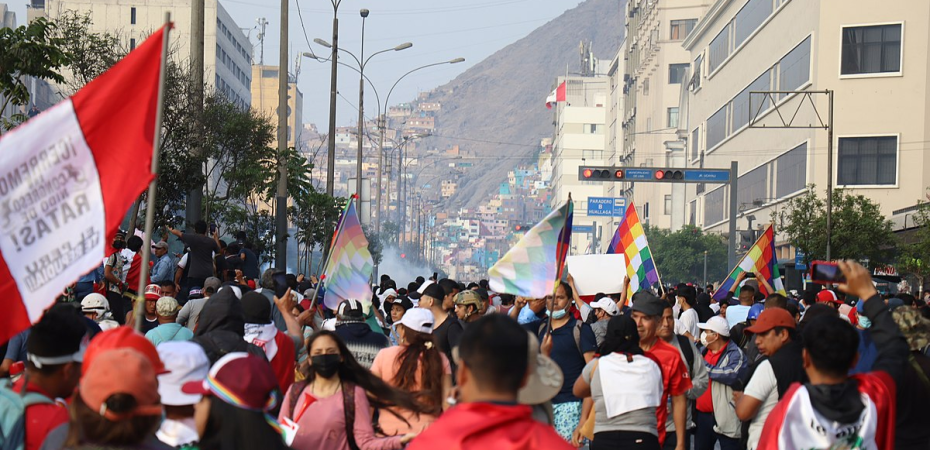
The raids came at the end of a week of renewed protests across Peru, which saw violent clashes between police and demonstrators. In Lima, police fired volleys of teargas against an initially peaceful demonstration, which carried cardboard coffins to represent the dozens of civilians killed so far by Peruvian police.
Protesters came to Lima in huge numbers on January 19th. They filled streets and plazas, marched, and impeded access to government offices. Lima residents and social movements stocked food for them and, with the help of schools and universities, provided shelter.
One group of protesters in the capital were medical volunteers who were mourning Marco Antonio Samillan, a 30-year-old student doctor fatally shot while helping an injured protester last week in the deadliest bout of violence since the protests began.
Two massacres
Samillan was killed in Juliaca, along with sixteen other protesters and bystanders when the police fired with live rounds earlier this month. One of those killed was a 17-year old girl.
An Inter-American Commission on Human Rights fact-finding mission “received reports of indiscriminate shootings against demonstrators in certain regions.” The UN human rights office has demanded an investigation.
The government won a motion of confidence in Congress following the massacre, but the Attorney-General’s office has launched an investigation into the new President and members of her cabinet to investigate allegations of genocide.
The massacre followed an earlier burst of deadly state violence in December in Ayacucho, when unarmed protesters – mainly students, shopkeepers, street vendors and agricultural workers – were shot at from army helicopters. Ten were killed.
Government war on ‘terror’
Both massacres took place in southern Andean regions, where there is a significant Quechua and Aymara population. Indigenous people have long been excluded from Peruvian society. As one analyst argues, much of the region “is seen as Lima’s colony: a land rich in natural resources, but inhabited by ‘native savages’ that need to be ‘civilised’ in order for Peru to progress.”
Omar Coronel, a sociology professor at Peru’s Pontifical Catholic University, argues that the government has formed a tacit coalition with powerful far-right lawmakers who have portrayed the protesters as ‘terrorists’, a throwback to Peru’s internal conflict with the Shining Path in the 1980s and ‘90s. The police are behaving accordingly.
As part of the state’s campaign against the guerrillas at that time, it tortured, detained, disappeared and murdered tens of thousands of innocent farmers and Indigenous people, accusing them of supporting or being part of the insurgency.
Today’s ‘anti-terror- offensive is also targeting the indigenous and rural poor. There are also reports of leftists’ homes being raided in the search for incriminating literature – Marx, Lenin, etc.
The current unrest gripping the country has seen fifty fatalities and several hundred people injured. The seriousness of the crisis is underlined by the government’s decision to close the Inca citadel of Machu Picchu, Peru’s largest tourist attraction, which brings in more than a million visitors a year.
Indigenous and poorer Peruvians have been at the forefront of protests. The Guardian reported one indigenous mineworker as saying, “People are really angry because of the people who have been killed, most of them farmers and Indigenous people, and about the racism and classism of those in power.”
Recurring institutional crisis
President Pedro Castillo was impeached and jailed on December 7th after attempting to dissolve Congress and rule by decree. The dissolution was intended to be temporary, prior to holding elections to elect a new Congress with Constituent Assembly powers.
The detention of the President sparked massive protests, strongest in the areas where Castillo drew much of his electoral support. Protests have included industrial action, occupations and road blocks, which are now having a serious impact in on the movement of essential goods in some areas.
Demonstrators burned down banks in Yunguyo, in the department of Puno and a police station in Triunfo, Arequipa. In the Antapaccay mining company compound in Cuzco, the people seized assets of the corporation, and set fire to its facilities. Yet most of the protests have been peaceful, which has not deterred the fierce repression unleashed by the new President Dina Boluarte, who declared a state of emergency and suspended key civil liberties.
As previously reported on Labour Hub, the situation in Peru has been one of recurring institutional crisis. In the last six years alone, since 2016, three presidents have been ousted by Congress. Under Castillo, minister after minister faced impeachment proceedings from a hostile legislature: in the 495 days he lasted in office, Castillo was forced to appoint a total of 78 ministers.
Castillo was the first progressive candidate from his background ever to win a presidential election in Peru. Despite his inexperience and mistakes in office, he was seen as a symbolic representative of the one-third of Peruvians who live in poverty, the 50% food-insecure, the indigenous and rural masses.
The US supports the new government. Others, such as Mexico’s president, have spoken out against the state of emergency and use of state violence. Argentina, Bolivia and Colombia joined Mexico in a joint statement that declared Castillo a victim of “harassment” throughout his presidency.
Here, Jeremy Corbyn MP said: “It’s an absolute disgrace what is happening. An elected president has been removed. The ambassador of Mexico has been removed because he tried to visit the President in prison. Protesters are being brutally attacked by the police and other forces.”
There is little sign of the protests winding down. Two days ago, hundreds marched through the southern city of Cusco, carrying placards that denounced the president as a monster, a murderer and a Judas.
The demands remain: the immediate release of Castillo, the withdrawal of the army and for the election of a new Congress with Constituent Assembly powers. Current opinion polls show majority support for this, with 71% rejecting the government and 80% opposing the Congress.
Peruvian analyst Héctor Béjar believes the protests mark “a qualitative shift. It’s the first time in Peruvian history that a movement surging up from the people themselves is setting forth a clear political agenda that takes precedence over immediate, isolated demands limited to local problems.”
The embattled President Boluarte is now asking Congress to bring forward elections scheduled for April 2024 to the end of this year. Congress had already brought forward the elections by two years in an unsuccessful attempt to defuse the crisis earlier this month.
Boluarte said she hoped the proposal would “get us out of this quagmire”. Frankly, that looks unlikely.
“The people have woken up,” one protester is quoted as saying, “and no one can tell us what to do.”
Mike Phipps’ new book Don’t Stop Thinking About Tomorrow: The Labour Party after Jeremy Corbyn (OR Books, 2022) can be ordered here.
Image: Protests in Lima December 2022. Author: Mayimbú, licensed under the Creative Commons Attribution-Share Alike 4.0 International license.
 Labour Hub