

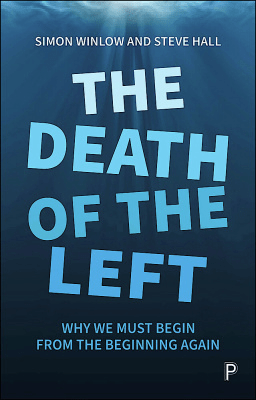
Mike Phipps reviews The Death of the Left: Why We Must Begin from the Beginning Again by Simon Winlow and Steve Hall, published by Policy Press
The Death of the Left is a provocative title. The thesis, propounded here by two criminology professors, is that the left in developed countries has abandoned offering any alternative to the existing order and has been able to win elections only by embracing neoliberalism. At the same time, a “cultural or identitarian left has accepted neoliberalism’s individualised mode of social competition and rejected democratic socialism’s appeal to solidarity and common interests.”
The charge sheet against the left is hefty: “stoking hostile intersectional culture”, “intellectual mismanagement and reductive political tribalism”, “moralistic denunciations”, “divisive identity politics” – and that’s just the Introduction.
One of the problems, however, is that ‘the left’ is never clearly defined. After the financial crisis of 2008, for instance, “the best the mainstream left could do in response was to offer a moralising critique of corporate bankers’ untrammelled greed.” Sometimes the left is the Blair-Brown leadership, Clinton, Obama, etc. At other times, it’s the Corbyn Project and its radical commitment to social justice.
Thus, “Millions of working people looked at influential figures in the left’s political parties and its high-profile media commentariat only to conclude that they had absolutely nothing in common with them.” I’m not sure who the left’s “high-profile media commentariat” is, but the authors clearly believe its sociological middle class nature is a key factor in turning working class voters towards the privately educated Nigel Farage and other right wing populists elsewhere.
There’s something missing here, however. It may be legitimate to assert that the differences on economic policy between New Labour and Conservatives were negligible, as both favoured post-crash austerity. Yet it was precisely the failure of that elite consensus to represent ordinary people that led to the rise of Corbynism – and similar alternatives elsewhere – and a real anti-austerity alternative.
But that’s not how Winlow and Hall see it. Former Shadow Chancellor John McDonnell’s fully costed spending plans in their eyes are evidence of his capitulation to neoliberalism. Later, Corbyn allowed himself “to be surrounded by neoliberal advisers”. Really?
The repeated refusal to define who the left is – sometimes, more accusingly, the liberal left – may signal intellectual laziness. But it is a laziness born of assumed shared beliefs that there are good people on the one hand, and the ‘bad’ liberal left irretrievably on the other. It’s a binary that is hard to take seriously.
Similarly, the EU referendum is inexcusably presented in crude class terms, where Brexit equals working class, equals good, with the democratic verdict of the people undermined by “middle-class leftists” who “ultimately wanted the nation to remain part of a neoliberal free-trade area that in its economic policies had made the poor poorer and the rich richer.” For them, “The working class was the hostile right-wing establishment.”
But it’s an inconvenient fact that the working class was not remotely united in its endorsement of Brexit. (London? Scotland?) In reality, the biggest layer of Leave voters came from an entirely different social stratum, but in this version it’s as if a large chunk of the Conservative Party and the finance and rentier capital that it represents had never agitated for a No vote.
This outlook plays into a wider narrative where the “liberal left”, whoever that might be, “seems sure that there is nothing positive about the nation” – unlike the patriotic working class, still committed to its culture and traditions.
The charge sheet against the left continues. “Despite their loud hostility towards the nation and the state” – note the merging of two distinct concepts here – “they rail against the state’s refusal to address climate change, racism, sexism, hate crime and a whole host of often quite bespoke cultural themes that they believe structure social injustice.” This is apparently accompanied by a lack of interest in economic justice, strangely counterposed here to social justice, as the left “adopted the haughty, holier-than-thou image of moral and cultural superiority.”
This supposed attack on the working class by entitled liberal leftists also takes the form of a move from universalism to particularism, claim the authors, as, “Only those who had fully lived and experienced a marginalised identity should be allowed to ‘speak their truth’.”
“Community was reframed as ‘imaginary’…” – it’s interesting to follow the footnote here to Benedict Anderson’s ground-breaking book Imagined Communities (full title: Imagined Communities: Reflections on the Origin and Spread of Nationalism), which is precisely about how nations are a recent creation and are “imagined”. This is not in the sense that a national community is fake, but because a national community is so large that its members cannot possibly know each another on a face-to-face basis. This is in contrast with real communities that develop organically. So not all communities are imaginary at all – but that’s a nuance unlikely to be noticed in this broad-brush attack on ‘the left’.
The backlash against the left takes the form of populism. “For anyone not consumed by fear and loathing of the common people, populism is best understood as an eruption of the raw energy from which democracy can be fashioned.” Really? No element of manipulation from within a section of the elite itself? Apparently not: the elite were the ones who dared to criticise the new populism for rousing dark political passions – apparently the very essence of democracy.
“It would be wrong to present the populist movements that developed between 2008 and 2019 as universally positive,” concede the authors. Yeah, well, there was Trump of course – and the attack on the US Capitol two years ago, and Bolsinaro, and his supporters this January defecating in the Brazilian parliament when their leader lost the democratic presidential election to that presumed elitist Lula – that probably wasn’t universally positive; nor was Farage, nor the rise of the French National Front, but apart from them…
The problem is that it’s all very well to say that people who vote for these charlatans just want to “free themselves from the confines of mainstream politics”, but there were other options – Jeremy Corbyn’s leadership and Bernie Sanders in the US being the most obvious examples. Nor was there much evidence of populists in office breaking with neoliberalism – which may suggest this wasn’t the main motivation many people had in voting for them.
Winlow and Hall disagree, taking at face value Johnson’s Tories’ pledges to invest in the deindustrialised north. But these promises were as empty as the ones to build 40 new hospitals.
Jeremy Corbyn, on the other hand, is dismissed as “weak and ineffectual”: “Few voters believed that he possessed the gravitas to lead the nation.” “Meetings we attended were dominated by middle-class, university-educated cultural activists” who expressed “bellicose class bigotry” towards the Brexit-voting working class.
Worse, the liberal middle class cultural agenda stole the Corbyn project from the working class. “Working-class intellectuals could either fall into line and accept the ideas of their middle-class superiors or leave.”
I’ve read some dim-witted analyses of the ultimate failure of the Corbyn project but this one is in a league of its own. The role of supposed middle class leftists pales into insignificance compared to the sabotage of the Labour Party apparatus, the treachery of key figures in the Parliamentary Party and even the conservatism of key union leaderships within the Corbyn project itself, which limited the scope of reforms that would extend internal Party democracy or scale back Britain’s expensive, unusable, immoral nuclear deterrent. Nor is there much distinction made here between Corbyn’s astonishing result in 2017 which deprived Prime Minster May of her majority and what happened two years later.
There are many reasons why the Corbyn project ultimately failed which I have discussed elsewhere and “cultural radicals… more interested in establishing new intersectional pecking orders than in building equality and class solidarity” is simply not one of them.
But it’s not just the Corbyn leadership that gets misrepresented in this way: Bernie Sanders in the US comes in for similar treatment. “Despite their honesty and the brief flurry of support they received,” write the authors, “they also seemed to alienate some voters and inspire a number of worrying stereotypes about what the contemporary left would mean for ordinary people.”
In other words, Sanders too succumbed to a supposed agenda of cultural radicalism that alienated blue collar voters. Others, however, might attribute the relative failure of Sanders in 2020 to the need to stop Trump and the fact that Biden’s blue collar appeal was far stronger than Hilary Clinton’s four years earlier. As for the idea that both Corbyn and Sanders failed because of the threat they posed to the system, this is merely “comforting”.
The authors’ relentless hostility to liberal cosmopolitanism and the left’s supposed double standard in seeing immigrants of colour as “eternal victims” while demonising white westerners turns into something of a rant. “The subtle forms of cultural inequality that may exist between a poor white man and a poor black man are unimportant in relation to the things that they share as a result of their socioeconomic position,” they opine.
But are they? Reducing the very real problems faced by people of colour – greater likelihood of police harassment, discrimination in health, education, jobs and a range of public services, to name a few – to “cultural inequality” devalues the struggle against the se injustices, marginalises them and in the process makes it more difficult to forge the class unity the authors profess to desire.
In the US context, their wish that skin colour be seen as unimportant and that people should focus on what they have in common is positively grotesque, neglecting as it does that without addressing these issues, every attempt at progressive reform, such as Roosevelt’s New deal, ends up replicating the same structural racial inequalities.
It gets worse. “The liberal left refuses to accept the legitimacy of all alternative ethics and political programmes,” argue Winlow and Hall. “The liberal left has brought dialogue to a standstill.” The logical consequence of such a conclusion, however, must surely be authoritarian: why tolerate such supposed intolerance on the part of the ‘liberal left’? After all, time is short: the liberal left has already taken ideological control of the university and “seems to be making considerable headway in our schools.”
The long history of the British labour movement at the heart of this book is an attempt to explain how we reached this cul-de-sac. There’s considerable idealisation of early movement leaders for their supposed willingness to pursue socialist objectives while leaving the apparently conservative culture of the working class unchallenged. The gaping hole in this narrative, however, is the colossal influence of British imperialism on the labour movement. Its leaders’ refusal to challenge that ‘culture’, which includes patriotic nationalism, led the working class into the slaughter of the First World War and left the Irish labour movement isolated and betrayed by leaders of its British counterpart. None of this is mentioned.
The authors’ survey of the post-war new left is confined to its cultural agenda. On that basis, it’s pretty easy to dismiss its broader impact. But the real impact of the new left was on more conventional terrain: challenging the Atlanticism that allowed Wilson’s Labour government to support US atrocities in Vietnam, as well as the statist bureaucracy and social conservatism of the Establishment consensus – again scarcely mentioned here.
The focus on the new left’s cultural agenda is deliberate. It seeks to find common ground between the new left’s shift from an economist understanding of what constitutes politics, on the one hand, and the rise of rampant individualism that accompanied the New Right on the other. This is problematic, to put it mildly. It was not the left that proclaimed the ‘end of history’ and the triumph of liberalism; it was the left that critiqued such a notion, pointing to the challenges of ecologism, religious and secular authoritarianism and the fragmentation of liberalism into its democratic and neoliberal economic components – the latter increasingly hostile to democratic participation.
The rant goes on – against post-modernism, post-structuralism, identity politics, intersectionality, all helping to create “the landscape in which populist reaction grew.” As for past colonial and imperial oppression, “What sense did it make to suggest that the working class of the industrial age had been a direct beneficiary?” ask the authors? But arguably, you cannot understand the historic course that the labour movement in Britain took without factoring in the ‘benefits’ of the British Empire.
As the authors glide from discussing “white people in the working class” to the “white working class”, an unscientific concept much championed by the Tory right, we find ourselves again in depressing, well-trodden territory. Obviously, identity politics has its limitations and can act as a brake upon a universalist perspective. But Winlow and Hall, while decrying the emphasis on minority identities, seem to tumble into a right wing trap by legitimising the notion of a ‘white working class.’
As Kenan Malik has argued, critics “view the politics of identity as primarily the possession of the ‘metropolitan left’ and of minority groups. But the racialisation of class – the very category ‘white working class’ – is itself a product of identity politics, though many pretend otherwise.”
In this nightmarish narrative, members of the so-called white working class feel victimised by the championing of minority rights by the white middle class/ the liberal left, etc. “They were at the back of every queue,” claim the authors. Hence the right wing populist backlash, clearly to some extent justified in this dystopian view.
Except that’s not quite what happened. In Britain, the loss of the ‘red wall’ looks increasingly to be a limited phenomenon. In Scotland, the solid Labour vote defected to a progressive-looking SNP in 2015, with its emphasis on inclusion. Interesting too, that Scottish working class voters did not react to their poverty and disempowerment by voting for a right wing, exclusionary, nationalist-led Brexit. What actually happened to working class allegiances across the UK may have more to do with the economic record of the Blair-Brown governments than any misbehaviour by an all-powerful metropolitan left.
In any case, the evidence does not stack up. A report from the think tank CLASS last year found most people in the UK take a different view. Based on conversations within working class communities, their research concluded that 58% think that people of colour face greater barriers to economic success than white people and 60% think that focusing on and talking about race is necessary to move toward greater equality. The line of irreparable racial division in the working class is simply not widely held.
At the end of this lengthy tirade, one is left with the sense that the authors have been battering a caricature. I’m still not sure who the ‘liberal left’ are – Tony Blair? Stuart Hall? Bernie Sanders? But I was left thinking about liberal values. Freedom, rationality, toleration, social justice – are these ideas really so bad? Shouldn’t some of the authors’ venom be directed at how reactionary elites use nationalist populism to manipulate and control mass society? But Winlow and Hall see only ‘liberal elites’, often described as “hysterical” and invariably terrified of working class people.
Take this, for example: “Of course, when in office Trump and Bannon were labelled sexist, racist, nativist, fascist and so on. Underneath that was the real threat of economic nationalism combined with a greater degree of isolationism and political independence.” So the ‘labels’ of racism and sexism’ weren’t real’? Or were they just the inventions of a ‘liberal media elite’? The authors need to come clean, but they prefer a fudge – apparently the ‘real threat’ of Trump was political independence – that’s why everyone opposes him. It’s no surprise that this line of thinking leads to a minimising of the human rights abuses of the Russian regime too.
Is there any hope? Apparently not. Ignoring all the positives of the Corbyn experience, the Sanders election campaigns, the achievement of the NUPES alliance in the French legislature last year (not even mentioned), the authors’ forecast is bleak. I wasn’t particularly surprised by the Western-centric bias of their analysis, which ignores the rise of mass movements and left wing governments across Latin America, so, within their own terms of reference, their conclusion that “the left’s death will be eternal” was predictable. Its distance from reality might also underpin the one moment of self-awareness in the whole sorry story, embodied in their desperate plea: “is anyone really listening?”
Hopefully not.
Mike Phipps’ new book Don’t Stop Thinking About Tomorrow: The Labour Party after Jeremy Corbyn (OR Books, 2022) can be ordered here.
 Labour Hub