
It has been a very violent start to the year in Colombia, with the current rate of killings set to exceed that of 2022, itself the deadliest year for the killing of activists since 2016. In addition to the murders of eight social activists, there were 12 massacres in January. Indigenous communities, small farmers, trade unionists, environmental activists and political candidates were among those targeted. Full details here.
Inter-American Court ruling
Meanwhile a landmark ruling by the Inter-American Court of Human Rights has found that the Colombian state participated in intense human rights abuses against the left-wing Patriotic Union (UP) party in a campaign of “extermination”.
From 1984, more than 6,000 UP activists, members and supporters were targeted. The UP was founded in 1985 under the terms of a peace agreement between the then-government of Belisario Betancur and the Revolutionary Armed Forces of Colombia (FARC). It brought together former guerrillas and other leftist groups as they pursued political change through electoral means, a major shift from the armed struggle that the FARC had previously engaged in.
However, after the UP made electoral gains at regional and local levels, state forces colluded with paramilitaries, politicians and business groups to carry out brutal violence against the party, in a campaign commonly referred to as a ‘political genocide’ in Colombia. The objective was to prevent the UP’s emergence as a credible alternative.
The ruling by the Court – an autonomous tribunal tasked with carrying out investigations into human rights violations across the Americas – says that among the acts of “systematic violence” suffered by victims and carried out on a nationwide scale were forced disappearances, massacres, extrajudicial executions and murders, threats, physical attacks, stigmatisation, legal persecutions, torture and forced displacement.
Investigations into these crimes, if carried out at all, were woefully ineffective and characterised by “high levels of impunity which operated as forms of tolerance on the part of authorities.” Along with the active collusion of authorities in the violence, the absence of repercussion enabled the killings and other abuses to continue unimpeded.
Additionally, the Court found the state responsible for violating victims’ rights to freedom of expression and freedom of association. This was done through ongoing stigmatisation of a party depicted as an ‘internal enemy,’ a discourse which legitimised persecution against the UP, with high-ranking state officials prominent in feeding the climate of aggression.
Victims’ rights remain violated today, as the state has failed to properly investigate the violence, to prosecute those responsible or to uphold the right of victims to the truth. In its ruling the Court issued several forms of state reparation (details here).
This is not the first court ruling into violence against the UP. In March last year, the Special Jurisdiction for Peace (JEP), the transitional justice court created in the 2016 peace agreement, revealed that 5,733 UP members were murdered or disappeared from 1984 to 2018. In total, the JEP documented almost 8,300 people who had been targeted over their affiliation to the UP.
In January 2021, journalist Alberto Donadio reported that Colombian president Virgilio Barco Vargas, who succeeded Belisario Betancur the year after the UP’s foundation, approved the extermination campaign against the party. The campaign succeeded in getting the UP legally stripped of its status as a political party, a situation that was reversed only in 2013. Today the UP is a member of the Historic Pact coalition of President Gustavo Petro, elected last year as the first leftist government in Colombian history.
Anti-union repression
As Ethel Buckley, Deputy General Secretary of SIPTU, Ireland’s largest trade union, wrote following a Justice for Colombia delegation visit to the country last year, it is multinationals that “have reaped the benefits of violence directed against trade unionists and social activists, as well as the forced displacement of millions of people that opened mineral-rich territories to resource extraction.”
“From the late-1990s, the Colombian military received massive US funding as it committed atrocities against civilians. When communities exercised democratic rights to demand social improvements, they were massacred. The result was a Colombia which was lucrative for global capital while consigning large swathes of the population to perpetual hardship and violence.”
The International Trade Union Confederation (ITUC) has declared Colombia to be the world’s deadliest country for trade unionists. Anti-union violence and regressive legislation has generated some of the world’s weakest workers’ rights. In December, Colombian prosecutors named a US mining company as a ‘third-party’ in the murder of two trade unionists in 2001.
New government
Change came in June 2022, when for the first time in Colombian history a progressive government was elected. The new president is Gustavo Petro, a former guerrilla and mayor of Bogota. The vice-president is Francia Márquez, a black, single mother from one of Colombia’s poorest and most conflict-affected regions, with decades of involvement in environmental, feminist and social activism.
Both have received credible death threats many times. Just last month, Francia Márquez avoided an apparent assassination attempt after her security personnel discovered explosives on a road leading to her family home.
The Historic Pact coalition won last year’s elections thanks to a political agenda that prioritised peace, human rights, workers’ rights, equality and the environment. Since taking office, peace has been prioritised. President Petro has moved to fully implement the 2016 peace agreement, open negotiations with the country’s largest remaining guerrilla movement, the ELN, and invited other paramilitary and armed groups to round-table discussions. These steps have met with the approval of United Nations Secretary-General António Guterres.
The new president has also addressed state violence by removing 15 generals implicated in human rights violations. He further plans to re-structure the country’s lethal riot police.
The new government aims to move the economy away from dependence on fossil fuels and to ban fracking. Additionally, the president has named two trade unionists to head the Labour Ministry, signalling a clear change to the previous policy of stigmatisation of unions.
This article was compiled from reports from Justice for Colombia.
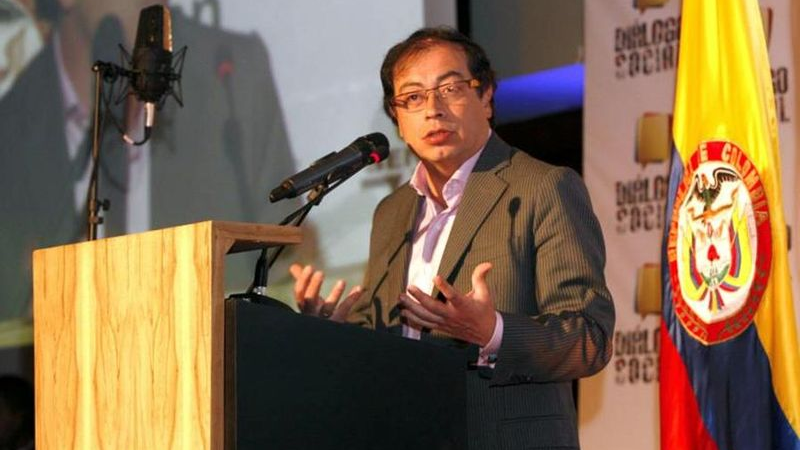
Image: Gustavo Petro. Author: Coronades03, licensed under the Creative Commons Attribution-Share Alike 3.0 Unported license.
 Labour Hub