
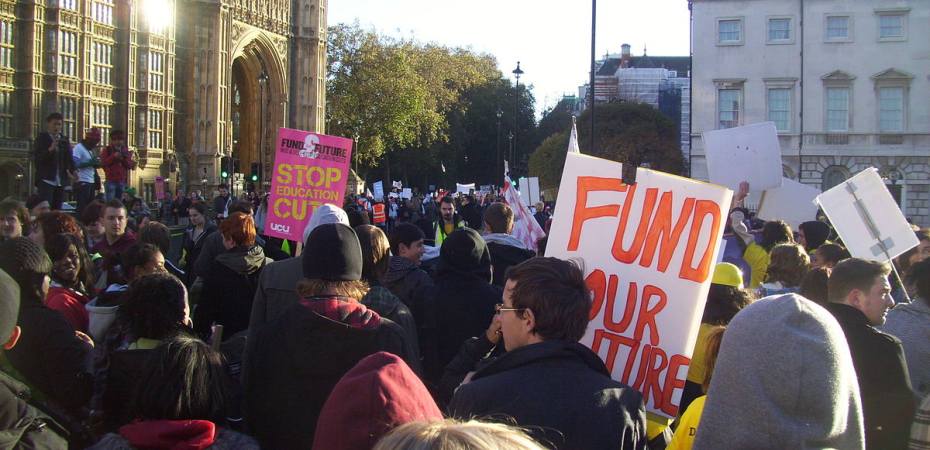
Keir Starmer is facing a battle over Labour’s tuition fees policy, after the Party’s student wing passed a motion in favour of free education. The resolution sets the stage for another major policy battle within the Party, which is currently consulting members and campaign groups on the policies for the next manifesto.
Starmer promised to abolish tuition fees in his leadership campaign pledges, but in recent weeks and months has signalled that the policy is up for review, with both Starmer and Shadow Chancellor Rachel Reeves stressing when asked that “a Labour government won’t be able to do everything we want.” (2).
Any such move is likely to incur the wrath of the Party’s youth and student wings, where the Momentum-backed ‘Socialist Future’ slate secured majorities in elections last year. The motion, passed at a Labour Students committee meeting on Friday, calls for the Party to commit to free education, including the abolition of tuition fees and the restoration of universal maintenance grants. It came after dozens of Labour clubs – university Labour societies – signed a letter demanding the Party leadership commit to free education.
Starmer’s tuition fee headache is only set to get worse, with a Labour Students Conference planned for later this year, where activists are expected to keep the pressure up.
The development comes as Momentum, the thousands-strong left-wing campaign group within Labour, announced a push with the Socialist Campaign Group around the Party’s National Policy Forum consultation running until mid-March, aimed at pressuring Starmer to adopt ‘flagship’ policies with widespread support in the party and among the public. Tuition fees is said to be high on the group’s priority list, alongside policies like public ownership and wealth taxes.
A recent study found that a whopping 9 in 10 students are worried about the cost of living. Meanwhile, the main academic trade union – the University and College Union (UCU), which is currently leading strike action in universities across the country – is also a vocal critic of the tuition fee system.
Fabiha Askari, Vice-Chair of (the National Committee of) Labour Students, said: “Student Labour members are speaking loudly and clearly: Keir Starmer must keep his word and commit the Party to the abolition of tuition fees in Labour’s next manifesto. Free education is vital not just to ensure the voice of young people is respected, but also to build a fairer future. Labour’s pledge to abolish tuition fees lit a fire in the belly of our 2017 election campaign – we need that sense of hope now more than ever.”
Nabeela Mowlana, Chair of Young Labour, said: “Like so much else in our country, the Tories have broken our higher education system, and indebted hundreds of thousands of young people in the process. To fix it, Labour needs to be bold. That means nothing less than the abolition of tuition fees and the restoration of universal maintenance grants. Young people are a key plank of any winning electoral coalition for Labour – we must not take them for granted.”
Text of the Motion
Motion: Labour Students supports free education, an end to tuition fees and the reintroduction of maintenance grants for all students.
Education should be free for all, from cradle to grave. It was this principle that led our Party to introduce free secondary school education for all children and establish the Open University. It was also this principle that led the last Labour manifesto to promise to ‘end the failed free-market experiment in higher education, abolish tuition fees and bring back maintenance grants’.
This position must be retained. Education ought to be a civic right. Not only does society benefit from the skills it allows people to develop, but it also ultimately allows for the satisfaction of our curiosities, the ability to express ourselves creatively, and the fulfilment of our potential.
Whilst the introduction of tuition fees was designed to level the playing field, the experiment has failed. The current generation are the first in 100 years to be worse off than our parents, with the poorest graduates leaving university with an average £57,000 of debt.
It is no surprise that over half of under 40s voted Labour in 2019, in large part because of our embrace of the principle of free, accessible higher education. As a party seeking to build a winning electoral majority, it is crucial that we do not take this support for granted.
Now more than ever we need to fight for free education. The next Labour government will have a once-in-a-generation opportunity to make this a reality.
National Labour Students Committee believes:
- In a system of demarketised higher education, that is refocused on learning and development not private profit;
- In the abolition of tuition fees for all UK students;
- In the re-introduction of maintenance grants for all students;
- That we should bring the UK higher education system closer in design to those in countries like Germany, France, Sweden, Denmark and Norway – we must recover some of Britain’s international reputation, this starts by having a functional education system that doesn’t rinse students for money.
National Labour Students Committee therefore resolves to:
- Publicly and proudly support free higher education, the abolition of tuition fees and the reintroduction of maintenance grants for all students, as laid out in more detail in ‘Appendix A’ of this motion;
- Commit to a Labour Students higher education policy of supporting free higher education, until and unless Labour Students Conference takes a position to the contrary;
- Write to the Shadow Secretary of State for Education, urging them to publicly support this position;
- Lobby the Labour Leadership and Shadow Education team to publicly commit to this in policy-making and manifesto decisions;
- Call on the NEC to include free education in the manifesto-making Clause V meeting.
Appendix A.
Free Higher Education Policy Paper
Two of the biggest issues in the UK higher education system are:
- Exorbitant tuition fees; and
- Maintenance loans that trap all students, especially those from working-class background, in thousands of pounds of debt when they graduate and become a medium-earner.
Before 1998, the Education Act 1962 made provision for all UK-resident students studying their first degree to not have any tuition fees they are obliged to pay. In effect, for all students studying only one degree, education was made completely free.
Similarly, the Education Act 1962 made provision for all UK-students to be entitled to a maintenance grant, not a loan, that would cover their cost-of-living through the duration of their studies.
Labour Students proposes a return to the principle of free higher education, but not necessarily to the exact system laid out by the Education Act 1962.
Labour Students proposes:
- A universal maintenance grants system that pays students the living-wage, as calculated according to the student’s region (i.e. London-based students with a higher cost-of-living should be remunerated accordingly), with reference to the system implemented by Welsh Labour.
- No tuition fees for a UK student’s first degree, and minimal tuition fees for secondary degrees.
Labour Students notes that a means-tested system of maintenance grants balanced according to, say, parental wealth, is flawed. This kind of system forces students to be financially reliant on parents or family, even if, for instance, they are victims of emotional or domestic abuse, or if the familial situation changes abruptly causing payments from family to end.
This system is not radical: it is the system that Labour’s sister parties administer in Germany and across Scandinavia. Free at the point of use higher education should not be controversial in a developed first-world country.
Labour Students notes that there are problems with the fee-system for non UK-resident students (i.e. international students), and that Labour Students ought to work constructively with the Labour Party and other organisations to develop policy to fix this aspect of our higher education system and make the UK a more attractive prospect for prospective international students. This area is not, however, within the scope of this policy document.
Image: Student protest march 2010. Author: BillyH, licensed under the Creative Commons Attribution-Share Alike 3.0 Unported license.
 Labour Hub