
Mike Hedges AM crunches the numbers
While discussion often takes place about electoral systems, little discussion takes place about the effect of the electoral system on the result. There are advocates of STV which is used in Scotland for Council elections, but the SNP have resisted bringing it in for Scottish parliamentary elections. The Northern Irish result where Sinn Fein won the most votes but not the most seats showed it to not be a strictly proportional system.
The 1945 general election, like all general elections, took place under the first past the post system giving a large Labour majority, but Labour actually polled less than the Conservatives and Liberals combined. It was the electoral system that meant a change of government, if the system had been proportional, we could have had a Conservative/Liberal government and no NHS.
The Welsh Senedd currently has sixty seats with forty directly elected by first past the post and twenty additional members elected via the D’Hondt system on a regional basis to bring some proportionality into the system. This was brought in at the creation of the Senedd and while Labour has always won a majority of the first past the post seats, it has never won more than three of the twenty additional member seats. This has led in good years to Labour winning thirty of the sixty seats but in poorer election years, the number of seats won reduced, to 26 in 2007 and 29 in 2016.
What happened in 2007 is that an attempt, which almost succeeded, was made to create a Conservative, Plaid Cymru and Liberal Democrat Government but the Liberal Democrats eventually withdrew their support and the attempt failed. Plaid Cymru then formed a coalition with Labour with Rhodri Morgan continuing as First Minister. In 2016 UKIP and the Conservatives backed the Plaid Cymru leader to become First Minister which only failed because the sole Liberal Democrat did not support them.
I think both sets of actions show that anyone who thinks Plaid Cymru are natural allies of Labour are either overly optimistic or delusional.
The proposal currently being discussed is to create a 96-member Senedd by pairing the 32 proposed parliamentary constituencies into sixteen constituencies electing six members each via the D’Hondt election method. These parliamentary seats, many of which are substantially different from the current parliamentary seats have not had an election so it is difficult to make any prediction on how they will vote at a general election and at subsequent Senedd elections on the joined constituencies.
What would have happened if the forty first past the post had been paired and elected three members per constituency or if the five regions had elected twelve?
The advantage of doing this is that we know how people voted in 2021 so it does not mean that predictions and estimates are needed. The assumptions made are that the constituencies joined must be adjacent, turnout would have been the same and that people would have voted the same way. If constituencies became more marginal, turnout would probably increase but also tactical voting could reduce.
The formula used to calculate the result using D’Hondt was provided by the Senedd research service.
Creating a sixty-member Senedd based upon using D’Hondt with twenty current constituencies created by pairing neighbouring constituencies to calculating the result would produce Labour on 35 seats, Conservatives on thirteen seats and Plaid Cymru on twelve seats. This is a better result for Labour than was achieved on the current additional member system.
If they were paired as above and elected six members each, Labour would win less than half the seats.
Applying D’Hondt to create a sixty-member Senedd based upon twelve members per regional constituency would produce 26 Labour members, eighteen Conservative seats, fifteen Plaid Cymru members and one Liberal Democrat.
At the 2022 Senedd election:
- On 40% of the vote Labour got thirty seats
- On 26% of the vote the Conservatives got sixteen seats
- On 20% of the vote Plaid Cymru got thirteen seats
Any more proportional system will see Labour winning fewer than half the seats.
The proposals for new constituencies are based upon pairing the 32 new parliamentary constituencies producing sixteen constituencies and having six members in each.
The boundary commission has decided on the 32 constituencies, but we do not know how they will be paired, and we have not had an election on these boundaries, so predicting the result with any accuracy is, I believe, impossible. What can be done is estimate the number of seats by using the 2021 results and allocating votes cast to each of the new constituencies and then pairing them.
The result I get from this is that Labour win between 44 and 46 seats, the Liberal Democrats one, which would mean the combined vote of the Conservatives and Plaid Cymru would be over half the seats.
Whatever system is introduced, Labour wins the most seats because it gets the largest vote.
For a 96-seat Senedd, assuming the Liberal Democrats win one seat, then on a strict proportional system Labour remain the main party on 44 seats but the Conservatives win 29 seats and Plaid Cymru 22.
To do as well under the proposed system as the current system, Labour would need to win four seats more than it would on its proportion of the vote. Unless the new system is less proportional than the current one then we do not get a majority Labour Government
We also know from 2007 and 2016 that when Labour wins fewer than half the seats then the Conservatives and Plaid Cymru try and form an alternative administration. Each time the Liberal Democrats stopped them by not supporting them, but on these figures they would have enough between them to not need the support of the Liberal Democrats.
What this shows is that there is no reason that Labour cannot win a majority using D’Hondt instead of the additional member system. The smaller the constituency, the better the result for Labour. Once constituencies get larger, other parties do better and Labour worse.
Mike Hedges is the member of the Welsh Senedd for Swansea East.
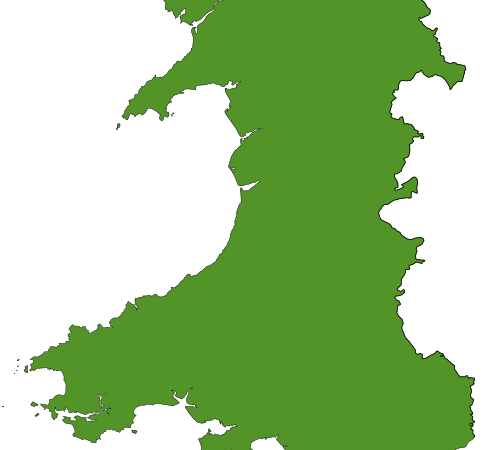
Image: Map of Wales.. Author: User:XrysD; Llywelyn2000, licensed under the Creative Commons Attribution-Share Alike 4.0 International license.
 Labour Hub