

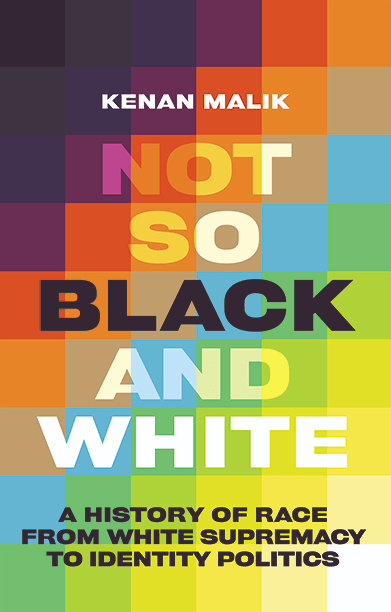
Mike Phipps reviews Not So Black and White: A History of Race from White Supremacy to Identity Politics, by Kenan Malik, published by Hurst
“The Britain in which I grew up in the 1970s was very different to the Britain of today,” Kenan Malik writes in the Introduction to his new book. “Racism was vicious and visceral and woven into the fabric of society in a way difficult to imagine now… But if it was racism that drew me to politics, it was politics that made me see beyond the narrow confines of racism… My politics, in other words, was not shackled to my identity, but helped me to reach beyond it.”
But times have changed. “Many of the organizations that allowed us to make those wider connections—such as the Asian Youth Movements—have disappeared. Countless groups in wider society that helped foster solidarity, whether within the antiracist or the labour movements, have disintegrated, too. Making those broader connections, seeing the bigger picture, breaking the shackles of identity, is more difficult today. Far from taking us beyond our narrow identities, contemporary politics is frequently circumscribed by them.”
Malik’s book is about the concept of race and the politics of identity. The origins of identity politics lie not in the left, but the right, with its focus on the questionable notion of race – not just physical and mental attributes, but also values and aspirations. Today the idea that one’s beliefs are defined by one’s identity is frequently found within antiracist circles, for example in the idea that if minorities do not follow the set script of what they are supposed to believe, they are not really black or Asian but straining to be white. Meanwhile the far right exploits the language of pluralism and diversity to remake racial ideas.
Malik argues that racism does not come about because “races collide”, but the opposite: elites invented ‘races’ to justify the varying treatment of different peoples. What made such an invention necessary was the gulf between the way Western nations sought to define themselves by their attachment to liberal Enlightenment values of freedom and equality, embodied for example in the American Declaration of Independence, and the reality of structural inequality, including slave ownership. “The contradiction was waved away by insisting that certain people were by nature unequal and not deserving of liberty and equality.”
This also helps explain why working class people more generally, irrespective of colour, were historically sometimes seen almost as a distinct racial group. In Virginia, USA, in the 17th century, it was common for indentured servants to be beaten, maimed, even killed with impunity. Half of Virginia’s servants died before their terms of servitude were complete: in the Caribbean islands the figure was even higher. Well into the 20th century, pauper orphans and even fathers of illegitimate children could be forced into bonded service in many Southern states.
In earlier days, black slaves and white indentured servants often made common cause – rebelling together, running away together, stealing together, making love together. They saw each other as sharing the same predicament. “Class distinctions, not racial divisions, were the means by which early colonial life was structured,” notes Malik. “There was no ‘white identity’ across class lines.”
Thus transatlantic slavery did not develop for racial reasons. The new colonial elites developed a quasi-slave system utilizing poor whites initially. Only later would this change. Virginia introduced legislation allowing for property belonging to blacks to be seized and sold, with the profits used to support poor whites – highly effective for sowing racial discord. ‘Miscegenation’ was made a crime.
But even as ‘whiteness’ was constructed, there were challenges to the inclusivity of the notion and new hierarchies created within it. Were Jews truly ‘white’? Were Irish people? Ideas of racial distinctiveness were a given in many Western societies and shaped their politics immensely. Even the extreme horrors of the Nazi Holocaust had its parallels in the beliefs of moderate US politicians who talked of the extermination of Native Americans as “moral”, or Western colonists who sought the extermination of entire peoples.
The hypocrisy of many Western liberals about the selective application of their so-called universal values has led some to dismiss the Enlightenment as an essentially European phenomenon. But this, argues Malik, is to miss the importance of the non-European world in shaping many of its ideas. This input ranges from ancient philosophies and religions to more recent struggles for fundamental rights, such as the Haitian Revolution and the efforts of organisations like the American Communist Party to unite workers regardless of race around a common agenda. It was “through the struggles of those denied equality and liberty by the elites in Europe and America that ideas of universalism were invested with meaning. And it is the demise of that radical universalist tradition that has shaped much of what we now call identity politics.”
The horrors of the 20th century led many on the left to become disenchanted with the Enlightenment. The rise of mass culture equally led to a loss of faith in the working class, argues Malik. Cultural perspectives opened new ways of telling stories about people and groups who had previously been ignored. But they also began to define the working class as much by its cultural attributes as by its economic or political aspects, and in doing so distorted both past and present. As the real power of the organised working class declined, “social conversations about politics and class gave way to increasingly fraught exchanges about culture and identity.”
The cultural lens provided a new framework for discussing race. The problem with this, asserts Malik, is its vision of the world “comprising myriad distinct cultures, not inextricably intertwined, but stiffly separate; a view, too, of human interactions as better understood in terms of cultural differences rather than of social similarities.”
This leads to unproductive debates about who has the right to comment on other cultures’ suffering. Discussions about cultural appropriation, Malik believes, are less about ownership than gatekeeping – and gatekeeping tends to protect the powerful rather than the marginalised.
More controversially, Malik is highly critical of the notion of “white privilege”: “it is not a ‘privilege’ not to have to face discrimination or bigotry; it should be the norm.” He enters into further tricky territory when discussing Black Lives Matter: “It is not just African Americans whose lives are devastated by police killings. More than half of those killed by US police are white… Studies show, unsurprisingly, that police violence is correlated with poverty—the poorer a neighbourhood, the greater the risk of an individual being killed by the police… Black people have suffered grievously and disproportionately from police violence, but paradoxically not simply because of racism.”
The problems around US policing have intensified with its militarisation. Under a programme initiated by the Clinton Administration, US police departments received $7.4 bn worth of equipment, including armoured vehicles and grenade launchers, from the Pentagon. Police patrolling schools are instructed to see themselves as “soldiers at war.” Contemporary police violence is more than just the product of racism, argues Malik: it’s the consequence of a long campaign to police poverty and contain the ‘lower class’.
Unsurprisingly, Malik is unhappy about the rise of identity politics: “we live in times in which any universalist perspective, or any desire to transcend imposed categories of race, is chimerical, and so we must appropriate for ourselves the identity cages in which we have been placed.” Although he briefly touches on the concept of intersectionality, a fuller consideration of this could have produced a more nuanced discussion.
But while the embrace of identity politics by much of the left has not always been constructive, far more dangerous is the right’s contemporary deployment of these ideas. Increasingly the conservative critique of identity politics is to reinforce its preferred identities – nationality and race against ‘globalisation’.
There remains plenty of room for the left to embrace an internationalist and universalist narrative. Malik’s strong belief in a politics of solidarity based not on particular identities but a shared set of values and beliefs, and the struggles to win acceptance for them, chimes with that.
Mike Phipps’ new book Don’t Stop Thinking About Tomorrow: The Labour Party after Jeremy Corbyn (OR Books, 2022) can be ordered here.
 Labour Hub