
Gregory Claeys outlines twelve steps towards a more sustainable future
My book commences from the premise that the state of the earth’s environment has passed from the critical to the catastrophic stage. Accordingly, if we do not act dramatically swiftly, we are unlikely to save the human species and much of the natural world from complete destruction.
The environmental premise rests on a consensus that at our present warming rate of about 1.2-1.3° above a pre-industrial baseline, we are witnessing an acceleration towards 2.5° and more within only a few years. Notional goals of keeping to 1.5-2° are rapidly being superseded as CO2 and other emissions continue to increase. The result is melting glaciers, polar icecaps, the depletion of the Amazon and other factors which indicate rapid water and food supply loss. Whether we look to the Colorado, the Rhein, the Rhone or the Yangtze rivers, or the Great Salt Lake, dramatic water shortages are now imminent. Far from having the luxury of considering 2050 as a suitable goal for levelling out emissions, we likely have only about seven years to reverse this process.
There is a way of averting this catastrophe, however. A programme of extremely rapid sustainable energy development, mainly wind, solar and tidal power, could produce 100% renewable energy supply by 2030.
However, energy supply is not the only issue confronting us. Resource depletion, and carbon and other harmful emissions, are crucially the result of the consumption habits of the wealthiest 10% or so of the globe’s inhabitants. Globally the richest 10% generate 50% of global greenhouse gas emissions, and the richest 1%, 80% of that total. Without curtailing this waste we stand no chance of survival.
So my book proposes that the history and concepts associated with the utopian tradition can be extremely helpful in the transition to sustainability. The utopian tradition has long relied on the idea that both individual and social happiness rests on substantial social equality, and that such equality in turn rests upon a contempt for vanity and the obsessive consumption of luxury goods. This we glean both from the theory of works like Thomas More’s Utopia (1516) or William Morris’s News from Nowhere (1890), but equally from large numbers of practical utopian communal experiments, mostly from the 16th century onwards, in which the price of social harmony has often been calculated in terms of a willingness to place needs above wants, and to discourage excessive consumption.
In Part One of the book, I outline a theory which permits the use of the concept of utopia to designate a real or existing state of affairs, in which prominence is given to equality, sustainability, and providing a sense of well-being which I orient around the idea of belongingness. Part Two then surveys the history of the tradition to identify problems of the wider strategy of promoting sustainability by looking at which variants of the tradition have been most successful in promoting a reduction of wants without entailing personal misery on their populations. The psychology of consumerism, and a brief history of its development from the late 18th century, along with the debate on luxury, are also considered.
Part Three then provides a general programme for introducing sustainability throughout the world. A detailed analysis is presented, indicating the major sources of current emissions and the likely costs – perhaps $200-300 trillion – of introducing sustainability.
Reducing consumerism requires at least twelve strategies. Firstly, we need to end planned obsolescence, or the deliberate design of goods to have the shortest viable shelf-life. Our attitude must be, to paraphrase Aldous Huxley, that mending is better than ending. [Brave New World (Penguin Books, 1955), p. 49.]
Secondly, we need to curtail certain forms of advertising – it has recently been proposed that the use of attractive young men and women to sell anything should be abolished. [Oliver James. Affluenza, p. 333.] This will not release us from the tyranny of branding, nor will it end the emulation of social ideal types, but it is a step in the right direction.
Thirdly, we need to reduce the impact of fashion on consumption, again perhaps by legislating against advertising, impossible though this sounds.
Fourthly, we need to shift towards a concept of public luxury, shared by all in museums, festivals, including free public transport and the like, and away from private luxury, and at the same time shift our values towards ‘consuming’ experience shared with others (or alone, as in some computer games) and away from consuming unsustainable commodities. This will require remodelling cities to give a feeling of neighbourhood and ‘belongingness’, a sense of place with which we can identify, and which is in my view also a central goal of utopianism historically.
Fifthly, restraining population growth will suppress demand for commodities. Sixthly, we must reduce our sense of self-identity as a reliance on having a choice of consumer goods. Social solidarity can only grow where an attachment to objects diminishes.
Seventhly, we must begin to displace techno-centred personal encounters, like sitting at a café with our friends, all of us staring at our phones, with human encounters in which technology is sidelined if not banned.
Eighthly, we can reduce our working hours, particularly as new machines are introduced, once demand for output is reduced. (But we need to avoid simply displacing greater demand to commodity-centred leisure activities.)
Ninthly, we require a vibrant feminism which results in equalising gender opportunities across society. Women, who possess considerably more power than men in disposing of household budgets, need full choice over their reproductive capacities, which will reduce family sizes.
Tenthly, expanded state action can publicise and sustain these goals. Decentralisation has its place, but small state ideals are not suitable to the complexity of a world-wide solution which must be forged and implemented in a few generations.
Eleventh, we must eliminate the expectation that speed of delivery and the volume of the product are the ultimate goals in consumption. This process, sometimes termed the McDonaldization of society [George Ritzer. The McDonaldization of Society (9th edn, Sage Publications, 2019)] places a premium on quantity over quality, and haste (‘fast food’) and instant gratification over sociability and delayed satisfaction. It also encourages indebtedness (‘buy now, pay later’), and the downward spiral of shopping-to-compensate for the depression we feel from being indebted as a result of shopping too much. Slower is often better.
Twelfth, and perhaps most obviously, we must drastically restrict carbon consumption to reduce C02 and other emissions. This will entail an immediate move to renewable forms of energy, reforestation, a drastic reduction in the most dangerous forms of consumption, and many other measures.
We should be clear that the crisis we face is completely unprecedented. Its magnitude remains unacknowledged. It calls for measures more complex and more radical than those yet in public discourse. It calls for us to set aside every other issue which divides us. It calls for common dedication and energy of a type never before mustered, beginning with massive civil disobedience to alert the public to the magnitude of the problem. If we act in time, the apocalypse can be averted.
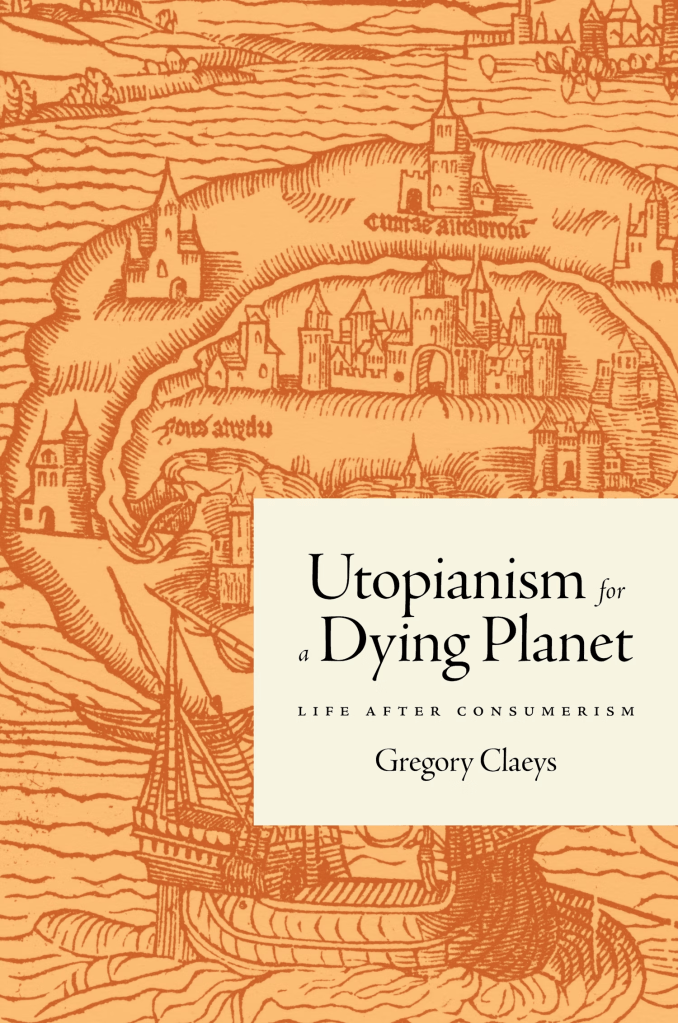
Utopianism for a Dying Planet: Life After Consumerism, by Gregory Claeys was published by Princeton University Press in 2022. Gregory Claeys is Professor of the History of Political Thought, Royal Holloway, University of London.
Socialist History Society public meeting
Utopianism for a Dying Planet
Life After Consumerism
How the Utopian tradition offers answers to today’s environmental crises
Speaker: Professor Gregory Claeys
7pm, Thursday 23rd February 2023
Free to attend, but you will have to register here
 Labour Hub