
Peter Rowlands examines the current balance of forces
The short story is that Labour has moved to the right, but it is worth looking in greater detail at and the background to this.
Firstly, the main figures. The huge influx of new members after 2015 largely comprised Jeremy Corbyn supporters. This was reflected in the 2016 leadership contest, which probably gives us an accurate breakdown of the balance of force: Owen Smith got Smith 190,000 votes, Jeremy Corbyn 310,000.
One might have expected a similar result in the 2020 leadership contest, except that a substantial number of Corbyn supporters switched to supporting Starmer on the grounds that his ‘Ten Pledges’ signalled a continuation of Corbynist policies. Since then up to 150,000 members have left, the vast majority, it can be reasonably assumed, Corbyn supporters. I
f this is anywhere near the case, it would give the right a small majority. This would be consistent with their dominance at conference in 2022 and at local level in terms of challenging left MPs, largely unsuccessfully. At local level factional activity is, in my observations over the years, usually confined to a small number, 5% or so of the membership, who also do most of the organising and campaigning, helped by a further 10% or so who help with some of it. The remaining 80% or so do nothing, and this applies to most of those who joined up for Corbyn in 2015.
There doesn’t seem to be much impetus coming from the left at the moment, whether it’s Momentum, the Campaign for Labour Party Democracy or the Socialist Campaign Group. The broadly right wing path that Labour is now on is likely to be enacted in government, although a majority Labour government is by no means a certainty. The Parliamentary Labour Party is not necessarily all on the right, but the left and soft left do not have a majority. SCG membership is a guide to the ‘hard’ left, but that of Tribune isn’t – Starmer’s a member! With the SCG’s 35 or so, and probably at least another 30 soft lefts, that would still leave the rest (effectively the right) in a broadly 2 to 1 majority in a PLP of around 200.
That is not to say that this ‘right’ is predominantly neoliberal, or socially conservative, but it sees even timid social democracy as a step too far. This is likely to be accentuated by the arrival of new right wing Labour MPs after the election, if recent selections are any sort of indication. Such a Labour government would not envisage any major change, but pressures may be too strong to permit that. Let us hope so. Otherwise the strategy appears to be to say nothing much until the manifesto is agreed this summer, with minimal rank and file involvement.
However, it is difficult to see that the current crude, patriotic, pro-NATO and pro-business orientation can do anything except to limit Labour’s appeal, and possibly help to trigger a major Lib-Dem revival. There are large numbers out there whose main concern is public services and housing, who are broadly pro-EU and know that international relations are a mess. Labour can’t win without support from this group, which its current approach makes difficult. Starmer shows no understanding of this, but the more perceptive leaders of the right surely do, although how that manifests itself is not yet clear. The last thing they want is to end up with some sort of messy coalition, which is a danger if the present orientation continues.
Meanwhile, the issue of proportional representation has to be confronted by the leadership. Although they have opposed any commitment to PR, without giving any reasons, it is unlikely that that position can be sustained, given the overwhelming support for it in the membership, including much of the right. Ruling out PR would further increase electoral support for the Lib-Dems, and it looks politically unfeasible overall, particularly as it has the support of about half the electorate. It is therefore likely that what will be agreed is a commitment for a future Labour government to review the issue.
However, the determination of some of the right to expel the left needs to be confronted by the left with confidence, unity and a clear strategy. I am afraid to say that I currently see little sign of any of that. The left must acquire that well before the big event, namely the non-selection of Corbyn, so that it has a clear response.
Corbyn has been treated disgracefully by Starmer and the leadership, and they continue to promote lies and distortions about him in much of what they write or speak about, usually centred on the ‘worst result since 1935’ accusation. It is worth reminding readers that the 2019 election result in terms of votes was better than that of Miliband in 2015 or Brown in 2010.
Corbyn, along with Bevan and Benn, is one of three Labour figures to have attracted large numbers to the left of the party through an appeal to basic socialism. Unlike the other two, however, Corbyn was leader, and his exclusion symbolises the new leadership’s rejection of left policies, as it is intended to.
Prospects for the left are not good, but we must hang on in there and make every effort we can to sustain and improve our position.
Peter Rowlands is a member of Swansea West CLP
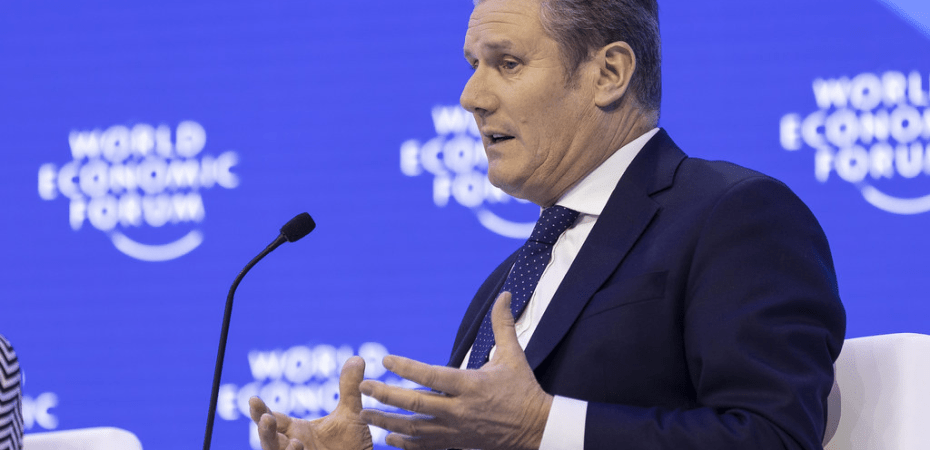
Image: Keir Starmer. Source: https://www.flickr.com/photos/worldeconomicforum/52636289312. Licence: Attribution-NonCommercial-ShareAlike 2.0 Generic (CC BY-NC-SA 2.0)
 Labour Hub