
By Professor Corinne Fowler
Through my involvement in writing the National Trust report on its country houses’ historical connections to slavery to British colonial rule, I found myself in the middle of a major news story after the report was published in 2020. The report was condemned by Cabinet Members and 59 Common Sense Group MPs and Peers, who turned the spotlight on me and my team of historians.
We were presented by influential opinion writers as unpatriotic denigrators of British history. My safety was threatened, I could not walk alone and I had to call on the police. Inflammatory news articles about the National Trust report sent lots of hate mail my way.
I did answer my hate mail, though, and I learned a lot from it. I discussed with the writers of those letters and emails what had upset them, and I discussed the evidence. We nearly always parted on good terms. All this brought home to me how divisive and unnecessary culture wars really are.
One prominent theme of these angry communications, which I received all that year, was the question: why are you talking about British colonial history? What about the sufferings of British factories and mines? But there is no need to choose between writing about British labour history and British colonial history. The factory system, agricultural work and rural poverty in Britain have everything to do with colonial history. Though colonized people and the British labouring classes are generally discussed separately, they belong to the same story.
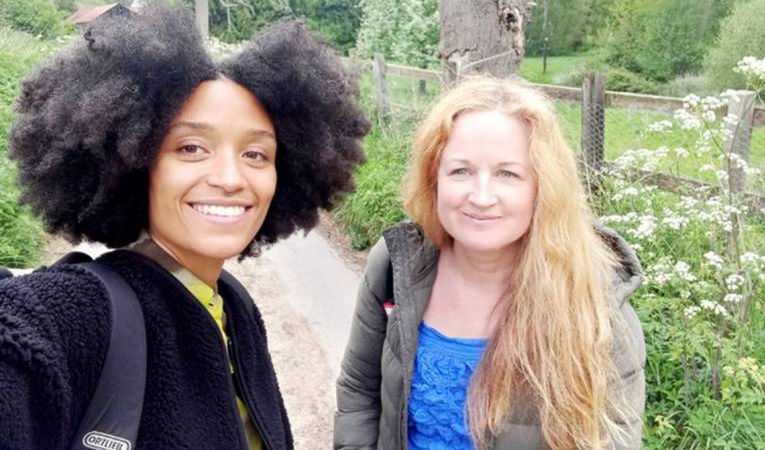
I decided to take ten country walks through the British countryside to explore Britain’s local histories of empire. The result was Our Island Stories: Country Walks Through Colonial Britain (Penguin Allen Lane, September 2023), my antidote to culture wars. The book is all about conversations, not shouting. I invited people to walk with me who’ve got ancestral connections to empire. My walking companions told me what local rural landscapes meant to them. Throughout our walks, we discussed the colonial activities which shaped those places, and considered history’s human dimensions.
Walking throughout the British Isles, from Scotland to Cornwall, I was keen to discover regional connections with empire. I was aware of the general historical pattern: plantation owners and East India Company employees returned to Britain with new wealth. They acquired social status and often political power, bought country estates and became MPs, magistrates, squires, landowners and employers. Moving deep into the countryside, I was after more particulars and wanted to discover how different parts of the country were uniquely changed by colonial figures like these.
I knew that colonial figures bought and developed cotton factories and copper mines in Cornwall or used their money to acquire rotten electoral boroughs. As Parliamentarians they upheld laws which denied labouring classes a say in law-making and political representation.
The local stories were fascinating. The Berkshire village of Pangbourne is one such example. Basildon Park is just three miles from Pangbourne and was owned by Sir Francis Sykes, the right-hand man of Clive of India. In Bengal, Sykes had the (lucrative) responsibility of raising tax revenues. He invested his newfound wealth in private trade in Indian goods and became a very wealthy man. He returned to Britain, acquired three country estates and became an MP. One of these was Basildon Park near Reading. His enclosed park changed the local landscape and dominated local lives.
Many such men who bought estates and created pleasure grounds availed themselves of Parliamentary Acts of Enclosure. One such man was William Windham Dalling in Norfolk, near Bungay village, a slave-owner whose father had been Governor of Jamaica. He used his West Indies plantation wealth to enclosure the local commons, where local people had collected firewood and grazed their livestock. The commons were privatised and local footpaths were blocked up. These are just some of the stories I came across on my walks.
Walking through British landscapes brings home the relationship between distant colonial rule and the experience of labouring classes in Britain itself. Our local places are so connected to British colonial rule. I explored links between Cornish copper mines and sugar plantations, Welsh wool and slavery, cotton factories and the Deep South, unionisation and British penal colonies.
One of the questions we have to ask about culture wars is why we often resist talking about the British empire. One of the answers is that this history feels unfamiliar to people. Successive governments have failed to provide even a basic knowledge of British colonial history. The people who sent me angry letters and emails had learned very little at school about the Royal African Company, the East India Company and even the British slavery system (and neither had I). To them, it felt as though the National Trust report had almost invented the colonial history of its places.
Having been embroiled in culture wars for an extended period, it is clear to me that we need to decontaminate our public conversations. First of all we need to stop weaponizing history and think of knowledge as a resource and not a stick to beat people with. In fact, we need to stop fighting altogether. Instead, we need emotionally intelligent and evidence-based approaches.
Colonial history and labour history are both repressed histories and it is productive to consider how they are connected. Deepening our knowledge of British colonial history can only benefit us. I have set about modelling better ways of having these conversations, including in a free online course called Country Houses and the British Empire Country Houses and the British Empire – Online Course – FutureLearn, which takes two very different people through the colonial history of stately homes in conversation with each other and with experts in the field. We should emphasize shared stories and this can only help us to understand the society we live in today.
Professor Corinne Fowler is Professor of History and Heritage at Museum Studies, University of Leicester. She will be speaking at the event below.

The Countryside: Three Walks Through Colonial Britain
UCL Caribbean Seminar Series 8th March 2023, 5:30 pm–7:00 pm
To attend the talk, book here
 Labour Hub