
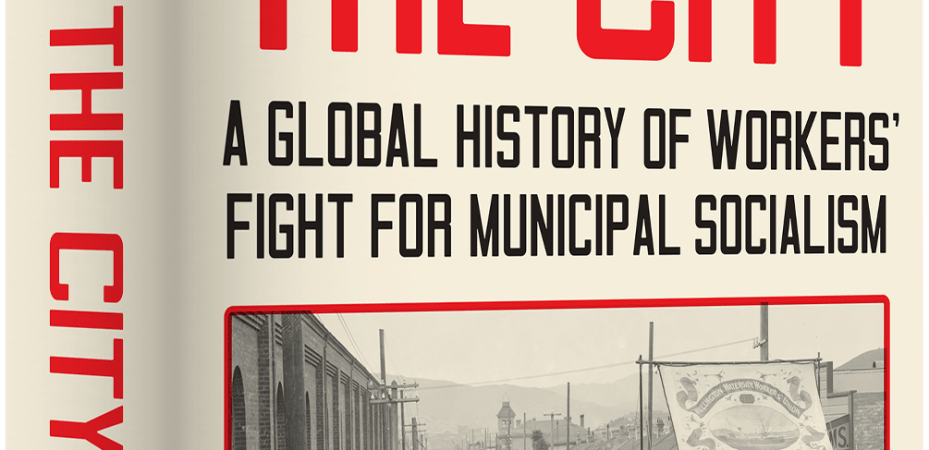
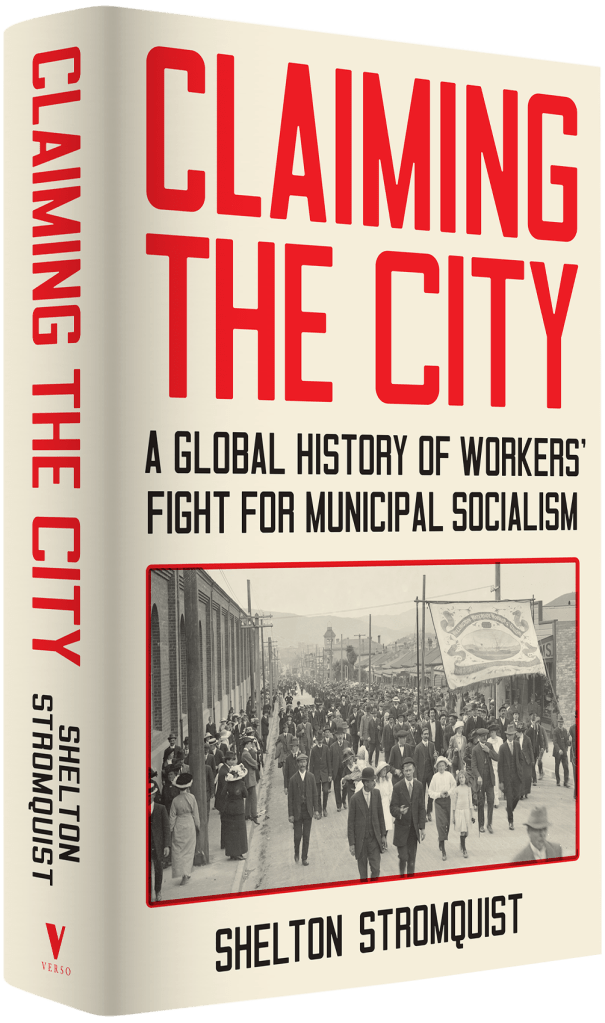
Mike Phipps reviews Claiming the City: A Global History of Workers’ Fight for Municipal Socialism, by Shelton Stromquist, published by Verso
An 850-page book, twenty years in the writing – and it really goes only to the end of World War One – the rest is covered in a short Epilogue. It’s a bit daunting for the reader, and for any reviewer who wants to convey some of the book’s ideas – and Stromquist’s ideas are worth hearing about. He opens with a quotation from over 110 years ago:
“Of all the fields of political activity the municipal one is in some respects the most important inasmuch as it is nearer to us than any other, touches our daily life closer, and has the most intimate bearing on the great social problem we are all striving to solve. Our municipalities are in fact the nearest thing to practical Socialism we possess.”
“Reforms That We Wanted,” The Worker (Sydney), January 13, 1911
Stromquist is drawn towards municipal politics because: “The most striking feature of labor and socialist politics at the municipal level in the late nineteenth and early twentieth centuries lay in the remarkable uniformity of its programmatic vision. Labor, socialist, and feminist activists across the industrializing world crafted programs that promised immediate relief and popular, democratic control of the local urban worlds they inhabited.”
Since the Paris Commune, the stories of municipal socialists have tended to be seen as marginal additions to the national narrative. But in fact, suggests Stromquist, they recast that narrative. For workers, the city is a more important focus of identity and struggle than the nation-state. Indeed there was often a significant tension between the two:
“Social democrats’ aspiration to parliamentary power became a Faustian bargain in which they accepted, even celebrated, nationalism and the nation-state’s dominion at the expense of workers’ local power and international class solidarity. Social democratic parties could become simply reform parties, their socialism diluted and subdued. Their bargains with liberals… provided a continuing path that beckoned them to power-sharing and ultimately in the context of war subverted their internationalist rhetoric.”
Stromquist’s alternative narrative takes us from the Paris Commune and its brutal suppression, through 19th century municipalism, the great city strikes at the turn of the 20th century and the rise of labourism.
The scope is wide. Stromquist covers Britain, Germany, Austria, Sweden, Australia, New Zealand and the USA in detail. The focus on internal party debates, especially in Germany, between radicals and gradualists (and in the US, between “constructivists” and “impossibilists”), makes sections of this book a bit heavy-going.
But the sense of steady progress comes to an abrupt end with the assassination of French Socialist Jean Jaurès, the onset of the First World War and the collapse of the Second International. Despite significant anti-war protests in small towns and cities in France and Britain, inevitably the failure of national leadership and state repression demobilised these movements.
As a result, in the face of nationalist fervour, local labour activists “at first hunkered down, refocused their attention, and prepared to assert their claims to economic fairness and democratic rights in a nation at war.” In Britain especially, “it was to local government institutions that workers and their Labour Party allies turned for remedies to the deteriorating conditions of daily life brought on by the war.”
Local Distress Committees soon became sites of political struggle. When these unelected bodies tried to exclude working class representation, other organisations mobilised. In some towns ‘Vigilance Committees’ were set up, in one case following a public meeting in opposition to local businesses’ price-gouging, a frequent complaint.
As wartime created “a stew of popular discontents that weakened the hold of ruling elites locally and nationally”, reports Stromquist, “hard-pressed tenants, conscientious objectors,
free speech advocates, consumers, trade unionists, socialists, and the ILP gravitated toward opposition” – with increasing openness.
Housing was a key issue, with Tenants Defence Leagues sometimes promoting rent strikes. A War Rents League formed, highlighting thousands of cases of landlords raising rents to outrageous levels. On Clydeside, huge meetings, often organised by women, led to a massive rent strike of 20,000 tenants in 1915, with direct action to thwart sheriffs’ deputies. The agitation spread to Birmingham, Sheffield, Belfast, much of London, Coventry, Birkenhead, and Northampton and forced the government to adopt a new Rent Act that reined in landlordism to some degree.
Industrial militancy also increased. Although wartime strikes were discouraged, there were some significant actions – again ‘Red Clydeside’ led the way. Given that 2.4 million workers struck in 1919, one historian concluded that “the period of the war simultaneously strengthened workers enormously, angered them bitterly, and forced them to interpret their problems politically.”
Australia also saw major industrial militancy in the War years, including a general strike in 1917. In other countries, the fight against conscription took centre-stage, particularly in the US where a system of “selective service” was used to isolate and marginalize war opponents, and private organisations like the American Protective League were mobilised to round up and detain thousands of draft -age men.
Campaigns against conscription also took off in Australia, drawing in significant numbers of women. Here and elsewhere, they necessarily oriented towards national politics. It’s a paradox of Stromquist’s book, which tries to emphasise the importance of the local in shaping the development of national movements, that the less municipal things are, the more interesting they become.
However, this is less true for central Europe. In Germany, protests against food shortages were invariably local, militant and increasingly significant, helping to shape and generate much of the energy for the Revolution of 1918. In Austria, patient work by the left culminated in the achievement of ‘Red Vienna’, when the Social Democrats held almost unilateral control of the city from 1918 to 1934 and raised taxes on the wealthy to fund extensive programmes of housing reform and social and cultural uplift.
Overall, I’m not sure that Stromquist proves his thesis that a deeper look at the municipal politics of this period leads to a significant rethink of our understanding of the development of the labour movement. But his book does convey the often brutal and polarised way that politics was conducted at this level. It’s an impressive achievement.
Mike Phipps’ new book Don’t Stop Thinking About Tomorrow: The Labour Party after Jeremy Corbyn (OR Books, 2022) can be ordered here.
 Labour Hub