
Ahead of a presentation of his new book, The Blue Commons, in the Wilson Room of the House of Commons at 19.00 on Monday, March 27th, Guy Standing sets out why the government needs to act urgently to protect the marine environment.
In 1982, as part of the United Nations Convention on the Law of the Sea (UNCLOS), the United Kingdom gained 4.8 million square miles of sea that meant that it owns twenty-seven times as much sea surface as land surface in what is called its Exclusive Economic Zone. Other countries gained huge amounts as well, resulting in what was easily the biggest ‘enclosure’ in history.
A great deal of economic activity takes place in the sea. Today, if the sea were a country, it would be the world’s sixth largest economy. It is projected to double in size by the end of this decade. The World Bank and other international bodies forecast that ‘blue growth’ will outstrip GDP growth for the foreseeable future.
Yet the blue economy receives very little political attention. There is a Green politics, but not a Blue. This neglect was brought out vividly in the COP26 agreement in Cairo last year and the COP15 agreement in Montreal shortly afterwards. In the former, a short section on the oceans that was in the draft was completely removed in the final agreement.
The neglect extends to domestic politics. Britain, along with other coastal countries, should appoint a Cabinet level Minister for the Sea. Somebody must be at the top table in Downing Street and Westminster defending and promoting the interests of the blue economy. The sea, the seabed and seashore should be treated as ‘the blue commons’, that is, as belonging to all citizens of the UK, with the government acting as the Steward responsible for preserving it as best it can. This is the core of my new book.
In the case of Britain, a new Secretary of State for the Sea should have a few urgent priorities in the next government. First, he or she should overhaul the fishing quota system. At present, the government gives quota to individual fisheries, mainly through Producer Organisations that are meant to be democratic bodies representing all fishers in various regions. But most are run by a few big fisheries or commercial interests. One result is that just 25 industrial fisheries have been given over two-thirds of all the quota and are in control. In 2011, 13 of them were caught in an illegal fishing scam, worth over £60 million. They were fined modestly but allowed to continue holding their quota.
The trouble is that illegal fishing is treated as a civil offence, not a criminal one. So, on the rare occasions when a fishing trawler is boarded and found to have broken the law, it receives the equivalent of a slap on the wrist and is allowed to continue. One vessel, a Dutch-owned but UK-registered boat that was the biggest in the whole fleet, was caught with 632,000 kilos of illegally-caught mackerel. It was fined £96,000 and then allowed to sell the mackerel, gaining over £430,000. The fishing industry effectively run the government, not the other way round.
The new Minister should overhaul the quota system, providing annually renewable licences and stating that any fishery caught illegally fishing or overfishing would lose all or part of their quota. What those massive trawlers have been doing is driving vital fish populations towards extinction. The government cannot escape responsibility for that.
This leads to a second priority. At COP15, all governments committed to protecting 30% of their land and oceans for the environment. But the protection is not real. At the UN Summit on Biodiversity in 2020, Prime Minister Boris Johnson was characteristically economical with the truth when claiming that Britain was already protecting 26% of its sea and was “world-leading”. This claim was based on measuring designated Marine Protected Areas (MPAs).
But studies have shown that bottom trawling, the most destructive form of industrial fishing, has been systemic in 71 of 73 offshore MPAs around Britain. And a Greenpeace investigation found that 25 supertrawlers, including 15 Russian boats and the four biggest vessels in the world, were fishing unchecked in 39 MPAs. Showing how little it cared, in 2020 the government blocked an amendment to its Fisheries Bill that would have banned supertrawlers in MPAs. That is not protection. It is a national disgrace.
Compounding the problem, since 2010 the government has slashed the budget of the body responsible for monitoring and policing the sea, the Marine Management Organisation, and in 2022 licensed over 1,000 foreign and UK vessels to bottom trawl in so-called protected areas. Besides banning such destructive activity, the new Minister must build up the monitoring capacity. Right now there are just 12 coastguard vessels designated to protect all British sea space against illegal fishing and other activities.
Another urgent priority is the need to regulate mining in the sea. Here a time bomb is ticking, which may have gone off before the Minister is appointed. Under UNCLOS, no deep sea mining is allowed anywhere until an international Mining Code and a benefit-sharing system have been established by the International Seabed Authority (ISA). Since it was set up in 1994, the ISA has failed to achieve either. But in July 2021, the tiny Pacific nation of Nauru, collaborating with a Canadian mining corporation, activated an obscure article in UNCLOS that states that if a nation applies to start deep sea mining, ISA has two years to produce a Code and sharing mechanism. If it fails to do so, deep sea mining can start. There is no prospect of such a Code by July this year. A wild west mining frenzy may begin.
Marine scientists are alarmed. Deep sea mining could have catastrophic ecological effects. But Britain has been passive. Indeed, in 2011 the government quietly gave a contract to the British subsidiary of a US arms company to undertake exploratory mining in its sea area in the Pacific. It refused to reveal the terms of the agreement. But in 2021, an NGO managed to have the details made public. It showed that the area of exploration was much bigger than allowed under international law and that the contract was for much longer than is allowed.
In short, the Minister must get a grip on regulating marine mining. We know that the seabed has a vast range of valuable minerals, many of which are only available in limited quantities on land and many of which are needed for any ‘green technological revolution’. But if commercial interests are allowed to supersede ecological concerns, in the interest of maximising economic growth, we could face major ecological disasters.
Another area where Britain has been lagging is in ‘marine genetic resources’. Globally, corporations have been establishing intellectual property rights to novel applications of organisms in the sea for medicinal, cosmetic and other purposes. So far, over 13,000 patents have been filed, each guaranteeing monopoly profits for 20 years. One German company, BASF, has 47% of them and three countries (Germany, USA, Japan) have 76%. Britain is nowhere. A government strategy is needed.
This has been made more topical by the agreement in New York of a United Nations ‘Oceans Treaty’ in March this year, after two decades of wrangling. Governments, including Britain’s, agreed that there should be international benefit sharing from marine genetic resources identified in the High Seas. It is far from clear what arrangement will emerge, let alone how long it will take to do so. However, the new Minister in a new British government should take a lead in negotiating such an arrangement.
Other priorities elaborated in the book include the need to regulate the rapidly growing aquaculture industry, the need to regulate our ports, all privatised by Margaret Thatcher and mostly owned by foreign financial firms and Chinese capital, and the need to stop the auction of the seabed by the Crown Estate. In short, we must demand all economic activities in the sea are treated much more seriously by government.
Guy Standing is Professorial Research Fellow, SOAS University of London and a Council member of the Progressive Economy Forum. He is author of various books, including The Precariat: The New Dangerous Class and The Corruption of Capitalism: Why Rentiers Thrive and Work Does Not Pay.
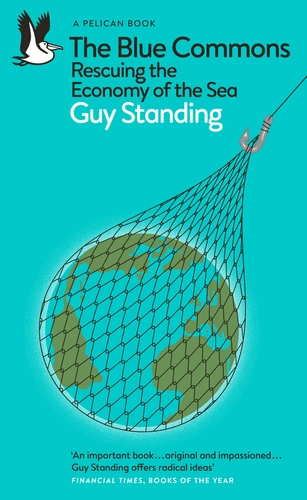
Guy Standing will be making a presentation of his book, The Blue Commons, in the Wilson Room of the House of Commons at 19.00 on Monday, March 27. He is making other public presentations in March and April in Bath, Keele, Oxford, New York and Southampton.
Image: https://www.pexels.com/photo/scenic-view-of-the-sea-722687/. Free to use (CC0)
 Labour Hub