
Twenty years on from the Western bombardment and invasion of Iraq, Jo Wilding who at the time was living in Baghdad and working as part of a children’s circus troupe, reflects on its barbaric impact.
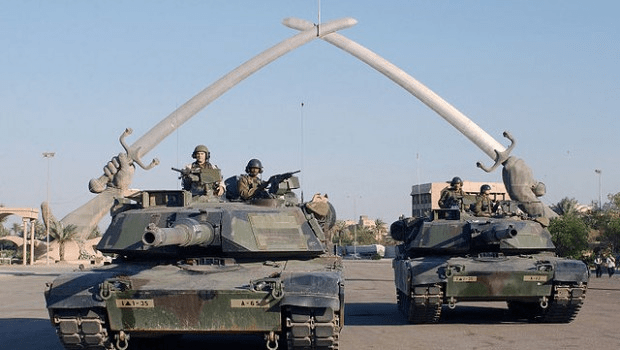
Iraq is the home of fairytales and legends. They literally line the streets: sculptures of Kahramana, the housekeeper of Ali Baba, pouring oil into the barrels where the forty thieves were hiding; Aladdin, taking to the air on a rippling carpet; Shaharazad, telling stories to Sharayare for 1001 Arabian Nights; these as well as the giant crossed swords commemorating the war with Iran, and road signs pointing you to Samarrah, Ur, and Babylon, where there were still bricks bearing the stamp of King Nebuchadnezzar.
Everything about Iraq in 2003 was smoke and mirrors, rumour and fairytale, but with real, flesh and blood humans walking through it: humans who had already gone through so much with dictatorship, successive wars, and over a decade of brutal economic sanctions which, if anything, had strengthened the dictator. Almost everyone depended on the food ration, which was one way of controlling the population, and there were financial rewards for reporting on your neighbour – which must have been tempting when you couldn’t afford even basic medicines.
In the weeks before, we were all tracking the international politics of it: would France or Russia use their UN Security Council veto? Would enough of the non-permanent members vote against? The foreigners, restricted to certain hotels, bought up tin foil to wrap up their laptops against the tech-destroying weaponry that the Americans were rumoured to possess.
At the same time, in Baghdad, people were making preparations – getting the well-diggers in to put a borehole in the garden, for when you couldn’t get water from the taps anymore; buying in bottled water, which by now cost more than petrol; taping Xs across their windows, because a nearby blast would shatter them, and the tape might save you from being lacerated by flying glass. Or they didn’t, and they just lived from day to day because the sanctions had left them so poor that they had to sell part of their food ration each month to buy medicine.
The BBC’s timeline of the Iraq invasion notes that, in the campaign of aerial bombing between 20th March and 9th April, “Bombs are dropped on a farming community outside Baghdad where intelligence incorrectly suggested Saddam Hussein might be hiding.”
I remember the families in those farming communities. Shocked, terrified, bleeding, bereaved, and completely unable to understand why missiles had been fired at their farmhouses.
The first we knew of it was when we met one of the families in the hospital, where we were gathering information about bombings with civilian casualties. A young man, Khalid, bandaged, crumpled to the ground as his father told him his newly-wed wife was killed. There were a lot of weddings in the weeks before the war. With them, a four-year-old boy, Mohammed, bleeding and crying; his sister Nada with serious head and leg wounds; another sister Zahra, dead, along with her aunt, Hana, in the rubble, and their mother Fatima howling for her dead daughter and sister, repeating over and over the same words we would hear again and again: “Why? Why? Give me one reason why?” It’s among the few Arabic words I still remember, 20 years later: Leish?
We went to the farmhouse the next day, far out in the countryside outside Baghdad. The mother had taken her children there to be safe from the bombing in the city. The little girl and the two young women had just been buried. People described seeing a plane circling overhead for a couple of minutes before it fired the three missiles. One hit the house, taking off the entire upper floor. Neighbours said their children’s ears bled.
Months later, we would meet them again. They still had no idea why their farmland was attacked. No one had mentioned to them the flawed intelligence that Saddam Hussein might have been hiding there. No one had been to ask after them, to see if they were OK, much less to offer help. They welcomed our visit, but they were afraid, because visitors might draw attention to you. Before, you never knew who was reporting to the Baathists. Now you never knew who was reporting to any number of groups.
On the morning after the bombing started, my friend Zaid turned up at my hotel in his car and asked the receptionist to let me know my driver had arrived. There were so many journalists around, each employing a driver and an interpreter or a fixer, that it was easy enough to get away with. Normally foreigners couldn’t just spend time with Iraqis unsupervised by a minder. The old rules were not gone yet – as we would discover when a friend who worked for Médecins Sans Frontières was arrested for having a satellite phone, and didn’t reappear until after the fall of Baghdad, when all the surrounding towns and cities were also occupied, several weeks later.
But this was a space in between, and Zaid and I drove around the city seeing what was happening. In between, my colleague Julia and I went to hospitals and the sites of bombings, to try and piece together the nature and extent of the attack on civilians – who was being hit, where in the city, and with what kind of weaponry, aimed at what kind of targets? I still hoped that eyewitness evidence would lead to some kind of justice.
On 31st March, about a week and a half before the fall of Baghdad, I was expelled by the Foreign Ministry. It happened to most of us, sooner or later, as the paranoid Iraqi government struggled for control of at least something. The coalition would take control of Baghdad on 9th April and the last surrounding areas in the following days.
When I went back, in November 2003, I quickly learnt a new set of words: Wayn al infijar? Where was the explosion? Wayn al qunas? Where is the sniper? Wayn al dababa? Where is the tank? There were concrete blast walls, and the UN building was bombed not long before I got back. The little boys who used to shine shoes outside the hotels were addicted to solvents and being controlled by gangs, but some friends of ours set up a shelter that provided a kind of half-way house before the kids could adapt to life with rules in a children’s home.
There was a curfew still in place, put in eventually to stop the looting and carjacking and chaos that happened immediately after the invasion, which would soon be lifted to allow people to spend time with their families during Ramadan. Petrol queues were massive, and there were severe punishments for black marketeering. Women who had never covered their hair in the past were now afraid to go out without a headscarf.
Even so, it was the calm between the storms, before the two Fallujah sieges, before ISIS, before all of the sectarian horrors that were to come. I came home in April 2004, finished qualifying as a barrister, and went into immigration and asylum law.
Our friends whom we worked with in the circus, were attacked, two of them murdered, along with a friend, and the rest forced to flee – some to Egypt, some to Syria. Zaid got work as a journalist, but ended up having to flee to the US. Others fled to Canada, Jordan, the UK. And my caseload was full of Iraqi refugees, fleeing the violence and the chaos, the hell that had been unleashed. Now, 20 years later, they’re still coming – although the Illegal Migration Bill aims to deny them any protection.
I know a lot of people felt a sense of hopelessness when the war began, in spite of everything, everyone who tried to stop it. We shouldn’t, because we’ll never know how many more wars and invasions that resistance has prevented. Most of all, though, we shouldn’t, because resisting war was the right thing to do.
On one of my last days in Iraq during the bombing, we were talking to victims of a bombing outside a mosque at the end of prayers. A young man had shrapnel in his forehead and doctors were trying to treat him, in whatever the 12-year sanctions regime had left of their hospital. His mum could only whisper, “I am his mother”, through tears as I held her. But his dad thanked us for coming:
“Help us, because we are attacked in homes and streets and markets. We are not something to be squeezed. We are thankful to people in all the world [for opposing the war], but especially England and America. More than a million people in England say no to war. There is not a problem between people. There is a problem between governments.”
Now more than ever, never give up fighting for that shared humanity.
Jo Wilding’s book Don’t Shoot The Clowns: Taking a Circus to the Children of Iraq was published by New Internationalist in 2006. She is now a Lecturer in public and migration law at the School of Law, Politics and Sociology at the University of Sussex.
Image: Iraq-War-US-tanks. Author: Shockabrah, licensed under the Creative Commons Attribution-Share Alike 4.0 International license.
 Labour Hub