
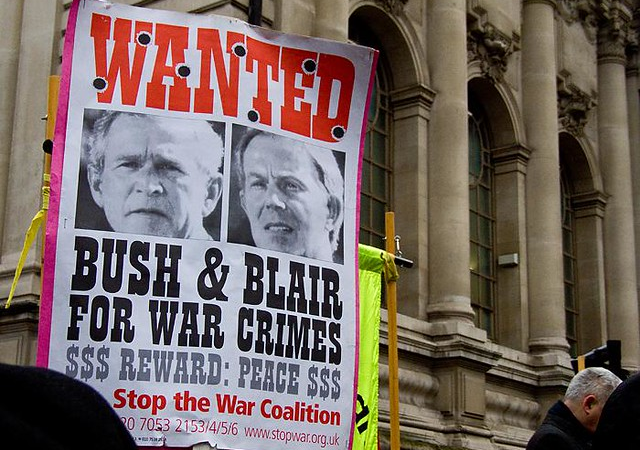
Pennie Quinton recalls an evening of police brutality
On WhatsApp a friend who is a retired lieutenant colonel in the British Army texts me: “20 years ago today I was invading Iraq.”
I respond: “20 years ago, today I was supposed to be teaching filmmaking to youth in the South Bank London. But my class walked out to protest the invasion of Iraq.”
“Nothing against you Miss,” they said, “but this war is wrong. We have to protest – sorry,” they said as they walked out of the door.
I followed my students across Waterloo Bridge onto the Strand where I saw thousands of young people heading to Trafalgar Square. As I had my camera gear for the workshop I filmed.
The police were outwitted as they were not ready for how fast and fit teenagers are. The youth were determined to reach Trafalgar Square.
As I arrived at Trafalgar Square, it was getting dark. There were metal barriers erected in the middle of the square. The police officers were forcing crowds of teenagers onto the metal barriers where they were being crushed. I spotted my friend, an ex–Marine, caught up on the barriers trying to protect the kids.
The police seized him and smashed his head repeatedly against the barrier – there was blood pouring from his forehead. He was arrested and taken, we guessed, to Charing Cross police station.
When we got to the police station – there were two Bengali men waiting at the counter. I heard them enquiring about their younger brothers who had been arrested on the protests. The desk sergeant asked them to wait. They waited.
It was our turn- there were about 20 of us who all knew J, the ex- Marine. At first the officer refused to tell us that they had J in custody, saying he had been taken to University College Hospital (UCH) A&E. We called UCH A&E, but they knew nothing of J.
We were extremely concerned for J’s safety after the officer denied any knowledge of J, having witnessed the violence the police had inflicted on him. I later learned that behind locked doors, as J was being processed by the custody sergeant, the following exchange took place.
“I need a surgeon,” J had said, “I’m bleeding.”
The officer denied this, saying: “I don’t see any blood.” J took his palm, dipped it into the blood pouring from his skull and made a bloody handprint on the custody book. “There’s some blood,” he said, at which point he was taken to hospital.
After much haggling and us calling three different A&E departments, the officer finally admitted he was in their custody and that he would be taken to hospital. We waited until we finally tracked him down to an A&E department.
The cops told us to leave and just as we were leaving one male cop said, “I’ve had enough of this.” He came into the foyer and attacked the two young Bengali men still awaiting news of their younger brothers’ arrest. The men were doing nothing, just politely waiting at the counter.
I started filming the assault – a cop picked me up and hurled me out of the door. I hit the side of a moving van passing on the street. I bounced off the van in time to see the cops beat everyone else down the steps out of the police station.
One man said to the officer attacking him: “You hit me.”
“Yeah, I fucking hit you,” was the officer’s response.
As I got to my feet a female police officer came after me with her fist raised. “Come on then, come on then,” she said.
I guessed she wanted to provoke an arrest to confiscate the footage of their attacking the Bengali guys. I put on a police inspector voice and said, “Get back, three feet, stay back.”
She reverted to her training and stepped back. I walked away. As I reached the Strand, police were attacking skateboarder kids and I stopped to film. The cops picked me up and threw me into the bundle of kids they were beating. One cop started whacking me across the back with a skateboard. Someone pulled me out of the heap of bodies.
It was a hellish night of police violence as what seemed to be the entirety of London’s school children walked out of school in a mass protest against Blair and Bush’s illegal invasion of Iraq.
Pennie Quinton is currently a doctoral candidate at King’s College London, at the Department of Global Health and Social Medicine, examining the somatic impacts of conflict on women’s health. Her research examines women’s lived experience of dispossession in the occupied Palestinian territories. She is also a freelance journalist who writes articles and contributes photo essays on issues of social justice and the visual arts. Her articles, videos and photographs have been published in the Saatchi Gallery Art and Music Magazine, the Guardian, Al-Jazeera English online and Ceasefire magazine.
Image: https://www.flickr.com/photos/chrisjohnbeckett/4314337934, by Chris Beckett. Licence: Attribution-NonCommercial-NoDerivs 2.0 Generic (CC BY-NC-ND 2.0)
 Labour Hub