
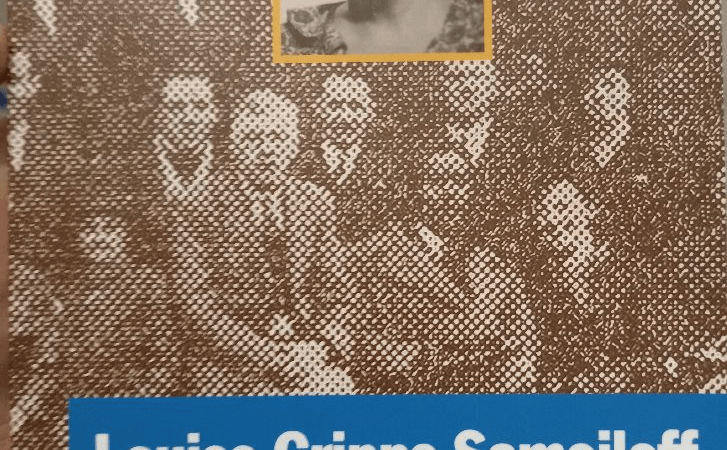
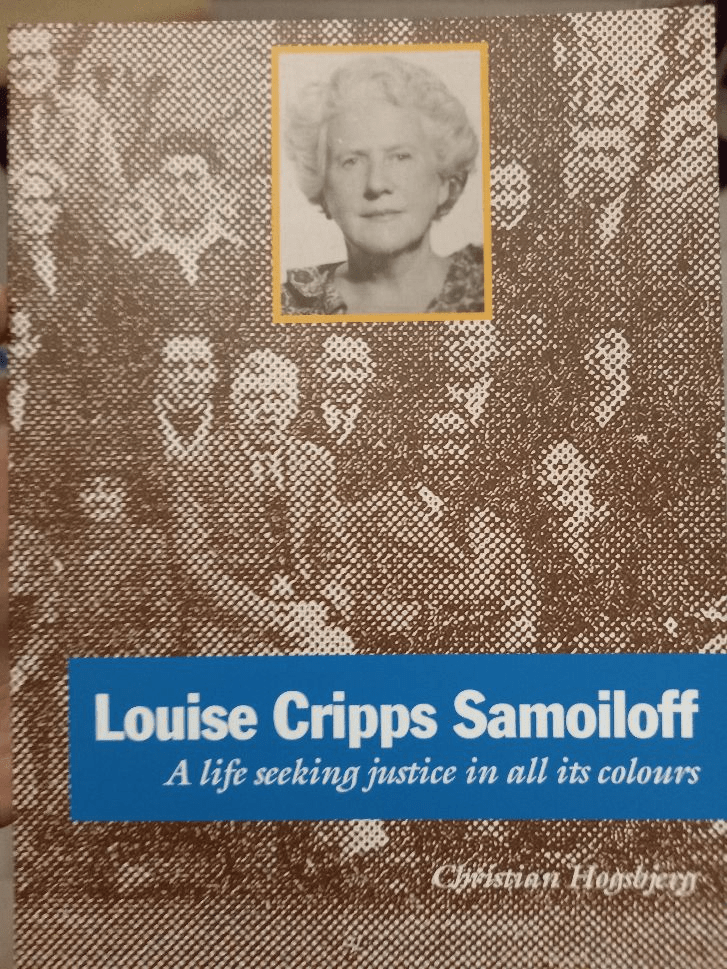
Christian Høgsbjerg introduces his new book Louise Cripps Samoiloff: A life seeking justice in all its colours, ahead of his Socialist History Society talk about it
Louise Cripps Samoiloff was an English-born socialist, writer, journalist, publisher and historian who was the author of over a dozen books, including a novel, but like many twentieth century radical women, has remained somewhat ‘hidden from history’.
She was born into a conservative middle class family in London in 1904, and at one time worked for Vogue magazine, but like many during the greatest crisis of capitalism ever in the 1930s became political, becoming a Marxist, and joining the tiny British Trotskyist movement. By the time of her passing in 2001 she had become an American citizen and written many anti-imperialist books, particularly focused on advancing a clear socialist case for the independence of Puerto Rico. These included Discovering Puerto Rico (1969), Puerto Rico: The Case for Independence (1974), The Spanish Caribbean: From Columbus to Castro (1979), Human Rights in a United States Colony (1982), Calamity in the Caribbean: Puerto Rico and the Bomb (1987), and Should Puerto Rico become the 51st state? (1998).
Her books were mostly written after she and her second husband, Leon Samoiloff, had retired and moved to Puerto Rico. While her heart condition meant she was unable to be politically active, she was able to put her energies into writing for what she called this ‘new cause’. As she put it towards the end of her life, “my political books … had as their objective the call for independence of Puerto Rico. In all, I had ten books published: only two of them about Puerto Rico were apolitical [Portrait of Puerto Rico, 1984 and Puerto Rico: An island Christopher Columbus discovered 500 years ago, 1987]. The rest dealt with various problems of the island as a colony of the United States. They were issued by well-known North American publishers and distributed mainly through the United States and Puerto Rico.”
One Puerto Rican writer friend of hers, Piri Thomas (1928-2011), author of works such as Stories from El Barrio and his bestselling memoir Down These Mean Streets, eloquently described her as “one of those who see justice in all its colours and believe, as we all do, in the right of self-determination for all countries, large and small, which includes our island national Puerto Rico, Boriquen, isla de Encanto [Boriquen, island of charm].”
Over the course of her life, Louise Cripps Samoiloff courageously and determinedly challenged what has been described as “the fortress of the masculine public sphere”, striving to fully participate in public life as a woman, even if she was not in general self-consciously doing this as a woman. In the process Louise met many leading political, intellectual and cultural figures of the twentieth century including not only Piri Thomas himself but also Roger Nash Baldwin, Earle Birney, G.K. Chesterton, John Dewey, Havelock Ellis, George Grosz, Harold Laski, Gordon K. Lewis, George Orwell, George Padmore, Paul Robeson, Bertrand Russell, Benjamin Spock, Adlai Stevenson, Norman Thomas and Eric Williams. She was even offered the opportunity to work as a secretary for the exiled Leon Trotsky, and one of her greatest regrets was that she turned this down.
Yet perhaps most critical for her politically was her relationship with the black Trinidadian Marxist C.L.R. James, author of the classic 1938 history of the Haitian Revolution, The Black Jacobins, whom she first met in the summer of 1934. As she was to write later of her “close association” with James, “I, a young bourgeois woman whose aims, until then, had been to be a first-class literary writer, was pushed into a revolutionary ambiance. But it was an experience that for me, too, would colour my political perspective for a lifetime. When I started writing my own books at last, they were written from the perspective of those views I had learned in James’s London group [of Trotskyists]. They were about the Caribbean, but about Puerto Rico and the Spanish Caribbean. They were written mostly from a political viewpoint, not a literary one.”
To date, Louise Cripps Samoiloff has been most closely examined, whether by herself or by other scholars, through the lens of her relationship with James. The purpose of my book is to try and piece together a portrait that for the first time makes sense of her life and work as a totality. A key source in this undertaking is the autobiographical reminiscences that form part of her work C.L.R. James: Memories and Commentaries, written in her later years and published in 1997. This memoir is used alongside other published sources, including her semi-autobiographical novel, Lirazel, which also came out in 1997. Inevitably there are still gaps and threadbare areas in what is known and can be known about her, but it is hoped that the appearance of this biographical study will stimulate further research and bring new material to light.
Socialist History Society meeting
Louise Cripps Samoiloff by Christian Høgsbjerg
Christian Høgsbjerg will launch his new publication for the Socialist History Society
on March 27th at 7pm
Also speaking will be Martin Samoiloff, Louise’s grandson
Please register here:
 Labour Hub