
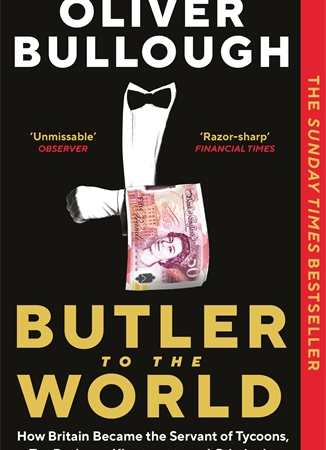
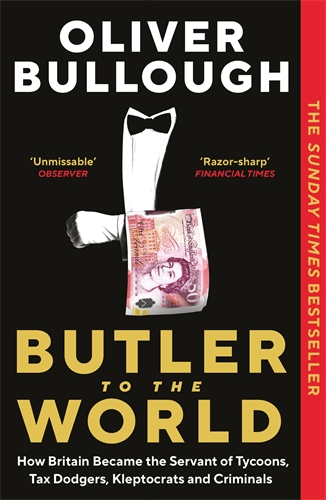
As Britain sinks deeper into institutional corruption, Mike Phipps reviews the new edition of Butler to the World: How Britain became the servant of tycoons, tax dodgers, kleptocrats and criminals, by Oliver Bullough, published by Profile
“The UK has been downgraded in an annual global index of civic freedoms as a result of the government’s ‘increasingly authoritarian’ drive to impose restrictive and punitive laws on public protests,” reports the Guardian.
The Civicus Monitor, which tracks the democratic and civic health of 197 countries across the world, now classifies British democracy as “obstructed” – putting it alongside countries such as Poland, South Africa and Hungary.
It’s not the only league table in which the UK is slipping. In January, Transparency International published a report showing that Britain had slumped to its lowest-ever score in the pressure group’s global Corruption Perceptions Index. A decade ago, Britain ranked as the world’s eighth least corrupt country: now it is only eighteenth.
Data collected for this year’s Index included
- details of the government’s ‘VIP lane’ for fast-tracking offers of PPE from companies with political links, a process systemically biased in favour of those with connections to the party of government.
- concerns raised by a cross-party parliamentary watchdog that decisions on how to award money from the £3.6bn towns fund, designed to boost economic growth in struggling towns, were not impartial and were politically motivated.
- 40 potential breaches of the ministerial code that were not investigated in the past five years.
- an investigation into wealthy donors to the Conservative Party who gave at least £3 million, became temporary party treasurers and commonly went on to be given a seat in the House of Lords.
Ministers will no doubt shrug off these findings, claiming league tables of this kind are a simplistic measurement. But the real problem with the Index lies with the definition of corruption. As Adam Ramsay says, “Pay $100 to a Kenyan police officer so they turn a blind eye, and you’re corrupt. Pay $100,000 to a US senator’s re-election campaign, so they ensure legislation turns a blind eye, and that’s ‘just how things work’.”
The ‘dark money’ that has long contaminated the US political system is increasing its influence in the UK. A recent openDemocracy analysis found that the UK’s most secretive think tanks raised more than £14m from mystery donors in the past two years. These are the same groups that influenced recent policy changes, such as the tax cuts announced by Liz Truss that crashed the UK economy last year.
In short, measuring corruption is difficult when the system itself is corrupt. Journalist Oliver Bullough also criticises the Corruption Perceptions Index in that it “calls poor countries looted by kleptocrats corrupt, and rates highly the rich countries that host the kleptocrats’ money.”
Britain in particular excels at this, as the Panama Papers underlined. The Papers comprise 11.5 million leaked documents that were published in 2016 detailing information for more than 214,488 offshore entities. The data were taken from former Panamanian offshore company Mossack Fonseca. Over half of the entities implicated were registered in British Overseas Territories and Crown Dependencies, and that professional enablers from the UK were the second biggest users of Mossack Fonsecca’s services.
Bullough has some knowledge of what he is talking about: he has acted as a guide on the London Kleptocracy Tours, which show off oligarch-owned properties in the pricier parts of Knightsbridge and Belgravia.
He has also written extensively about the subject in previous books. Butler to the World is not his first study of financial crime. In 2018, he published Moneyland: Why Thieves and Crooks Now Rule the World and How to Take It Back.
In a review in the London Review of Books, Vadim Nikiton writes:
“Bullough defines ‘Moneyland’ as a ‘virtual country where, if you are rich enough, whoever you were, or wherever your money came from, the laws did not apply to you’. This is because, in the age of globalised financial flows… ‘money is international while laws are not.’… ‘Wherever money is stolen from, it ends up in the same places: London, New York, Miami,’ Bullough writes. ‘And wherever it ends up, it is laundered in the same ways, through shell companies or other legal structures in the same handful of jurisdictions.’ Bullough’s core argument is that international criminal elites are using financial secrecy jurisdictions (often former British colonies), as well as Western legal, civic and political institutions, to launder money. The kleptocrats do this with the ‘enthusiastic collaboration of Western professionals’.”
Bullough returns to the theme in Butler to the World. Not only does Britain not seriously investigate the movement into the country of illicit money, it actively facilitates it. Hundreds of billions of pounds are laundered through the British banking system every year.
His investigations, among other things, take him through the British Virgin Islands and Gibraltar and piece together the story of how UK governments made Britain a gamblers’ paradise, without a thought for the social and economic consequences. He explores the influence of oligarchs in the British establishment and the difficulties of bringing to justice financial fraudsters who take refuge here.
The material is often dry and intricate. Bullough’s achievement is bringing it to life and providing an analytical thread reflected in the title: Britain as a butler to whoever can pay.
It won’t surprise those who follow this depressing topic that the UK government’s secrecy extends to promising Vladimir Putin’s cronies total privacy if they launch a legal bid to be removed from the UK’s sanctions list. In contrast, appeals against EU sanctions are recorded publicly. Worse, the government granted a licence to a sanctioned individual that allowed him to hire British lawyers to pursue a frivolous legal case that would leave a British investigative journalist tens of thousands of pounds in debt.
The suffocating secrecy of British overseas territories has been criticised by the UK’s closest allies. The latest US State Department report on human rights practices, just published, singles out the British Virgin Islands, where the law “criminalizes with imprisonment for up to 14 years and a fine ‘sending offensive messages through a computer.’ The law applies to a message that is ‘grossly offensive or has menacing character’ or that is sent ‘for the purpose of causing annoyance or inconvenience.’ Media freedom NGOs strongly criticized the law.”
Butler to the World won plaudits galore when it came out last year, including Daily Mirror Best Non-Fiction Book of 2022. The new paperback edition contains a highly topical Introduction focusing on Britain’s relationship with Ukraine.
Mike Phipps’ new book Don’t Stop Thinking About Tomorrow: The Labour Party after Jeremy Corbyn (OR Books, 2022) can be ordered here.
 Labour Hub