
By Tim Hollins
September 11th 2023 will mark the 50th anniversary of the vicious military coup that destroyed the progressive and democratically elected government of Unidad Popular / Popular Unity in Chile, and resulted in then President Salvador Allende’s death, along with thousands of Chilean supporters, tortured, murdered, disappeared or forced into exile. It also marked the beginning of the first experiment in ‘neoliberal’ economics, imposed in Chile at the barrel of the gun.
Like all historical events, the background to the coup provides the essential context to understand not just what happened, but why, and how it continues to effect not only Chile, but also our lives in Britain, and arguably much of the rest of the world today. It was a global turning point.
In 1959 the Revolution in Cuba had inspired a generation of young Latin Americans to believe, in the modern phrase, that ‘another world is possible’. Cuba showed how real it was, and the Vietnam war through the 60s showed the brutality that the US would use to defeat its political enemies in the so-called ‘Cold War’. A Marxist, though committed to upholding the Chilean constitution, Allende was seen as a threat to US commercial and political interests. Yet he managed to not only win the 1970 election, but manoeuvre skilfully to finally be inaugurated as President. Ominously the head of the armed forces was assassinated just after the election – a sign of the brutality to come.
Allende’s Popular Unity government lasted just three years, its programme of 40 pledges – health and education for all, strictly controlled rents, paid holidays, art and culture in the service of the people, etc. – was quickly achieved. But as today, powerful interests were threatened by this progressive, democratically elected and popular government. Both wealthy local right wingers, the neo-fascist Patria y Libertad (Fatherland and Freedom) and the US government of Nixon and Kissinger did all they could to destabilise Popular Unity – from transport strikes, hoarding of goods to create shortages, to terrorist attacks. As Kissinger memorably said: “I don’t see why we need to stand by and watch a country go communist due to the irresponsibility of its people.” Nixon vowed to “make the (Chilean) economy scream” to destabilise Allende.
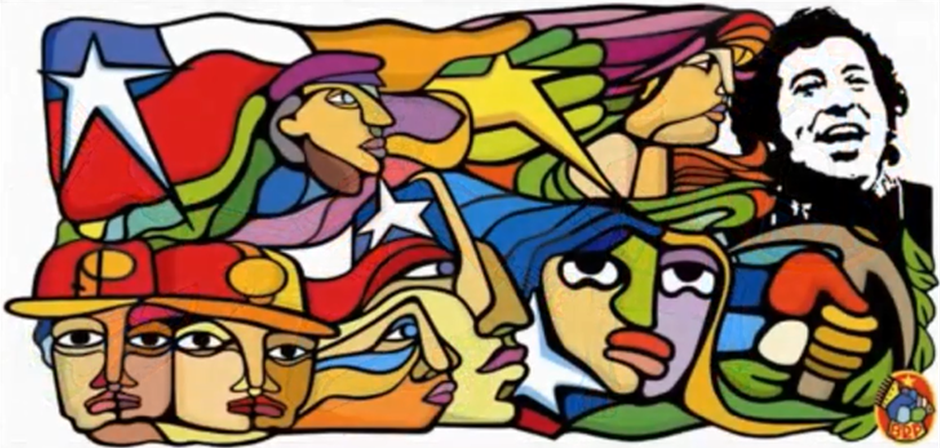
Chilean mural in the ‘Brigada Ramona Parra’ style
As Popular Unity became more and more popular in Chile, despite the economic hardships – and of course many internal arguments and debates – a military coup to destroy the government was the right’s final option. General Pinochet led the coup on the morning of September 11th 1973. The Presidential Palace was bombed by British-made Hawker Hunter jets, and Allende died in the ruins of the palace. It was not just a change of government, but a brutal destruction of all the ideas that had led to Allende’s mass support – from the burning of books, murder of thousands of supporters, destruction of the new universities, etc. If ever we are unsure what lengths ‘the system’ would go to to preserve itself and its power, Chile shows us clearly.
And throughout Latin America, Plan Condor was put into operation, attempting to destroy left wing ideas wherever they could be found, through the murder or disappearance of tens of thousands of activists, workers, trade unionists, peasants, students, teachers, academics, etc.
All that was 50 years ago. But the so-called ‘Chicago boys’ – right wing Chilean economists trained at Chicago University – forced through a new economics in the Pinochet dictatorship which we now call ‘neoliberal’ – privatising state assets, cutting taxes, cutting back all social welfare provisions, shrinking the state and aiming to return the wealth from the vast majority back to the hands of a tiny minority. Sound familiar?
In Chile, resistance was virtually impossible under military dictatorship. In the UK, Margaret Thatcher followed this doctrine from 1979, and all subsequent governments whether Labour or Tory have more or less signed up to the same policies. Looking around us today, we can see the long-term destruction that people were persuaded to vote for. Privatisations, profits flowing to the wealthy, marketisation, destruction of the welfare state, austerity, financial industry deregulated, legal restrictions on trade unions (and especially on the right to strike), university fees – all have their roots in the Chilean coup of 1973.
After work by a newly formed network, Academics for Chile, together with the World University Service, a number of Chileans were able to get out of the nightmare of Chile and pick up their studies and start new lives here in the UK. With the election of the Labour government of 1974 –79 there was far more generous support, despite resistance in some areas of government, led by Judith Hart MP, in granting study visas to some 3,000 mostly young Chileans. They had nearly all been subjected to imprisonment and mistreatment and often torture during the Pinochet dictatorship – praised by Margaret Thatcher as returning Chile to ‘true democracy’.
Those Chileans – whose only ‘crime’ was to support Popular Unity and work for Allende’s new Chile, have had a massive impact on Britain, bringing with them their politics, music, poetry – and empanadas (small pasties)! Some have now gone home to Chile, but many are still here, and their children (now in their thirties and forties) and grandchildren continue to enrich Britain, and especially our understanding of Latin America.
This year, a group of Chilean exiles and 2nd generation Chileans have now set up a one-year long network, Chile 50 Years UK to organise and co-ordinate events across the country to mark the anniversary of the coup, and the death of Allende and so many others.
Go to www.Chile50years.uk for information and upcoming events.
A model motion for trade union branch/regional support is available from the website (‘get involved’ tab).
And the Victor Jara festival in Machynlleth, Wales, will be marking the anniversary in song, poetry, politics and film in mid September – details from the Chile 50 website. The festival has the title “The Dream Lives on – El Sueño Existe”. Allende’s hopes and dreams did not die with the coup, as Pinochet and Nixon intended; they are alive today wherever people organise together, and work towards a better future of peace, solidarity and social justice.
Tim Hollins is part of the El Sueño Existe organising team, and West Midlands co-ordinator of Cuba Solidarity Campaign.
Main image: New logo for Chile 50 Years UK
 Labour Hub