
By Saleh Mamon
On Saturday 14th April, the two armed factions in Sudan, the Sudanese Armed Forces (SAF) under the command of General Al-Burhan and the Rapid Support Forces (RSF) under the command of General Mohamed Hamdan Dagalo, better known as Hemedti, launched attacks against each other with no holds barred.
The confrontation became inevitable after the RSF had deployed its forces in Khartoum and all the other cities without the SAF’s approval, using the pretext that this was part of its normal duties to ensure “security and stability and fighting human trafficking and illegal migration.” Tensions between the two generals had been building up for some time.
The scale of the conflict
It has been over a week now. The fighting rapidly spread across the four corners of the country from Merowe (North), Port Sudan (East), Kassala (South East), El-Obeid (South) and to already conflict- torn Darfur (West). Battles have raged as the factions fought to control the air fields and military bases across Sudan.
The most intense battle has been for control of the capital Khartoum and its neighbouring city Omdurman. The two sides are using tanks, artillery and other heavy weapons in densely populated areas. Fighter jets have been launching air strikes at RSF positions.
The old African proverb is apt here: when elephants fight, it’s the grass that suffers.’ The civilians are being trampled on and are paying a heavy price for the fight between the two generals.
Over the week, the World Health Organization reported that by Friday 21st April 413 people had been killed and 3,551 injured. The toll is definitely much higher because the roads of the cities are littered with dead bodies which may have not been counted. UNICEF spokesperson James Elder said that at least nine children had been reported killed in the fighting and that more than 50 had been injured. One analysis revealed that two-thirds of civilian fatalities were recorded outside Khartoum, indicating how much of the fighting was occurring in remote regions.
Hospitals have been thrown into chaos. On its Facebook page, the Central Committee of Sudanese Doctors posted on 19th April that 39 out of 59 hospitals in Khartoum and nearby states are “out of service”. Nine hospitals were bombed and 16 hospitals were subjected to forced evacuation by soldiers. By Wednesday morning, only 20 hospitals were fully or partially operational. These were understaffed, as many doctors and nurses could not get to their hospitals. Power outages affected them as they did not have fuel for their generators.
Their wards are overwhelmed with the wounded. In many cases, patients, relatives, nurses and doctors are trapped because their area has turned into a war zone. The World Health Organization said many hospitals in Khartoum reported shortages of “blood, transfusion equipment, intravenous fluids, medical supplies and other life-saving commodities.”
The RSF has taken up position in many residential areas. Civilians in many of these areas are huddled in their homes fearful of possible hits by the artillery or air strikes. Where electricity substations have been hit, there are power outages. In some places, water pumping stations have been hit, leading to the water supply being cut off. There is a shortage of bottled water in some areas. People cannot go outside their homes to shop for basic necessities.
Online postings show many cases where scores of students in campuses have been trapped for three days with food and drink supplies running low. One student at Khartoum University was hit by a stray bullet and was buried at the site by his fellow students. Videos released show students sleeping on the floor in a library. All of them are scared of being shot by either faction of the army.
Thousands of residents of Khartoum including women and children have fled from their homes as life has become impossible, some by car and others on foot with whatever they can carry. They had to brave the uneven patchy ceasefire which makes escape risky and hard. There has been a mass displacement of people across Sudan according to the UN Office for the Coordination of Humanitarian Affairs (OCHA). The UNHCR is alarmed about the 10,000 to 20,000 civilians, mostly women and children, crossing into eastern Chad from Darfur.
This comes at a time when the humanitarian situation has been at its worse since 2021 with nearly 16 million people, a third of the population, requiring food relief to survive. Sudan already has one of the highest rates of malnutrition among children in the world and now critical life-saving care for an estimated 50,000 severely acutely malnourished children has been disrupted. This is life-threatening. The deaths of humanitarian workers and the looting of supplies have jeopardised the provision of such relief by the aid agencies.
The situation is so serious that the US, UK, Germany, Italy, Canada, Japan and others were searching ways in which to evacuate their citizens from Sudan safely by the end of the week. The damage to Khartoum airport and the ongoing fighting there makes it an unsafe point to arrange for evacuation. During the weekend, Saudi and UAE citizens were evacuated from Port Sudan. The US has airlifted their citizens successfully this weekend.
The two factions are armed to their teeth. The SAF is estimated to have a 100,000-member army supported by a small air force and navy. Irregular tribal and former rebel militias and Popular Defence Forces supplement the army’s strength in the field. The RSF is estimated to have 100,000 battle-hardened fighters with hundreds of pickups with mounted cannons and artillery.
Origins of the conflict
The rise of Hemedti and the RSF over a very short time into a formidable force started with the Janjaweed militia in Darfur where it carried out a genocide to win the approval of Al-Bashir’s regime. He formalised its status with a command structure and state funding under Hemedti in 2013. Hemedti won commissions for gold mining and sales from Al-Bashir to amass immense wealth. His geopolitical links grew when 40,000 RSF soldiers were sent to Yemen to support the Saudis and UAE and 10,000 were sent to Libya to support the Libyan National Army. The roots of the power struggle that we see now started in Darfur in 2000.
After the overthrow of 30 years of dictatorship by President Al-Bashir in the 2018 December Revolution, massive repeated public protests, followed by brutal military crackdowns, pressured the two generals who took charge to sign a transitional power-sharing agreement with the civilian Forces for Freedom and Change (FFC) on August 2019. The civilian government under Prime Minister Abdalla Hamdok took over in September 2019 with Al-Burhan as the Chair of the sovereignty council and Hemdeti as his deputy.
On 21st October 2021, the two manoeuvred to overthrow the Hamdok government which let to massive public protests and resistance. While Al-Burhan acted as a de facto President, Hemedti became the de facto Vice President, exercising immense executive powers with access to the country’s budget and the mandate to represent Sudan globally, forging alliances and trade deals.
Since then, the country has plunged into a greater economic crisis. The 2019-21 Hamdok government had successfully negotiated debt relief with the IMF and bids to attract foreign financing. The international support of billions of dollars and debt relief was frozen after the coup putting development projects on hold, straining the national budget and exacerbating the already dire humanitarian situation. The generals faced widespread public protests and civil disobedience campaigns week in and week out which made the country ungovernable.
Under pressure from the US, the African Union and key regional players, negotiations facilitated by Volker Perthes, head of the UN Integrated Transition Assistance Mission in Sudan (UNITAMS), paved the way for the military as well as the right wing FFC parties to make compromises and come to another power-sharing agreement.
On 5th December 2021, with the participation of more than 50 civilians, including the FFC leaders, party heads, professional association representatives and civil society groups, a Framework Agreement was signed with the military junta to return Sudan to full civilian authority at all levels, and a Security and Defence Council headed by the Prime Minister.
The negotiations continued to Phase II in January 2023 to address many outstanding issues, such as security reforms, transitional justice and the status of the Juba Peace agreement, and to build broader support for the deal by including other civil society organisations and leaders. Plans were announced by the FFC for nationwide workshops led by the Sudanese Professional Association to develop these initiatives.
One contentious issue was the integration of the RSF within the SAF. Al-Burhan wanted a fast-track integration within two years but Hemedti wanted it spread over ten years. Because of this, the final political agreement that was to be signed on 1st April never took place. The two sides were preparing for a confrontation.
Once the clashes broke out on 14th April, the repeated attempts to get a 24-hour ceasefire called by the UN, US and other powers, failed. The three-day ceasefire agreed by both sides for the celebration of the Muslim festival of Eid-ul-Fitr on Friday 21st April also did not stop the fighting. This clearly shows that this is an existential battle for each of the generals and that trust had broken down irretrievably.
It is clear from the pronouncements that the two generals consider this a life and death struggle. General Al-Burhan has called for the disbanding of the RSF and arrest of Hemedti. Hemedti has called General Al-Burhan a “criminal” and an Islamist who is prepared to bomb civilians. The rhetoric from both sides is uncompromising.
At the heart of this conflict lies a fundamental contradiction. No nation-state can have two well-armed factions under two different commands. Sooner or later they will collide. The SAF has been long established over seven decades. This battle is about the Sudanese armed factions controlling the Sudanese state in the final analysis. The Sudanese state has allowed the officer class to control immense economic and commercial wealth. The RSF equally commands immense wealth from gold mining and exports across the country. Hemedti does not consider himself accountable to the Sudanese state controlled by Al-Burhan.
What next?
The Sudanese people have risen up in 1964, 1985 and 2018 for a democratic revolution but after a brief period of civilian rule, the SAF had crushed the revolution and restored military rule. The army has been a counter-revolutionary force. They treat the country as their fiefdom and have no compunction about civilian deaths nor care for their wellbeing.
It is difficult to gauge how this will all end. The situation is in flux. If General Al-Burhan succeeds, then we might see the return to power of the Islamist movement which will settle scores with those who brought Al-Bashir and the National Congress Party down. If Hemedti succeeds, he has a record for brutality in Darfur and over the last three years in the suppression of the protest movement. It is inconceivable that his ruthlessness will not show its face.
Both of them say that they would like a civilian government but they want a civilian facade behind which they can control the political power and maintain control of the economy. Both factions are counter-revolutionary.
The best option for the Sudanese people is for this internecine war to weaken the two armed factions giving the revolutionary forces a chance to make a transition to a civilian government. The climate for this would be right when the entire Sudanese people are horrified by the two armed factions destroying the country and have little credibility left.
A prolonged crisis could plunge Sudan into widespread conflict as it struggles with economic breakdown and tribal violence. The warring parties may resuscitate the unresolved peripheral wars in Sudan. If it is highly destructive, then the situation may become revolutionary when the ruling class cannot continue to dominate and the mass of the people are not willing to tolerate their rule. In such a situation, there would be an opening for transformative change by forces in civil society.
Over the last three years, the Sudanese people have paid a heavy price for their resistance with death and injuries. But they have also been creative. The 6,000 or so resistance committees organised across the country are unique and have become the guardians of the revolution. At the local level they have replaced Al-Bashir’s Popular Committees which controlled neighbourhoods. They have led the mass protests since the revolution and against the coup with the slogan “No negotiations, No Compromise, No partnership” with the military. They want the military out of politics and full civilian rule.
They have worked on draft charters for new Sudanese politics. They will be tested here whether they can organise to take power. They will have to be innovative. So far, the transitional civilian government of September 2019 was selected by the FFC and the military. It was also envisaged under the Framework Agreement that the transitional government of April 2023 would follow the same pattern.
This has lacked public legitimacy because of the absence of universal suffrage. One way forward for the revolution would be to call a national constituent assembly to elect a new government and agree on a new constitution. Such a move will have much greater legitimacy and give the grassroots organisations a national platform. It would also mobilise the whole population politically.
On the other hand, the regional powers involved in Sudan – Egypt, Saudi Arabia and UAE – do not want to see a democratic government in Sudan let alone a revolutionary one. They prefer a military government or one with a civilian facade. The US would not be averse to such an arrangement since it supports the military dictatorship in Egypt. If this happens, Sudanese revolutionaries will have to mobilise to defend their revolution against any foreign intervention in addition to the internal forces of counter-revolution.
Saleh Mamon is a retired teacher who campaigns for peace and justice. His research interests focus on imperialism and underdevelopment, both their history and continuing presence. He is committed to democracy, socialism and secularism. He blogs at https://salehmamon.com/
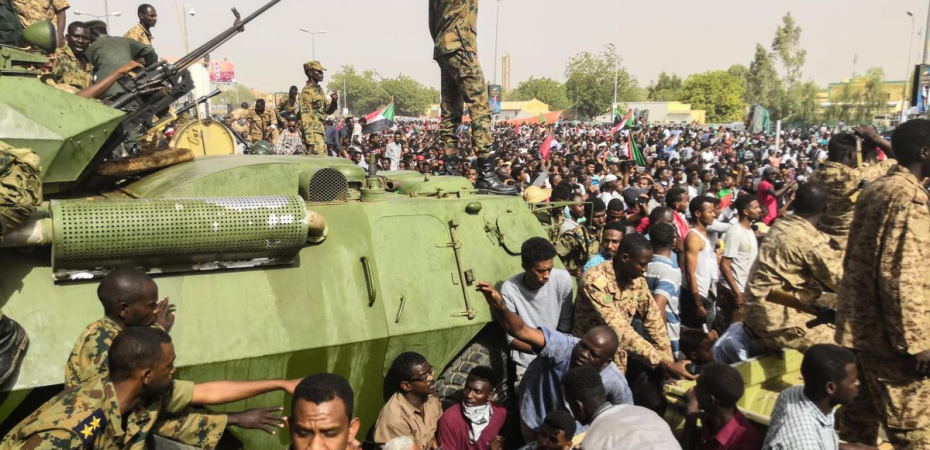
Image: The Sudanese army. Source: https://www.middleeasteye.net/news/military-coup-ousts-sudans-bashir-protesters-demand-civilian-government. Author: Agence France-Presse, made available under the Creative Commons CC0 1.0 Universal Public Domain Dedication
 Labour Hub