
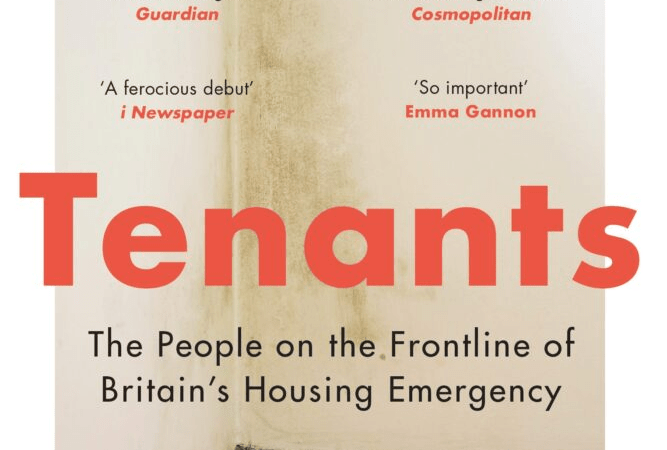
Mike Phipps reviews Tenants: the people on the Frontline of Britain’s Housing emergency, by Vicky Spratt, published by Profile
Vicky Spratt’s campaigning journalism helped get letting fees banned and deposits capped in 2019. But the ease with which agents and landlords have got around these restrictions – viewing fees, for example – shows that government attempts to tackle the problem may just be window-dressing.
There are now 11 million people living in precarious rented homes which could be taken from them at any time. Between 2011 and 2018 rents grew by 16%, wages by only 10%. On average, renters spend one-third of their pre-tax income on rent.
So unstable and unaffordable is private renting that it is a significant contributor to homelessness. Yet the private rented sector is thriving because home ownership is increasingly unaffordable and there’s a chronic lack of social housing. Some 40% of former council homes sold under Right to Buy are now owned by private landlords who charge up to twice as much rent as a local authority.
As a result, the government now spends £22 billion a year on Housing Benefit, double what it spent 20 years ago, despite cuts ineligibility. Around half of this goes directly to private landlords, a huge subsidy.
Much of this book is about the human misery of people caught up in no-fault evictions, thrown out of their home at short notice because the landlord can make more money out of someone else. Some of these stories are harrowing: women and children evicted from housing they had lived in for years, forced into squalid hostels far from their family, work, child’s school or mental health support.
Gentrification is another driver of the housing crisis and wider social problems. In Cornwall, the local NHS trust cannot retain vital staff because there is nowhere affordable for key workers on low salaries to rent. In London, even the private sector struggles to recruit and retain, because of high housing costs. But it is usually women, poorer and minoritized communities who are most affected.
It was the Thatcher government’s 1988 Act which ended security of tenure and opened the way for such practices. The question has to be asked: why did Labour, in office for 13 years, leave it in place? In Germany, the Netherlands and Denmark, tenants can be evicted only for a specific reason and other countries have long-term tenancies which give extended protection. In contrast, Britain is a landlords’ paradise.
There’s some ominous analysis here. Over the next 30 years, the number of households living in the private rented sector is set to treble. Because of the sector’s expensiveness, precariousness and poorer quality, this is certain to cause a major knock-on effect on people’s health.
The shocking connection between the housing crisis and public health was underlined by the Covid pandemic. People living in overcrowded accommodation and unable to isolate were disproportionately affected, especially poorer and minoritized communities. Lockdown in damp and insecure tenancies led to a rise in other physical and mental health illnesses.
Mould, as recent headlines demonstrate, can be a killer. Hospitals now regularly refuse to discharge patients with severe health problems because returning them to their damp, overcrowded or otherwise defective homes would worsen their condition. Up to 3 million privately rented homes are thought to pose a serious risk to health.
One of the biggest public health concerns is the shadow rental sector – illegal sublets to low income tenants which circumvent government-required immigration checks. The mainstream media usually frame this issue as immigrants creating housing shortages, rather than government legislation enabling profiteering landlords to rip off tenants in horrendous overcrowded conditions. Beside the public health implications, this practice is a huge driver of human exploitation, including modern slavery, Britain’s biggest organised crime activity after drug-dealing.
The law holding landlords responsible for the upkeep of their properties is full of holes and lacks proper enforcement. Unsurprisingly, tenants have had to organise themselves to get improvements, as this book details.
As for homeless people, there is a simple solution: house them – immediately, irrespective of employment status, addictions or anything else. Spratt is keen on the Housing First initiative which prioritises this approach.
Utopian? During the pandemic, the government told local authorities to get the homeless off the streets and gave them a £3.2 million emergency fund t do so. It’s actually cheaper to house people properly than to put them in temporary accommodation. What’s stopping the government from doing this? Ideology.
On renting, the government suspended all housing possession actions during the pandemic. Ending no-fault evictions, giving tenants greater security and imposing legally enforceable standards are the minimum that could now be enacted, not contingent on the Covid crisis.
Longer-term, more fundamental fixes are needed. A Land value Tax on landlords’ unearned income, measures to tackle house price inflation and more social housing are needed.
The roots of Britain’s housing crisis are touched on in the Epilogue to this book: “We are living in a country where poverty is entrenched, social mobility has gone into reverse, squalid housing conditions like those seen in the early 1900s are normal for too many people, and a twinned sense of hopelessness and individualism prevails.”
How true. At the heart of the issues tackled in this book are high levels of inequality. It’s worth recalling that building more homes takes time, money and resources, yet there is already a huge amount of capacity, often in the wealthiest areas. Over 34,000 homes across London are currently ‘long-term vacant’ – the highest number for over a decade.
If the government won’t take the radical steps needed to address the crisis, mass action may be required to show what’s possible. It’s happened before.
Tenants was hailed as one of the best books of 2022 by several major publications when it came out last year. This new paperback edition should bring it to an even wider audience.
Mike Phipps’ book Don’t Stop Thinking About Tomorrow: The Labour Party after Jeremy Corbyn (OR Books, 2022) can be ordered here.
 Labour Hub
[…] reviewed quite a few books on housing on this site in recent years, I would say that Bricking It is one of the best – brilliant at explaining the crisis, what […]