

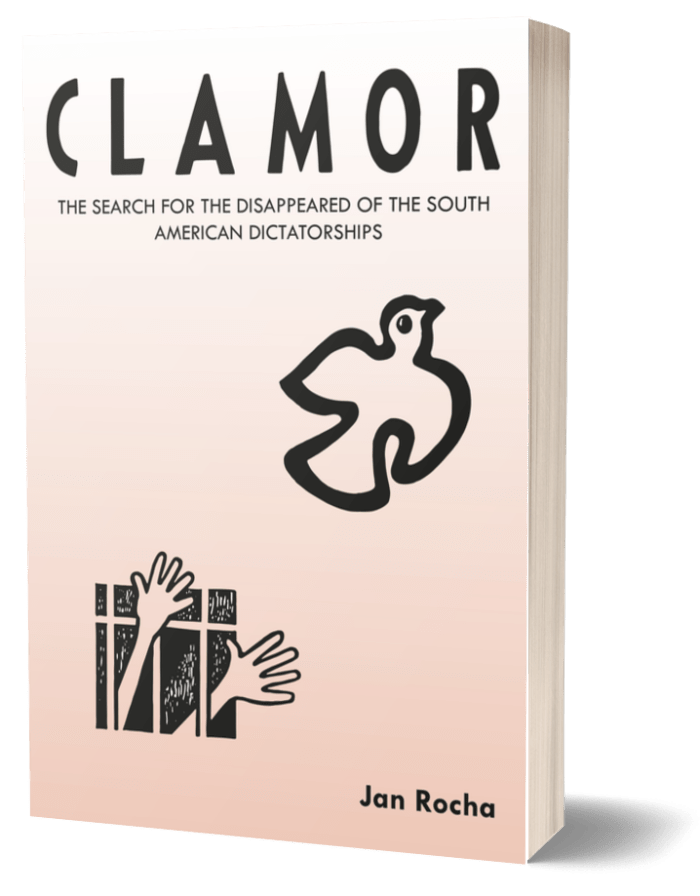
On April 27th veteran activist and writer Jan Rocha launched her book CLAMOR: The Search for the Disappeared of the South American Dictatorships. The book tells the story of a small organisation, based in Brazil, that was among the first to investigate, publicise and denounce state terrorism in Latin America’s Southern Cone dictatorships in the 1970s. Here we reproduce her speech from the launch.
In 1973 when a military coup overthrew the elected president Salvador Allende in Chile the brutal repression caused shock and horror around the world. Solidarity with Chilean exiles was huge and Pinochet’s name became a byword for terror.
Three years later, when the Argentine military overthrew Isabelita Peron, there was nothing like the same reaction. The coup there was a surprise to no one, the government of Juan Peron’s widow was weak and unpopular. Kidnappings, bombs, assassinations were frequent.
The military said their targets were all left-wing terrorists although these organisations had already been largely defeated. They used disinformation, calling the repression a `dirty war’ – although it was in reality state terrorism against unarmed men, women and children. The mothers who protested were called ‘loucas’ – madwomen.
For a long time they got away with it, because they had learnt the lesson from Pinochet and adopted different tactics. Instead of openly assassinating those who opposed them or those they considered enemies, they forcibly disappeared them.
People vanished in the middle of the night. Their homes were broken into and they were taken away, hooded and handcuffed, never to be seen again. If they had children, these were simply dumped with neighbours, or abandoned in the street, sometimes with a telephone number pinned to their clothes.
Some very small children disappeared with their parents, as did the many babies born to pregnant women, who were seized, tortured, allowed to give birth and then murdered. Very few people survived the clandestine detention camps to which the disappeared were taken. Later it was discovered that many had been taken on `death flights`, thrown out of planes drugged but alive, into the sea. Others were shot and their bodies burned.
When families tried to find out what had happened to their husbands, wives, sons or daughters, they were told there was no information on them, because they had not been officially arrested.
In the subsequent months and years, thousands fled to escape the repression. Many came to Brazil, because the two countries share a land border and no passport, only ID, is needed.
Most of them came to Rio and São Paulo, and in 1977 I got to know many of them. At first it was hard to believe what they told us: the stories were too awful. One night I had dinner with a couple from Tucuman, in the north. Talking about the disappeared, they said they were taken to concentration camps. For anyone of a certain age coming from Europe those words are not used lightly. They told me they knew of a survivor from a camp, who had reached Paraguay. I decided I had to go there and talk to him.
A visit was arranged through intermediaries. His nickname was Negro and he and Ana Maria, his wife who had also been taken to the camp, which was located in a former sugar mill, told me in detail about their ordeal. She said her clothes rotted on her because they were never allowed to wash. He said he saw men buried up to their necks in the ground and left to die. They were released only because their families had influential friends and Negro was not in fact the man the military were looking for.
Together with journalist Sue Branford, who also lived in São Paulo at that time and had opened her home to refugees, we wrote a story for the Guardian. We described what they had told us – the savage tortures, the camps, the fate of the disappeared. I got a letter from a friend at the BBC saying, “Many people who read your story just don’t believe it’s true.”
I then joined with a small group of people who did believe the stories, to create Clamor, an organisation to denounce what was happening in Argentina and the other countries of the region. They were now all ruled by right-wing military regimes, proclaiming Christian values but practicing terror and torture.
We also wanted to provide practical help to the refugees, finding them somewhere to live, schools for their children, documents. Many had arrived with nothing – for example Isabel, a trade union leader who arrived on my doorstep one day with only the clothes she wore, exhausted and desperate, because she had fled when she heard they were looking for her. Or Elida, a young student, who spent three days hiding in a park while friends got her false papers. Or the young couple who could only speak in a whisper, because they had spent a year hiding in a hidden room in a friend’s house, until she got pregnant. A modern day Anne Frank story.
Those were the stories that made us create Clamor.
We were an ecumenical, cosmopolitan group. One was a Presbyterian minister, another an American nun, another a French Canadian priest, and there was a Brazilian lawyer who defended political prisoners. We got the support of the archbishop of São Paulo, Cardinal Arns, who was an outspoken defender of human rights and critic of the military regime, and of the World Council of Churches. And we soon established links with human rights organisations in Argentina and the other countries of the region.
Clamor quickly became known through the news bulletins we sent out, in Spanish, Portuguese and English. Very soon letters came flooding in, many of them from families in Argentina and Uruguay denouncing the disappearance of their loved ones, the traumas of those they left behind.
“My husband died of sadness,” said the mother of a young woman who had disappeared.
“She never stops asking for her mother,” said a grandmother of the 4 year old left behind with her baby sister. I don’t know what to tell her.
Clamor made the children who had disappeared its priority, and was instrumental in finding the first to be located, a small brother and sister abandoned in a square, not in Buenos Aires, where their parents, Uruguayan exiles, were murdered, but hundreds of miles away in Valparaiso, Chile. Apparently this was to stop their families ever finding them.
Over the years we developed very close links with the Grandmothers, Las Abuelas de Plaza de Mayo, who made frequent trips to São Paulo, bringing and taking information, written on tiny bits of papers hidden in boxes of chocolates.
The Grandmothers reckoned that up to 500 babies and children had been disappeared, either appropriated at birth, sometimes by the same men who had tortured and killed their parents, or abducted as small children.Years later General Jorge Videla and ten others, including doctors, were tried and found guilty of what was termed a systematic plan for the stealing of babies during the dictatorship.
The members of Clamor were all volunteers except for Jaime Wright, the Presbyterian minister who was paid by his church and looked after most of the organisation. We also had a large network of collaborators, translating the bulletins, going on fact-finding missions.
One of them is here tonight, my husband Plauto Rocha, who went on a risky mission to Brazil`s border with Argentina to find out what had happened to a young Uruguayan who disappeared from a bus there. Detained himself and taken under armed guard to a military base, he was only released after producing a letter from Cardinal Arns. As a result the young man ‘reappeared’ in an official prison and his life was saved.
I decided I ought to write about the work of Clamor when I realised some years ago that it was completely unknown to younger generations, as was the fact that for a few years in the late 1970s and early 1980s Brazil had become home to hundreds of thousands of refugees and exiles from Argentina, Uruguay and to a smaller extent Paraguay and Chile, and there had been a huge amount of solidarity with them even when Brazil itself was still ruled by the military.
There was also a certain urgency in interviewing former members of Clamor, collaborators, and members of other human rights organisations, especially the Grandmothers, because no one was getting any younger and some had in fact already died, like Jaime Wright, one of our founder members.
Then there was the archive.
Clamor had built up a huge paper archive of letters, newsletters, testimonies, even some death certificates. They filled 106 boxes at CEDIC, the Research Centre of the Catholic University, which conveniently was just round the corner from my home. But they were all jumbled up together, not even sorted by country. I spent at least two years going through the boxes, reading everything, one by one.
So the book is an attempt to record the story of Clamor while some of us who remember it are still around, to remind younger Brazilians of a forgotten event in their own history, and to remember the disappeared who vanished into the secret detention camps, never to be seen again. It`s also a tribute to those who never gave up looking for them, their mothers, fathers and grandparents, and in some cases their sons and daughters. In Argentina over 120 of the babies who were appropriated by the military have been found, now of course men and women in their 50s who seek out the Grandmothers, rather than the other way round.
I have a brother who disappeared. He was a naval pilot and his plane crashed into the sea off Malaysia and was never found. He has no grave, no tombstone, but at least we knew what had happened to him, where it had happened, how it had happened. With the forcibly disappeared of Argentina, Uruguay, Chile, Paraguay, even that basic knowledge was denied the families. I hope this book will help to ensure that besides being disappeared, they are not forgotten.
Jan Rocha is a British-born journalist and writer who was correspondent for the BBC World Service and The Guardian in Brazil from the 1970s to the 1990s and now writes occasional blogs on politics for the Latin America Bureau. Her books about Brazil include Murder in the Rainforest and Cutting the Wire with Sue Branford. Her other work includes being first coordinator of the Rainforest Journalism Fund of the Pulitzer Center, and coordinator of an ILO project investigating the extent of slave labour in Brazil.
Image: Mothers/Grandmothers of the Plaza de Mayo, Buenos Aires, https://www.flickr.com/photos/anijdam/2502370510. Creator: AHLN. Licence: Attribution 2.0 Generic (CC BY 2.0)
 Labour Hub