

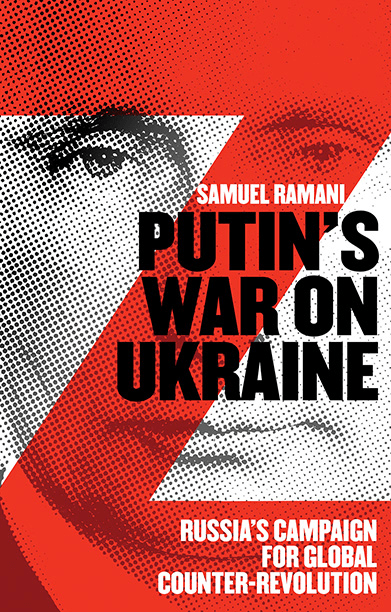
Mike Phipps reviews Putin’s War on Ukraine: Russia’s Campaign for Global Counter-revolution, by Samuel Ramani, published by Hurst
Why did Russia invade Ukraine? Samuel Ramani argues that Russia’s previous post-1991 military operations, in Georgia for example, were primarily motivated not by “territorial annexation but to prevent the spill-over of conflicts in the post-Soviet space.”
Ukraine was different. For Ramani, none of Putin’s justifications for the invasion stand up, including the fear of NATO expansion.
There was no indication that Ukraine was moving closer to NATO membership, whatever the hopes of its government. In any case, Putin himself said in 2002: “The decision is to be taken by NATO and Ukraine. It is a matter for those two partners.”
Ramani argues instead that Putin’s motivation was essentially counter-revolutionary: to overthrow the Maidan Revolution and the popular appeal it generated beyond Ukraine, and to consolidate his own brand of authoritarianism. It was thus driven primarily by domestic, not international factors.
Putin’s mining of Russian history to justify the war on Ukraine is revealing. The Russian state has a long history of supporting authoritarian reaction against popular revolution, certainly from the early 19th century on. This approach was briefly interrupted by the Bolsheviks after 1917, but soon resumed, especially under the Warsaw Pact, in the cases of East Germany and Hungary in the 1950s, where, as in Ukraine, Russia’s adversaries were delegitimised as ‘Nazis’.
Russia continued to buttress reactionary regimes after the fall of ‘Communism’ in 1991 and “embraced a policy of global counter-revolution during the 2011 Arab Spring.” This was underlined by its military intervention in support of the Syrian regime, and more recently its operations in Belarus and Kazakhstan.
Since Ukraine’s independence in 1991, Russia pursued its policy of hegemony through economic sanctions and soft power. Russian military intervention was later founded on a threefold false belief in Russian military superiority, a reluctance by Ukrainians to resist the inevitable and Western indifference.
Putin’s survival amid these massive miscalculations has been maintained by intensifying repression. The ideological implications of this turn are not yet clear. Ramani sees parallels between Putin’s crackdown on liberalism and Italian fascism’s blending of nationalism and reliance on the Church, yet recognises that the fascistic tendencies of Putin’s regime are usually overstated. In fact, Putin’s priorities are determined less by ideology and more by pragmatic considerations, such as shoring up domestic support and preserving Russia’s ‘great power’ status abroad.
Ramani unpicks Putin’s concocted rationales for invading Ukraine, namely demilitarisation and denazification. The latter is worth a moment’s attention as it is one of the ‘talking points’ frequently advanced by gullible or mendacious Kremlin apologists operating across the left internationally. To get around the obvious obstacle that President Zelenskyy is a Jewish descendant of Holocaust victims, Russian propaganda simultaneously advances the conspiracy theory that he is merely the drug addict puppet of a Nazi-infiltrated military, while redefining Nazism as Ukrainian patriotism. In practice, “Russia’s post-occupation denazification plans called for the complete destruction of Ukraine’s political and cultural life.”
This book dissects Russia’s strategic military failings, despite its multiple war crimes, and its underestimation of the strength of Ukrainian resistance. After initial setbacks, Russia pivoted to a military campaign more focused on the Donbas, causing the destruction of 95% of Mariupol. At the same time, Russia’s withdrawal from the suburbs of Kyiv revealed the mass executions of civilians and other genocidal crimes, similar to those perpetrated in Donetsk.
As the Russian government tried to deny responsibility for these outrages, its media stepped up their calls for cultural genocide. One prominent article identified pro-Europeanism as the dominant strain of ‘Ukrainian Nazism’ and called for the collective punishment of the entire Ukrainian people. The Russian orthodox Church lent its support, framing the invasion as a war against the Western values of toleration and diversity.
As Ukraine made territorial gains in a summer counter-offensive, Russia weaponised food, blockading Ukraine’s Black Sea ports, bombing civilian ships exporting grain and illegally smuggling grain from occupied areas. As Ukraine’s counter-offensive continued, Russia faced a manpower shortage and resorted to recruiting prisoners and imposing a sweeping draft, in the face of widespread opposition.
Ramani looks at the detail of Russia’s pseudo-referendums in four Ukrainian regions. For ‘security reasons’, most residents had to vote at home, in front of armed Russian soldiers who delivered the ballot papers. The farce was widely condemned internationally with only four countries – Nicaragua shamefully joining Syria, North Korea and Belarus – backing Russia’s fraudulence in a UN General Assembly vote.
As Russia suffered more battlefield defeats, it intensified its war on civilians. It also continued to stoke tensions with nearby countries in Europe: its unabashed destabilisation of defenceless Moldova is a particular cause for concern.
While its economic relations with the West nosedived, Russia’s trade with China grew. So did the two countries’ security cooperation. China, however, has no interest in getting involved in Ukraine and would prefer to pose as a voice of de-escalation in the conflict. Other authoritarian regimes in Asia have also adopted a stance ranging from non-condemnatory, for example India, to actively supporting Russia, such as Iran and Myanmar.
From the standpoint of the left, Russia’s ongoing influence in the Global South is more worrying. Ramani describes Africa as “polarised” by the invasion, despite its neo-colonial nature, its devastating impact on global food security and Russia’s egregious human rights abuses on the continent, especially in Mali. There’s an interesting discussion of Russia’s military, economic and propaganda expansion in Africa here.
In Latin America, initial opposition to Russia’s invasion has now been replaced by widespread abstention on UN proposals for its immediate withdrawal, mainly motivated by many countries’ desire to distance themselves from US foreign policy objectives. Meanwhile the authoritarian credentials of Nicaraguan dictator Daniel Ortega were underlined by his authorising the deployment of Russian military personnel in his country and making Russian state media available across the country on twenty channels.
Meanwhile Russia’s war on Ukraine continues. In April, Russia resumed its aerial bombardment of densely populated civilian areas in Kyiv, killing and injuring scores, including many children. Russia has amended its criminal code to increase sentences for treason and terrorism and to create new offences, such as aiding the work of international organisations like the International Criminal Court.
There are several Ukraine-based English-language websites that report regularly on the human rights abuses committed by Russia in Ukraine, of which the well-researched Information Portal of the Kharkiv Human Rights Protection Group deserves special mention. The Ukraine Information Group produces a fact-packed weekly digest of news here and the Ukraine Solidarity Campaign website is vital for solidarity campaigning.
Mike Phipps’ book Don’t Stop Thinking About Tomorrow: The Labour Party after Jeremy Corbyn (OR Books, 2022) can be ordered here.
 Labour Hub