
Last week the Labour Party issued an 86-page policy handbook, setting out its draft programme for a Starmer government. In the first of a series of articles analysing its contents, Karam Bales looks at its proposals for education.
As an educator and NEU activist the draft policy platform offers no big surprises. There are some broad-brush strokes which will be welcomed by many working in education; however, the details will be important, as will ensuring that implementation avoids the common pitfalls that education policy has a tendency to fall down.
Labour wants to roll out “an ambitious school improvement plan”. A school improvement plan in high quality teacher and support staff workers, ongoing teacher training, an expert curriculum review, and a national strategy with clear targets to close the attainment gap are generic policies that could be found in any manifesto of any party. These policies need a vision of what a high quality education system looks like, which sets out the intended outcomes. This is required to pull these policies together into a narrative voters can buy into.
Reviews and improvement plans need to include the participation of all stakeholders. Too often such exercises have an over-reliance on narrow working groups and unrepresentative focus groups.
If Labour recognises workload issues in schools, then any changes, such as in regards to the curriculum, will require considerable collaboration with the relevant sector and a long timeline to implement. Previous curriculum changes created extensive workload issues as schools struggled to juggle teaching the outgoing curriculum to older students while developing resources and launching a new curriculum for younger students.
It will be noted by many education campaigners that there is no mention of reviewing assessment methods. This should be considered alongside the curriculum. The omission suggests Labour aren’t considering any kind of large-scale reform to GCSEs: however, some will hope this might come as a result of the curriculum review.
The policy platform does have a focus on SEND pupils which will be welcomed by parents, as these students have been disproportionately impacted by austerity, but Labour must meet its rhetoric on providing the necessary resources with action. The most promising section in regard to SEND is the promise that “teachers and support staff have the training they need and recognition they deserve, and providing better consistency in conditions for staff and support for students.”
Support staff are vital to the provision of education and they are a poorly paid, undervalued section of the workforce. There are around 500,000 support staff workers in schools with hundreds of thousands working in early years, further education and higher education. They are always the first to face the brunt of squeezed budgets and are subject to pro-rata contracts. Support staff have spent years calling for professionalisation, access to training, fair remuneration and career progression.
Professionalising support staff was discussed during the final years of the last Labour government, building on the Workload Agreement of 2003 that first formalised the role of classroom-based support staff. Efforts were continued by the Lib Dems under the Coalition, but this was dropped after David Laws was replaced by Nick Gibb as Schools Minister, effectively ending any Lib Dem influence on Gove’s Education reforms.
This will be essential if Labour wish to meet their target of increasing the number of SEND pupils in mainstream education. The best way of accomplishing this as a long-term strategy is to invest in early intervention. Suggestions for education reform often focus on examination years in GCSEs and SATs – the rest of the system is constructed around these.
Early years and Further Education are often an afterthought, and in regards to these the draft platform merely provides generic ambitions that we’ve all heard before. It promises to reform early years care from end of parental leave to the end of primary school, while the call to create parity between apprenticeships and universities is a perennial promise that never gets delivered.
Similar things could be said regarding the proposed reform of Ofsted. Replacing a headline judgement with a more nuanced report card is a step in the right direction, as are proposals to ensure inspectors are specialists in the sectors and subjects they are inspecting. However, the details of the framework will decide if we have a genuinely supportive inspectorate focused on school improvement rather than the current system which has lost the confidence of education workers.
There are also proposals to create a new annual review of safeguarding, health and safety, attendance and off-rolling which is a sensible course of action. Safeguarding should constantly be reviewed and off-rolling has been an issue for many years, with the most vulnerable students being disproportionately impacted.
However, it will be interesting to see how Labour will manage the health and safety element, considering their failure to support the unions in regards to Covid. Absence rates due to sickness continue to be at extraordinary levels. While other countries have begun to introduce minimum clean air standards, the Department for Education has gaslit and dodged the serious investment required to improve air quality in schools, a measure the Royal College of Paediatric Care and Health was calling for before the pandemic.
There is also the scandal of dilapidated buildings, failure to meet fire safety regulations and asbestos in many of our schools that requires urgent action.
In the Health section of the policy platform there are also proposals to provide every school with a qualified mental health worker. This has been a demand of a number of unions for many years now. As with many of the other proposals, this will also require serious investment if we are to provide students with the support they deserve, rather than just a few positive headlines when the policy is announced.
The proposals are the bare bones of an education policy. While there is nothing radical, if these policies are fleshed out then it could be argued that they could represent a policy agenda that aims to get the basics right, providing the right resources and frameworks to each education sector.
If the details prove to be solid, then the funding will still have to be substantial to cover all of these proposals effectively. So far, the Labour Party has engaged in a bit of fence-sitting in regards to the ongoing teacher strikes. Considering the unions’ demands are in line with these proposals this will have to change.
The section of the platform on trade unions does provide some hope for the movement. The proposals to allow electronic voting (standard practice in many EU countries), provide appropriate facilities time, and protect reps from bullying and discrimination will be supported by the unions. However, there is a trust gap between unions and Labour at the moment that won’t be healed until such changes have been passed into law.
To summarise in the style of Ofsted: while there are some good features, the overall score is ‘Requires improvement’.
Karam Bales is a former member of the National Education Union Executive, writing in a personal capacity.
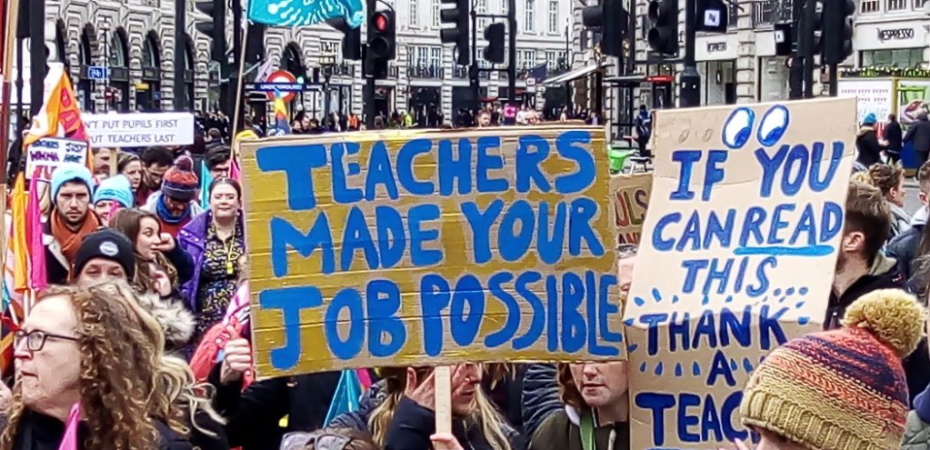
Image: Teachers marching through London, March 15th 2023, c/o Mike Phipps
 Labour Hub