
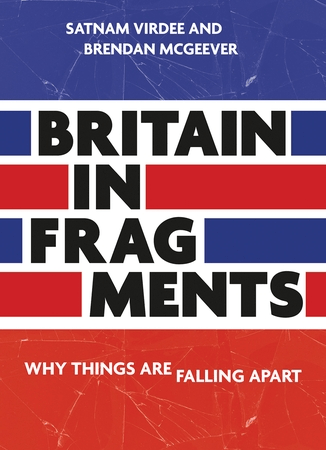
Mike Phipps reviews Britain in fragments: Why things are falling apart, by Satnam Virdee and Brendan McGeever, published by Manchester University Press
The political fragmentation of Britain takes many forms. The share of income going to the top 1% has tripled from 3% in the late 1970s to around 8% today. Life expectancy has stalled since 2011 and is likely to decrease. Geographical inequality has long been a feature of Britain, in particular its north–south divide. But what is more striking today is the intensification of sub-regional inequalities, not only between cities and neighbouring small towns but within them.
“What we are witnessing today is the unravelling of the democratic settlement,” argue the authors. This settlement consisted of social welfare provisions, voting rights and an electoral vehicle representing the working class. It has been under threat since the break-up of the British Empire, which created the surplus to underpin these social advances.
In retrospect, the Attlee government of 1945-51 was the high point of this democratic settlement, suggest the authors – “not just a rare moment of social democratic hegemony but the culmination of a century of continuous incremental reform and working-class integration into the nation.”
Labour’s post-war reforms depended on a soon-to-disappear empire, as one Labour MP understood too well: the primary extraction of resources from the colonies, he said, “by one means or another, by hook or by crook … is a life and death matter for the economy of the country.” Rita Hinden, head of the Labour’s Fabian Colonial Bureau, agreed: “We have not the intention … of sacrificing our standard of living for the sake of colonial development.”
Such a mindset was inevitably buttressed by widespread racism, not just from the political elite but from within the trade unions as well, where the ‘closed shop’ principle was used to limit Caribbean and Asian access to skilled work.
Yet, “Carefully cultivated over three centuries, the empire crumpled like a deck of cards in the face of a sustained cycle of anti-colonial resistance.” This created major problems for British capitalism, pushing the elite to seek membership of the Common Market from the early 1960s on, at the same time as trying to weaken the power of organised labour.
In the long run, this weakening would be achieved by the neoliberal policies of Margaret Thatcher. But this neoliberalism could not work on the basis of the original liberal promise of equal rights. As early as 1970, the authors point out, Conservative journalist Peregrine Worsthorne wrote that if a Conservative government was “going to reactivate the class war” by attempting to implement neoliberal policies, it would need a populist figure like Enoch Powell to secure a “patriotic hold over working-class votes.”
It’s true there was some trade union support in the late 1960s for Powell’s racially charged outbursts. It’s equally true that, amid the free market economic reforms, Thatcherism was a deeply conservative project on issues of race, gender and sexuality. But it’s also important to recognise that the major industrial battles of the 1980s were not lost because of these elite-orchestrated divisions, but for other reasons.
Equally, the failure of Enoch Powell’s politics at that time was not just because of an elite consensus that he had gone ‘too far.’ While his views had some support in the labour movement, the fact was that many active trade unionists and a very wide layer of society found his ideas vile. They helped build an inclusive mass movement against them, as the authors acknowledge, from solidarity with the Grunwick Strike to the Anti-Nazi League.
The scale of defeat for the working class under Thatcher was demonstrated by New Labour’s abandonment of the language of class and Tony Blair’s later statement that, “I always thought my job was to build on some of the things she had done rather than reverse them.” New Labour embraced individualism with born-again gusto and continued a policy of privatisation and the remodelling of schools and hospitals as semi-independent.
Contradictorily, this commitment to neoliberalism was accompanied by an attempt to repair the damage to society wrought by 18 years of Conservative rule. Blair and Brown implemented tax credits, the minimum wage, support for the EU social chapter, investment in schools and the NHS and a modernising of Britain’s ramshackle constitution – devolution, the Human Rights Act, Freedom of Information and so on.
This contradiction was also apparent in New Labour’s attitude to tackling racism: on the one hand, the official inquiry into the murder of Stephen Lawrence which resulted in the Macpherson Report, on the other, “an assimilationist state racism supported by imperialist wars abroad.”
In place of class, New Labour strategists began to configure a divisive politics of ‘winners’ versus ’losers’. ‘Hard-working families’, ‘middle England’, ‘aspirational workers’ were counterposed to the ‘underclass’ and those on welfare. Issues of inequality were now reframed as matters of personal responsibility – hence the cuts in single parent benefit and the introduction of Anti-Social Behaviour Orders. This fragmentation removed a key source of Labour’s historic rationale as a party.
Unsurprisingly, the disparities between rich and poor introduced under Thatcher widened under Blair. Regional inequalities grew too, with some towns in decline showing significant swings to the far right. Without the unifying concept of class, the fragmentation also took a racialised form, easily exploited: the ‘white working class’ in areas of decline, ‘unassimilable Muslims’, ‘asylum seekers’, etc. If you don’t believe it, look again at the stigmatisation of migrants that was introduced in these years, the rhetoric against Roma people and Blair’s speech demonising ‘black culture.’
This cancellation of class was pain-free in the eyes of New Labour thinkers, who complacently claimed that workers had nobody other than Labour to vote for. How wrong they were! England increasingly fell prey to the hard right, and later, triumphant Tory nationalism under Boris Johnson. In Scotland, devolution, originally intended to hold the Union together, created new openings for separatism and independence. These processes were given fresh impetus by Labour’s embrace of post-crash austerity.
The Great Recession hit the UK unequally, with Black and Asian women worst affected. Black people were also on the receiving end of a wave of racist hate crime following the 2016 Brexit referendum, with over 6,000 such crimes reported in the four weeks afterwards. In over half of the incidents, perpetrators referred specifically to the referendum in their abuse.
Virdee and McGeever argue that the background to this racializing nationalism is a deep sense of loss of national prestige. For some, the decline of empire created a siege mentality, where the migrant was both an economic and security threat. These racial explanations for decline accompanied the side-lining of a class understanding of the crisis in which a sinking Britain might be understood in terms of its parasitic economy and its elite political consensus around austerity.
These observations are true, but things are quickly changing, What’s not here is the fact that an increasing majority of people now view immigration not only as an economic benefit but a cultural one too. This is of immense importance.
How to explain this? Demographic shifts and a growing liberalism across society on other issues may be part of the answer. Perhaps the EU vote was just an emotional spasm which then reset the political dial. More likely, there were other reasons for the Brexit vote that cannot simply be explained in terms of rampant nationalism.
Perhaps too the shift towards more positive public attitudes to migration is connected to the breaking of the political consensus marked by the rise of Jeremy Corbyn. For once, Labour was led by someone who was happy to talk positively about the benefits of migration and confront the elite’s capitulation to racist far right rhetoric head-on.
Inexplicably, the authors have nothing to say about this. In fact, they barely mention the Corbyn leadership at all, almost as if it never happened – which seems to be increasingly the line taken in much of the mainstream media. The surge of optimism and the opening of political possibilities which accompanied Corbyn’s leadership and reached its zenith in the 2017 general election may have been swept away by political developments since 2019, but its longer-term legacy cannot be so easily dismissed.
Furthermore, the conditions that produced Corbyn’s election as Labour leader and the subsequent ‘Corbyn surge’ have not disappeared: if anything, they have intensified. “While there is no political force currently willing or able to represent it, there exists a social base for a democratic socialist politics,” acknowledge the authors.
The upsurge in strike activity in recent months suggests that the supposed retreat from class and collective struggle may be over. The Sunak government’s return to the politics of austerity, which won’t help the economy any more than it did a decade ago, has provoked a renewed fight to defend public services and the incomes and jobs of those who deliver them.
This new mass movement needs to be sustained. While the revival of Labour’s fortunes is welcome, if the burgeoning movement channels its energies entirely towards the election of a Starmer-led Labour government, it is likely to be disappointed in the realisation of its aspirations. Massive external pressure will need to be mounted if the social fragmentation analysed in this book is to be reversed.
Mike Phipps’ book Don’t Stop Thinking About Tomorrow: The Labour Party after Jeremy Corbyn (OR Books, 2022) can be ordered here.
 Labour Hub