
By David Osland
The menu at Ripon Workhouse in 1853 was scarcely replete with culinary delights. But burdens on the parish were granted seven ounces of bread and two ounces of cheese for both breakfast and supper, not to mention cooked meat, potatoes, soup and rice pudding for lunch. Every day.
Contrast the munificent generosity of Victorian Poor Law guardians with the markedly more upright attitude displayed by Ann Widdecombe in a television interview this week.
Ms Widdecombe was asked what she would say to families who cannot afford to feed their children, and are too hard up to pay for that most basic of meals, the humble cheese sandwich.
Even on the estimates of Britain’s current Tory government, we are talking about a lot of people. A House of Commons research briefing published last year found over four million living in households defined as ‘food insecure’.
But Widdecombe offered a blunt retort. “Well then, you don’t do the cheese sandwich,” she countered. A slice of crappy processed cheddar betwixt two slices of crappy processed bread cannot be regarded as “some kind of given right”, she sternly admonished.
Widdecombe is currently a member of fringe rightwing party Reform UK, but perhaps better known as a former Brexit Party MEP and a Tory Home Office minister under John Major.
She has enjoyed a long career in politics, and has even attempted to reinvent herself as a national treasure. In 2010, she made it to the quarter finals of Strictly, on the back of some of the lowest scores ever recorded in the contest.
Don’t be fooled. Remember instead her defence of chaining pregnant prisoners to their beds while giving birth, lest they flee towards a waiting getaway car while the surgeon conducting their caesarean section is momentarily distracted.
The Daily Telegraph inevitably came to Widdecombe’s defence, running an opinion piece under the headline “Ann Widdecombe is right: if you can’t afford a cheese sandwich, don’t make one.”
“It’s all too easy to write Widdecombe off as heartless, uncaring and out of touch,” readers were told. “All of us sometimes have to make sacrifices, even if it means denying ourselves things … If you can’t afford a BMW, go for a Toyota.”
When pontificating on the differences between a forced choice of car brands and the cusp of starvation, it’s worth remembering that BBC research puts the cost of a cheese sandwich as high as 40p.
That’s well over the 30p a meal threshold on which an adult can meet all food requirements, at least in the la-la land inhabited by Tory MP Lee Anderson.
Perhaps the line does have to be held somewhere. Once the poor are allowed to relish cheese sarnies, the metropolitan elite will suggest brie on ciabatta for special occasions.
The far left will inevitably table transitional demands, including a purported human right to cucumber.
Cultural Marxism’s insidious determination to undermine Western civilisation knows no bounds, and could stretch to calls for garnishes, up to and including Tesco value brand pickle or Hellman’s mayonnaise.
Incidentally, Widdecombe’s remarks follow similar recent comments from Environment Secretary Therese Coffey, when confronted in the House of Commons with the shortage of salad vegetables early this year.
Coffey exhorted the masses to “cherish” turnips, a stance that would won her nods of recognition from the collective leaderships of the Soviet satellite states in recurrent famine years.
Note, however, that even Widdecombe, Anderson and Coffey are compelled grudgingly to acknowledge that the working class does have to eat something, or else it won’t be able to work. This is where Karl Marx comes in.
In one of the most famous passages of volume one of Capital, Marx pointed out that labour power exists only as a capacity or power of living individuals.
The value of labour power – roughly speaking, what we would call wages and salaries – has to be enough for workers to meet the cost of subsistence.
Not only that, but capitalism requires future generations of labour power to exploit. So pay has to cover the expenses of rearing children as well.
Finally, there is what Marx describes as “a historical and moral element”. In developed countries, workers have come to expect more than the barest minimum. They are entitled to a degree of comfort, even luxuries.
This is a dilemma for the capitalist class. While lower wages equate to higher profits, the bourgeoisie has to ensure a mass market for the commodities it sells. It’s no good churning out flat screen TVs if nobody can afford them.
In Britain, this contradiction has played out in real time since the global financial crisis of 2008, which ushered in a period of wage stagnation throughout advanced capitalism.
Many workers are earning less in real terms than they did 15 years ago, which is the proximate cause of the current wave of industrial action in support of double-digit pay claims.
As Marx realised back in 1867, wage suppression can only go so far. Eventually it hits the cheese sandwich barrier.
Ann Widdecombe may have relatively little expertise in Marxist theory. But her outburst this week inadvertently makes precisely this point.
‘Bread, peace and land’ is a slogan that worked well for the Bolsheviks. Today’s socialists could do worse than update the programme to include ‘and unlimited cheese sandwiches too’.
David Osland is a member of Hackney North & Stoke Newington CLP and a long-time left wing journalist and author. Follow him on Twitter at @David__Osland
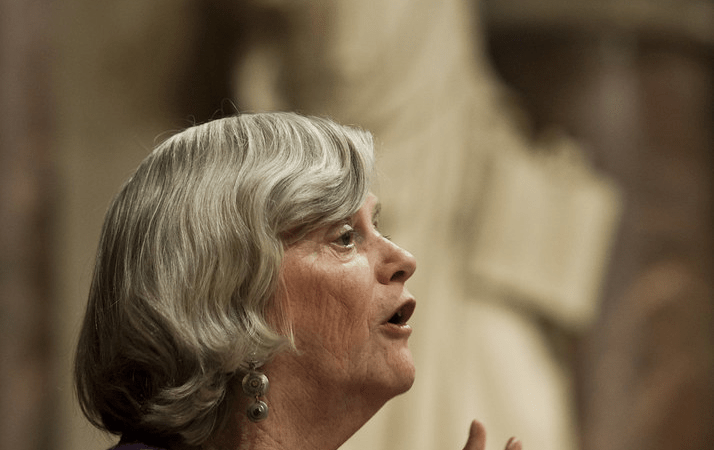
Image: Ann Widdecombe. Source: https://www.flickr.com/photos/catholicism/6172851871 Creator: Catholic Church England and Wales. Copyright: MARCIN MAZUR. Licence: Attribution-NonCommercial-NoDerivs 2.0 Generic (CC BY-NC-ND 2.0)
 Labour Hub